

Last Updated On – 09-09-2026
Starting a business often means spending money before the business has generated enough cash to comfortably cover every expense.
A new laptop may be needed before the first client arrives. Software subscriptions, equipment, advertising, stock, furniture and other setup costs can quickly consume a startup’s available cash.
That makes 0% interest credit cards attractive to startup founders. Instead of paying for an expense immediately, a 0% purchase card can potentially spread the cost across several months without purchase interest being charged during the promotional period.
However, there is an important distinction that founders need to understand.
Most of the longest 0% purchase credit cards available in the UK are personal credit cards rather than business credit cards.
A founder should therefore not assume that a personal 0% card can automatically be used as a company financing facility. Card conditions, accounting treatment, personal liability and the separation of personal and company finances all need to be considered.
For founders who need more substantial funding, startup business loans may be more appropriate than relying on revolving credit.
So, are 0% interest credit cards worth using for a startup?
They can be — but mainly when the expenditure is planned, the amount is manageable and there is a realistic repayment schedule before the promotional period expires.
What Is a 0% Interest Credit Card?
A 0% purchase credit card offers an introductory period during which eligible purchases do not attract purchase interest.
Suppose a founder spends £3,600 on equipment and receives an 18-month 0% purchase period.
To clear that balance before the promotional period finishes, the founder would need to repay approximately:
£3,600 ÷ 18 = £200 per month
If the required payments are made and the balance is cleared before the offer ends, no purchase interest would normally be payable on that £3,600.
But 0% does not mean:
- no monthly repayments
- no credit limit
- no late-payment consequences
- no interest forever or
- every transaction is interest-free.
Cash withdrawals, money transfers and other transaction types may have completely different rates and charges.
Can Startups Get Business Credit Cards With 0% Interest?
The choice is considerably smaller than in the personal credit card market.
Business cards are normally designed around expense management, employee cards, rewards, cashback or short-term working-capital flexibility rather than extremely long 0% purchase periods.
One notable business-specific option is Barclaycard Premium Plus, which currently provides an introductory 0% purchase period.
Personal cards can provide much longer promotional periods, sometimes approaching two years. However, founders must check whether the card allows the intended expenditure.
This distinction becomes particularly important for limited companies because the company is legally separate from its director.
Keeping business transactions separate also makes bookkeeping, tax reporting and cash-flow monitoring considerably easier. Startups still setting up their banking structure may therefore want to compare business bank accounts for small businesses alongside any credit facility.
Top 10 0% Interest Credit Cards Startup Founders May Compare
The following list focuses primarily on 0% purchase periods available in the UK during September 2026.
Important: Only the first option below is presented as a dedicated business credit card. The remaining cards are personal consumer products. Founders should check the provider’s current eligibility requirements and permitted use before using any personal card for expenditure connected with a business.
Promotional periods and rates can also change, and some providers offer different terms depending on the applicant’s circumstances.
1. Barclaycard Premium Plus Business Credit Card
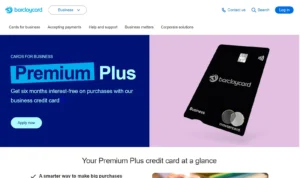
For a startup wanting a card specifically designed for business expenditure, the Barclaycard Premium Plus Business Credit Card is the most relevant option in this list.
Its 0% purchase period is much shorter than leading personal purchase cards, but it has one major advantage: it is actually structured for business expenditure.
| Feature | Details |
| Card type | Business credit card |
| 0% purchase period | 6 months from account opening |
| Standard purchase rate | Variable after promotional period |
| Representative APR | Around the mid-50% range, depending on current terms |
| Annual fee | £150 |
| Cashback | 0.5% on eligible business spending, subject to limits |
| Best suited to | Short-term planned startup expenditure |
A startup could potentially use the six-month period for equipment, technology, marketing or other planned operational expenses.
However, the £150 annual fee means the card is unlikely to make sense purely because it offers six months at 0%.
The value comes from combining the introductory financing period with its wider business features.
Startup verdict: Best option on this list where keeping expenditure on an actual business credit card is the priority.
2. TSB Platinum Purchase Card

The TSB Platinum Purchase Card offers one of the longest introductory purchase periods currently available.
| Feature | Details |
| Card type | Personal credit card |
| 0% purchase period | Up to 26 months |
| Representative APR after offer | 24.9% variable |
| Annual fee | £0 |
| Balance transfer offer | Up to 18 months at 0%, fee applies |
| Main strength | Very long potential purchase period |
| Startup consideration | Personal rather than business borrowing |
A founder receiving the maximum 26-month period could spread a large planned purchase across more than two years.
For example, £5,000 repaid evenly over 26 months would require payments of roughly £192 per month.
The important phrase is “up to”. The promotional period offered can depend on the applicant’s circumstances.
Startup verdict: Strong for an individual with planned expenditure and a defined repayment schedule, but not a dedicated business financing product.
3. M&S Bank Purchase Plus Credit Card
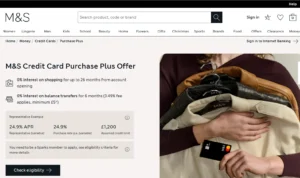
The M&S Bank Purchase Plus card is another long-term 0% purchase option.
| Feature | Details |
| Card type | Personal credit card |
| 0% purchase period | Up to 26 months |
| Representative APR after offer | 24.9% variable |
| Annual fee | £0 |
| Rewards | M&S Rewards points |
| Main strength | Long 0% period plus rewards |
| Startup consideration | Personal card terms must be checked |
The card may appeal to someone looking primarily for a long interest-free purchasing period while receiving some additional value through rewards.
For startup financing, however, rewards should be considered secondary.
The main question is whether the entire balance can realistically be cleared before the promotional period ends.
Startup verdict: Competitive long-term 0% option, but the founder should not select it simply because of the reward programme.
4. Lloyds Bank Platinum 0% Purchase Credit Card

Lloyds Bank’s Platinum purchase option provides a long promotional period and can be particularly useful for applicants wanting flexibility across both purchases and balance transfers.
| Feature | Details |
| Card type | Personal credit card |
| 0% purchase period | Up to 25 months |
| Representative APR after offer | Around 24.9% variable |
| Annual fee | £0 |
| Balance transfers | Promotional offer may also be available |
| Main strength | Long interest-free spending period |
| Startup consideration | Not a dedicated company card |
For a founder purchasing several essential items during the launch stage, 25 months can provide considerable repayment flexibility.
It should not, however, become a substitute for proper working-capital planning.
If the business needs continuing borrowing simply to remain operational, another funding structure is usually more appropriate.
Startup verdict: A lengthy promotional period, provided personal-card use is appropriate and repayment is predictable.
5. Halifax 0% Purchase and Balance Transfer Credit Card
Halifax also offers a long interest-free period on purchases.
| Feature | Details |
| Card type | Personal credit card |
| 0% purchase period | Up to 25 months |
| Representative APR after offer | Around 24.9% variable |
| Annual fee | £0 |
| Additional feature | Balance transfer promotional period |
| Main strength | Long-term purchase financing |
| Startup consideration | Personal liability remains with cardholder |
For startup founders, the main attraction is straightforward: a substantial purchase can potentially be divided across more than two years.
It could theoretically be useful for purchasing a computer, specialist equipment or another one-off requirement.
It is much less appropriate for recurring expenditure such as monthly payroll.
Startup verdict: Potentially useful for a defined one-off cost rather than continuing business losses.
6. HSBC Purchase Plus Credit Card
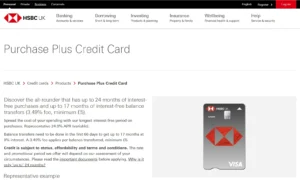
The HSBC Purchase Plus Credit Card currently offers up to 24 months without purchase interest.
| Feature | Details |
| Card type | Personal credit card |
| 0% purchase period | Up to 24 months |
| Representative APR after offer | 24.9% variable |
| Annual fee | £0 |
| Balance transfers | Up to 17 months at 0%, fee applies |
| Main strength | Long purchase period |
| Startup consideration | Promotional term depends on assessment |
Two years can provide plenty of time to spread a manageable startup purchase.
A £4,800 expense divided evenly across 24 months, for example, would require around £200 per month to clear.
That calculation should ideally be made before spending takes place.
Startup verdict: A useful long-term purchase card for suitable applicants who know how the balance will be repaid.
7. Barclaycard Platinum Purchase and Balance Transfer Card
This should not be confused with the Barclaycard business card ranked first.
The Barclaycard Platinum product is a personal consumer credit card offering a much longer promotional purchase period.
| Feature | Details |
| Card type | Personal credit card |
| 0% purchase period | Up to 24 months |
| Representative APR after offer | 24.9% variable |
| Annual fee | £0 |
| Balance transfer period | Up to 21 months |
| Balance transfer fee | Applies |
| Startup consideration | Consumer rather than business product |
The long period could make larger purchases easier to budget for.
However, founders should avoid confusing the personal Barclaycard Platinum with Barclaycard’s business credit card range.
Startup verdict: Good potential 0% duration, but the business version is generally cleaner where the expenditure belongs to a company.
8. NatWest Purchase and Balance Transfer Card
NatWest currently offers up to 23 months of 0% interest on purchases.
| Feature | Details |
| Card type | Personal credit card |
| 0% purchase period | Up to 23 months |
| Representative APR after offer | 24.9% variable |
| Annual fee | £0 |
| Balance transfer period | Up to 21 months |
| Balance transfer fee | 3.49% |
| Minimum stated income | £10,000 a year |
The actual promotional period can vary following the lender’s credit assessment, with applicants potentially receiving a shorter period.
That makes it important to check the final offer rather than building a startup budget around the headline maximum.
Startup verdict: Competitive, but founders should base repayment calculations on the actual promotional period offered.
9. Royal Bank of Scotland Purchase and Balance Transfer Card
The Royal Bank of Scotland Purchase and Balance Transfer Card has a very similar structure to the comparable NatWest product.
| Feature | Details |
| Card type | Personal credit card |
| 0% purchase period | Up to 23 months |
| Representative APR after offer | 24.9% variable |
| Annual fee | £0 |
| Balance transfer period | Up to 21 months |
| Balance transfer fee | 3.49% |
| Main strength | Purchases and balance transfers combined |
The maximum 23-month period provides significant breathing space for planned spending, but the credit still needs to be repaid.
A startup should therefore treat the card as a repayment tool, not additional income.
Startup verdict: Useful for predictable expenditure where the founder can comfortably clear the balance before the introductory rate disappears.
10. Tesco Bank Balance Transfer and Purchases Credit Card
Tesco Bank provides a somewhat shorter 0% period, but its purchase offer is notable because the current headline period is guaranteed for accepted customers rather than advertised purely as an “up to” term.
| Feature | Details |
| Card type | Personal credit card |
| 0% purchase period | 21 months |
| Offer structure | Guaranteed period for accepted applicants |
| Representative purchase rate after offer | 24.9% variable |
| Annual fee | £0 |
| Balance transfer offer | 21 months at 0% |
| Additional feature | Tesco Clubcard points |
Knowing the promotional period in advance can make budgeting easier.
For example, a £4,200 purchase divided across 21 months would require approximately £200 per month to clear before the promotional period finishes.
Startup verdict: Shorter than several rivals but potentially easier to plan around because the headline purchase period is fixed for accepted applicants.
Are 0% Credit Cards Actually Worth Using for a Startup?
They can be — but only in specific circumstances.
Consider a startup that needs:
- £1,500 for computers;
- £700 for office furniture;
- £600 for software;
- £700 for initial marketing.
Total expenditure is £3,500.
If £3,500 could be placed on an appropriate 0% card and repaid across 20 months, the target repayment would be:
£3,500 ÷ 20 = £175 per month
That can be considerably easier for cash flow than paying £3,500 immediately.
The strategy works because there are three things known in advance:
the amount borrowed, the repayment period and the source of repayment.
Problems start when one or more of those is unknown.
When Can a 0% Credit Card Make Sense?
A 0% card may work well for startup expenditure that is:
Equipment With a Useful Life
Computers, monitors, cameras, tools or other equipment may continue producing value long after they are purchased.
Spreading their cost can therefore make commercial sense where the repayment plan remains affordable.
Initial Inventory
A business may require stock before it can begin making sales.
Credit can bridge that timing gap, although founders need to consider how quickly that inventory is realistically likely to sell.
Marketing With a Fixed Budget
A startup might allocate £1,000 to launch advertising rather than continually charging additional marketing expenses to a card.
A fixed budget creates a clear maximum liability.
Website or Software Setup
One-off development, software licences or technology expenditure may also be suitable where the amount is known in advance.
When Should a Startup Avoid Using a 0% Credit Card?
Some types of expenditure are much more dangerous to finance with short-term credit.
Funding Payroll Every Month
If employees can only be paid by repeatedly increasing credit-card debt, the underlying business may have a working-capital problem.
Covering Continuing Losses
0% credit does not turn an unprofitable operation into a profitable one.
It merely delays when financing costs may begin.
Paying One Debt With Another
Continually moving balances without reducing the underlying debt can create a cycle of borrowing.
Borrowing Without a Repayment Source
A founder should be able to answer:
“Where will the money to clear this card actually come from?”
If the answer depends entirely on uncertain future investment, an unconfirmed client or optimistic sales projections, the borrowing carries significantly more risk.
Startups dealing with slow-paying customers may find invoice financing more appropriate because it addresses cash already tied up in outstanding invoices.
Personal Credit Card vs Business Credit Card for a Startup
This distinction deserves particular attention.
| Personal Credit Card | Business Credit Card |
| Borrowing belongs to the individual | Designed around business expenditure |
| Often longer 0% promotions | Usually shorter interest-free periods |
| Personal credit history is central | Business and owner circumstances may be considered |
| Can complicate business accounting | Helps separate business expenses |
| Provider may restrict business use | Intended for commercial expenditure |
| Founder remains personally responsible | Liability depends on the product and agreement |
For a sole trader, the legal separation between individual and business is different from a limited company, although keeping finances separate is still sensible.
For a limited company, business expenditure paid personally by a director needs to be properly recorded. Depending on the circumstances, it may be reimbursed by the company or reflected through the director’s loan or expense records.
Good bookkeeping therefore matters just as much as finding a long promotional period.
What Happens When the 0% Period Ends?
This is where a cheap borrowing strategy can become expensive.
A card offering 0% for 24 months may revert to a purchase APR around 24.9% or another variable rate once the promotional period expires.
Suppose £6,000 is borrowed and only £3,000 has been repaid by the end of the 0% period.
The remaining £3,000 may then begin attracting the card’s normal purchase interest.
The sensible approach is to calculate the required monthly repayment immediately after borrowing.
For example:
£6,000 ÷ 24 months = £250 per month
A founder could even target £275 or £300 each month, creating a buffer before the promotional deadline.
Can Missing a Payment Cancel the 0% Offer?
Potentially, yes.
Promotional credit-card rates normally require the cardholder to follow the agreement.
That includes making at least the required minimum payment and remaining within the credit limit.
Missing a payment may result in:
- late-payment charges;
- damage to the cardholder’s credit history; and
- potentially losing promotional terms, depending on the agreement.
Setting up a Direct Debit for at least the minimum payment can reduce the risk of accidentally missing the deadline.
The founder can then make additional payments separately to meet the planned repayment target.
Should Startups Use the Entire Credit Limit?
Usually not.
A £10,000 credit limit does not mean a business should immediately spend £10,000.
Keeping borrowing well below the maximum provides more flexibility if unexpected expenditure occurs.
High utilisation may also affect future credit assessments.
The amount borrowed should therefore be determined by what the startup needs and can repay, rather than by the largest amount the lender is prepared to provide.
Is a 0% Credit Card Better Than a Startup Loan?
It depends on the purpose.
| 0% Purchase Card | Startup Loan |
| Useful for smaller purchases | Better suited to larger funding requirements |
| Potentially no purchase interest initially | Interest normally applies |
| Flexible spending | Fixed borrowing amount |
| Promotional period eventually ends | Clear repayment schedule |
| Credit limit may be relatively modest | Potentially much larger funding |
| Easy to overspend | More structured borrowing |
A card can work particularly well for a £1,500 laptop or £3,000 equipment purchase.
It becomes less suitable when the startup needs £20,000 or £30,000 of dependable working capital.
Example: Using a 0% Card to Launch a Small Online Business
Consider a founder launching an e-commerce business.
Initial expenditure:
| Startup Expense | Cost |
| Laptop | £1,000 |
| Product photography | £500 |
| Initial inventory | £2,000 |
| Packaging | £400 |
| Advertising | £600 |
| Total | £4,500 |
Assume the founder has an appropriate 0% purchase period lasting 24 months.
The theoretical repayment is:
£4,500 ÷ 24 = £187.50 per month
Instead, the founder decides to repay £225 per month.
At that rate, the £4,500 would be cleared in approximately 20 months, leaving several months of protection before the introductory period ends.
That is a very different strategy from spending £4,500 and simply making the card’s minimum payment each month.
What Should Founders Check Before Applying?
Before applying for any credit card, check:
- Whether the product allows the intended type of spending
- Whether it is a personal or business card
- The actual 0% purchase period offered
- The standard APR after the promotion
- The annual fee
- Minimum repayments
- Credit-limit rules
- Cash withdrawal charges
- Foreign transaction charges
- Eligibility requirements and
- What could cause the promotional rate to end early.
Founders should also avoid submitting multiple full credit applications in a short period simply to see which lender accepts them.
Where available, an eligibility checker using a soft search can provide an indication of acceptance likelihood without creating the same footprint as a full application.
Are 0% Interest Credit Cards for Startups Worth It?
Yes, but they should be treated as short-term financing tools rather than free startup capital.
A 0% purchase card can work particularly well when a founder needs to finance a specific piece of equipment, initial inventory, technology or another clearly defined startup cost.
The strongest arrangement looks something like this:
£4,000 required → 20-month repayment plan → £200+ paid every month → balance cleared before 0% expires.
The weakest arrangement looks more like this:
credit limit available → continuing business losses → repeated card spending → minimum repayments only → promotional period expires with a large balance remaining.
The first approach uses credit strategically.
The second simply postpones a cash-flow problem.
For limited companies especially, a dedicated business credit card will normally provide cleaner separation between personal and company expenditure, even if the available interest-free period is shorter.
Ultimately, the best credit card for a startup is not necessarily the one advertising the longest 0% period. It is the one that fits the business’s expenditure, is permitted for the intended use and can be comfortably repaid before expensive standard interest becomes payable.
Frequently Asked Questions
Can a new startup get a 0% business credit card?
Possibly. Approval depends on the provider’s eligibility requirements, the applicant, the business and the lender’s credit assessment. Dedicated business cards offering lengthy 0% purchase periods are relatively uncommon.
Can a limited company use the director’s personal credit card?
A director can sometimes personally pay expenses relating to the company, but the transaction needs to be recorded correctly and the card’s terms must permit the intended use. A dedicated business card normally creates cleaner financial separation.
Does 0% interest mean there are no repayments?
No. Minimum monthly payments are still required. The balance should ideally be repaid much faster than the minimum so it is cleared before the promotional period ends.
Are cash withdrawals also interest-free?
Usually not. Cash transactions commonly have separate fees and can start attracting interest immediately.
What happens after the 0% period?
Any remaining purchase balance normally moves to the card’s standard purchase interest rate. This can make carrying a large balance significantly more expensive.
Is a 0% credit card better than a business loan?
It may be better for smaller, short-term and predictable expenditure. Larger funding requirements or long-term working capital are generally better assessed against structured business-finance options.
Can a startup pay suppliers with a 0% card?
Potentially, where the supplier accepts cards and the card terms allow the transaction. Founders should check whether additional payment-processing charges make the transaction worthwhile.
Should startups use credit cards for payroll?
Using revolving card debt to fund recurring payroll is generally a warning sign. Payroll requires dependable working capital rather than reliance on a temporary promotional credit facility.
What is the biggest risk of a 0% credit card?
Failing to repay the balance before the introductory period ends. The remaining debt can then move onto a substantially higher variable interest rate.
Is a 0% startup credit card free money?
No. It is borrowed money with a temporary interest-free period. The entire balance still needs to be repaid.

Blogger & Content creator | An insightful writer sharing practical advice for UK entrepreneurs