
The Bank of England cuts interest rates when policymakers believe borrowing costs can be reduced without creating unacceptable risks to its 2% inflation target.
After Bank Rate reached a peak of 5.25%, the Bank began gradually reducing rates in August 2024, with several cuts eventually bringing the rate down to 3.75%.
As of 15 September 2026, Bank Rate remains at 3.75%. The most recent reduction came in December 2025, when the Monetary Policy Committee (MPC) cut the rate from 4% to 3.75%. There have been no further cuts so far in 2026.
At the July meeting, six MPC members voted to keep the rate unchanged, while three favoured an increase to 4%, showing that policymakers remain concerned about renewed inflationary pressures.
| Measure | Current Position |
| Bank Rate | 3.75% |
| Most Recent Rate Cut | December 2025 |
| Previous Rate | 4% |
| Latest MPC Decision | Hold At 3.75% |
| Latest MPC Vote | 6 Hold, 3 Raise |
| Inflation Target | 2% |
| July 2026 CPI Inflation | 2.9% |
| Next MPC Decision | 17 September 2026 |
For households and businesses, the fall from 5.25% to 3.75% has helped ease some of the pressure created by high borrowing costs.
Lower Bank Rate can influence mortgage pricing, business finance, investment decisions and consumer spending, although lenders do not have to reduce their own rates by exactly the same amount.
Further interest rate cuts are also not guaranteed. Inflation, energy prices, wage growth, consumer demand and wider economic conditions will determine whether the Bank cuts, holds or potentially raises rates at future meetings.
Businesses should therefore avoid assuming that borrowing costs will continue falling steadily and instead plan for several possible interest-rate scenarios.
Last Updated; 15.09.2026
Bank Of England Interest Rate Cut Timeline
UK interest rates rose sharply between late 2021 and 2023 as the Bank attempted to bring high inflation under control.
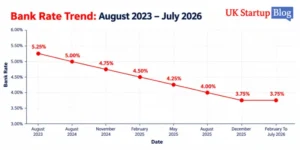
Bank Rate eventually reached 5.25% in August 2023 and remained there until the cutting cycle began in August 2024.
| Date | Bank Rate |
| August 2023 | 5.25% |
| August 2024 | 5.00% |
| November 2024 | 4.75% |
| February 2025 | 4.50% |
| May 2025 | 4.25% |
| August 2025 | 4.00% |
| December 2025 | 3.75% |
| February To July 2026 | 3.75% |
The reductions between August 2024 and December 2025 took 1.5 percentage points off Bank Rate.
The pace of change demonstrates why businesses should avoid building financial forecasts around an assumption that rates will always move steadily in one direction.
Why Does The Bank Of England Cut Interest Rates?
The MPC sets Bank Rate with the aim of keeping inflation sustainably around the Government’s 2% target.
When inflationary pressures are easing and economic activity is weak, cutting interest rates can support the economy by making some forms of borrowing cheaper.
Lower rates can potentially:
- Reduce Borrowing Costs: Variable-rate finance may become cheaper
- Encourage Investment: Businesses may become more willing to finance expansion
- Support Consumer Spending: Lower borrowing costs can leave some households with more disposable income
- Reduce Saving Incentives: Lower savings returns can encourage spending rather than holding cash
- Support Housing Activity: Lower financing costs may improve affordability for some buyers
However, the Bank cannot simply cut rates whenever economic growth slows. If inflation remains too high, rapid reductions could stimulate demand and make price pressures harder to control.
Why Has The Bank Held Interest Rates At 3.75% In 2026?
The economic picture has become more complicated during 2026.
Although underlying inflationary pressures had previously eased, energy-price volatility has created renewed uncertainty.
At the July 2026 MPC meeting, six members supported keeping Bank Rate at 3.75%. Three members believed the risks were significant enough to justify raising it to 4%.
That split highlights the difficult balance facing policymakers.
The Bank needs to consider:
- Headline Inflation
- Services Inflation
- Energy Prices
- Wage Growth
- Employment Conditions
- Consumer Demand
- Economic Growth
- Inflation Expectations
Holding rates gives policymakers more time to assess whether inflationary pressures are temporary or could become embedded in wages and prices.
How Does Inflation Affect Bank Of England Interest Rate Decisions?
Inflation remains central to every interest rate decision.
UK Consumer Prices Index inflation was 2.9% in July 2026, up from 2.6% in June and above the Bank’s 2% target.
The headline number is not the only measure policymakers examine.
Services inflation, wage growth and core inflation can provide information about whether price pressures are becoming persistent throughout the domestic economy.
Energy prices are particularly important because higher oil and gas costs can affect:
- Transport Costs
- Business Energy Bills
- Manufacturing Costs
- Distribution Expenses
- Household Bills
- Retail Prices
An external energy shock does not automatically require higher interest rates. The concern is whether the initial price increase begins influencing wages, expectations and prices throughout the economy.
What Do Interest Rate Cuts Mean For UK Businesses And Startups?
The impact of lower interest rates can be significant for businesses, particularly those relying on debt finance.
Business Loans And Borrowing Costs
Bank Rate influences the wider cost of borrowing, but it is not the only factor lenders use when pricing commercial finance.
A business lender may also consider:
- Credit History
- Trading Record
- Cash Flow
- Available Security
- Loan Size
- Repayment Period
- Business Sector
- Overall Risk
Businesses with variable-rate borrowing may see changes relatively quickly when market rates move.
Fixed-rate borrowers are generally protected from immediate changes until their existing agreement ends or they refinance.
Cash Flow And Working Capital
Businesses using overdrafts, revolving credit or working-capital facilities can be particularly sensitive to interest rates.
Lower financing costs may free up cash that can instead be used for stock, recruitment, marketing or other operating expenses.
However, businesses should stress-test their finances against both falling and rising rates rather than assuming today’s borrowing costs will remain unchanged.
Business Investment And Expansion
Lower interest rates can make planned investments more attractive.
A business might be more willing to finance:
- New Equipment
- Additional Premises
- Technology
- Inventory
- Recruitment
- Business Acquisitions
- Market Expansion
Startups can still face higher borrowing costs than established companies because lenders may view a limited trading history as an additional risk.
A Bank Rate cut therefore does not guarantee cheap startup finance.
Consumer Spending And Demand
Interest rates can also affect businesses indirectly.
When household borrowing becomes less expensive, some consumers may have more money available to spend.
This can support businesses operating in retail, hospitality, property, automotive and other consumer-facing sectors.
The opposite can occur when rates increase and households direct more income towards mortgage or debt repayments.
How Do Interest Rate Cuts Affect Mortgages?
The impact depends heavily on the type of mortgage.
| Mortgage Type | Likely Effect Of A Bank Rate Cut |
| Tracker Mortgage | Usually Responds Directly To Bank Rate |
| Standard Variable Rate | Lender Decides Whether To Reduce The Rate |
| Existing Fixed Mortgage | Monthly Rate Usually Remains Unchanged |
| New Fixed Mortgage | Pricing Depends On Wider Market Expectations |
A person with a fixed-rate mortgage will normally continue paying their agreed rate until the deal ends.
That means a Bank of England rate cut does not immediately reduce mortgage costs for every household.
Fixed mortgage pricing is also affected by expectations about future rates and wholesale financial markets, so mortgage offers may move before or after an official Bank Rate decision.
What Happens To Loans, Credit Cards And Savings When Rates Fall?
Existing fixed-rate personal loans usually continue at their agreed interest rate.
Variable borrowing may respond more directly, although individual lenders determine how and when rates change.
Credit card interest rates are influenced by a much wider range of factors and should not be expected to fall automatically following a Bank Rate reduction.
Savers can experience the opposite effect to borrowers.
When Bank Rate falls, banks and building societies may reduce returns on:
- Easy-Access Savings
- Cash ISAs
- Notice Accounts
- New Fixed-Term Savings Products
Lower interest rates can therefore benefit borrowers while reducing income for people holding significant amounts of cash savings.
Bank Rate Is Not The Same As A Business Or Mortgage Rate
A common mistake is assuming that a 0.25 percentage point Bank Rate reduction automatically produces an identical fall in every financial product.
It does not.
Commercial lenders must account for their own funding costs, risk, competition and the circumstances of individual borrowers.
For businesses, the final interest rate may depend heavily on financial strength and whether the borrowing is secured.
This means companies should compare the actual annual interest rate, total repayment cost, fees and conditions rather than focusing solely on headline Bank Rate movements.
Could The Bank Of England Raise Interest Rates Again?
Yes. Interest rates are not on a guaranteed downward path.
The July 2026 MPC vote demonstrates this clearly because three of the nine members preferred increasing Bank Rate from 3.75% to 4%.
Rates could remain unchanged or rise if policymakers see evidence that inflation is becoming more persistent.
Possible triggers include:
- Persistently High Energy Prices
- Stronger Wage Growth
- Higher Services Inflation
- Increasing Inflation Expectations
- Stronger Than Expected Demand
- Further Global Supply Disruption
Equally, weaker economic activity and falling underlying inflation could eventually create room for further reductions.
What Does The MPC Vote Tell Us About Future Interest Rates?
The nine-member Monetary Policy Committee makes the UK’s Bank Rate decisions.
Looking only at the final rate can sometimes hide important information.
For example, the December 2025 cut to 3.75% passed by a narrow 5–4 majority.
By July 2026, the disagreement had changed direction. Six members wanted to hold rates, while three wanted to increase them.
Businesses following monetary policy should therefore pay attention to the voting split as well as the headline decision.
A growing number of members supporting higher or lower rates can provide useful evidence about how policymakers view inflation risks.
How Have UK Interest Rates Changed Since The Pandemic?
Bank Rate was reduced to 0.1% in March 2020 as the UK economy faced the effects of the pandemic.
The direction changed in December 2021 when the Bank began increasing rates to address rising inflation.
Bank Rate climbed through 2022 and 2023 before reaching 5.25%.
The subsequent reductions from August 2024 marked the beginning of a gradual easing cycle.
The broader lesson for businesses is that exceptionally low rates should not be treated as normal or permanent.
Financing plans should remain workable under several possible interest-rate scenarios.
When Is The Next Bank Of England Interest Rate Decision?
The next scheduled MPC announcement is 17 September 2026.
Further scheduled decisions are due on:
- 5 November 2026
- 17 December 2026
Each decision can affect financial-market expectations even when Bank Rate itself remains unchanged.
Statements about inflation, economic growth and future risks can influence mortgage pricing, business finance and financial markets.
What Should UK Businesses Do When Interest Rates Change?
Businesses should focus less on predicting a single Bank Rate outcome and more on making their finances resilient.
Useful steps include:
- Review Existing Debt: Identify which borrowing is fixed and which is variable
- Check Refinancing Dates: Plan before major loans or commercial mortgages mature
- Stress-Test Cash Flow: Model the effect of higher and lower borrowing costs
- Compare Finance: Bank Rate changes do not affect every lender equally
- Review Cash Returns: Businesses holding large reserves should monitor savings rates
- Assess Investment Carefully: Lower rates should not turn an otherwise weak investment into a good one
The best borrowing decision depends on the company’s cash flow, risk tolerance and objectives rather than the direction of Bank Rate alone.
What Could Happen To UK Interest Rates Next?
There is no guaranteed timetable for another rate cut.
The previous easing cycle brought Bank Rate down substantially from its 5.25% peak, but the economic environment in 2026 has created new inflation risks.
Future decisions are likely to depend on whether inflation begins moving sustainably towards 2%, how energy prices develop and whether wage and services inflation continue to moderate.
For UK businesses, the key message is that borrowing conditions have improved compared with the peak-rate period, but financial planning should still account for the possibility that rates remain at current levels or move higher.
Conclusion
The period when the Bank of England cuts interest rates has already brought Bank Rate down from 5.25% to 3.75%.
That has reduced some financial pressure on borrowers and improved the financing environment for certain businesses, but it has not produced universally lower mortgage, loan or credit costs.
With inflation still above the 2% target and several MPC members already supporting higher rates, the next phase of UK monetary policy is less predictable.
Businesses should therefore use Bank Rate as one input in their financial planning rather than assuming that further cuts are inevitable.
FAQs
Will The Bank Of England Cut Interest Rates Again In 2026?
It is possible, but not guaranteed. Future decisions will depend heavily on inflation, energy prices, wages, economic activity and other risks facing the UK economy.
What Is The Bank Of England Interest Rate Now?
Bank Rate is 3.75% as of 15 September 2026. It has remained at this level since the December 2025 rate cut.
When Was The Last UK Interest Rate Cut?
The most recent cut took place in December 2025, when Bank Rate was reduced from 4% to 3.75%.
Do Mortgage Payments Fall When The Bank Of England Cuts Rates?
Not always. Tracker mortgages may respond quickly, while existing fixed-rate mortgage payments generally remain unchanged until the fixed period ends.
Are Interest Rate Cuts Good For Businesses?
They can reduce some borrowing costs and support customer spending, but the impact varies depending on the type of finance, business risk and wider economic conditions.
What Happens To Savings Rates When Bank Rate Falls?
Banks and building societies may reduce the rates offered on savings accounts, although individual providers decide how much of the Bank Rate change to pass on.
Why Might The Bank Of England Stop Cutting Interest Rates?
The Bank may pause or reverse rate cuts if inflation remains too high, energy costs rise, wage pressures strengthen or there is evidence that price increases are becoming more persistent.

Blogger | Business Writer | Sharing startup advice on UK business blogs