
Best Business Mobile Phone Deals In The UK For Startups And Growing Companies


UK Startup Blog Archive
Table of Contents
Choosing the right business mobile contract is no longer simply about finding the cheapest monthly payment.
UK businesses now need to compare network coverage, mobile data, handset costs, contract length, roaming, future price increases and the flexibility to add more employees as the company grows.
The market has also moved considerably since 2024. Business customers can now choose from competitive SIM-only tariffs, unlimited-data packages, 5G plans, eSIM options and contracts that combine current smartphones with business airtime.
For founders still building their operational setup, mobile connectivity should be considered alongside the wider costs and decisions involved in starting a business in the UK.
A cheap phone contract can quickly become expensive if it lacks enough data, performs poorly in the locations where employees work or locks the company into unnecessary services.
Prices and promotions mentioned below were checked in October 2026. Business mobile offers change regularly, so companies should confirm the final price, VAT position and contract terms before signing.
Which Business Mobile Deals Offer The Best Value For UK Companies?
The best business mobile deal depends on how the company actually operates.
EE remains a strong choice for businesses that value network performance and extensive data options. Vodafone has become particularly interesting for businesses needing broad connectivity, roaming options and scalable mobile services.
O2 combines flexible business tariffs with data rollover and international calling features, while Three continues to compete aggressively on large data allowances and lower-cost SIM-only contracts.
There is no single provider that will be best for every business.
A sole trader who works mainly from an office may only need a modest SIM-only package. A sales company with employees travelling across the UK may place greater value on network reliability.
An international consultancy may care more about roaming, while a growing startup may need easy multi-line management.
Companies should therefore judge value by the total service received for the total contract cost, rather than choosing whichever tariff displays the lowest introductory monthly price.
That same principle should apply to wider financial planning. When writing a business plan, recurring communication costs should be included alongside software, insurance, equipment and other operating expenses.
What Should Businesses Look For Before Choosing A Mobile Deal?
A business mobile contract can run for 12, 24 or even 36 months, making the initial decision more important than choosing a short-term consumer SIM.
The most important factors include:
- Network Coverage: Check coverage at the office, employees’ homes, customer sites and areas where staff regularly travel.
- Monthly Data: Office-based employees connected to Wi-Fi may need relatively little mobile data, while field teams, remote workers and sales staff can use substantially more.
- Contract Length: Longer contracts can offer attractive pricing but reduce the company’s flexibility to switch.
- Future Price Increases: Check the amount that will be charged throughout the full minimum term, rather than looking only at the starting price.
- Handset Cost: Decide whether the business genuinely needs new smartphones or whether existing devices can be used with cheaper SIM-only contracts.
- Roaming: Companies with employees travelling abroad should compare included destinations, fair-use limits and international calling charges.
- Multiple Connections: Businesses purchasing several SIMs may be able to obtain multi-line discounts or negotiated pricing.
- Support: Fast replacement SIMs, technical assistance and account management can be more valuable to a business than small differences in monthly price.
- Security: Device management, remote wiping, eSIM controls and account security become increasingly important as more employees receive company phones.
Ofcom says small-business customers with ten employees or fewer should receive written contract information covering matters such as charges, contract length and cancellation before entering an agreement.
Are Business Mobile Contracts Better Than Personal Phone Plans?
A personal contract can appear cheaper, particularly for a sole trader who only needs one phone. However, business contracts become increasingly useful as the number of employees grows.
Business plans can provide central billing, multiple connections, business customer support, roaming options and features designed for company use. Some networks also offer business apps, account management services and data controls.
Keeping work communications separate can also make record-keeping easier when preparing small business tax returns.
A business contract is particularly useful when the company pays for employees’ devices directly. HMRC says one mobile phone or SIM provided to an employee can normally be exempt from tax and National Insurance reporting where the contract is between the employer and the supplier.
Sole traders should not automatically assume a business tariff is cheaper. The best approach is to compare business and personal-equivalent tariffs based on total cost, data, roaming and support.
Top 5 Best Business Mobile Phone Deals
1. EE – Best For Coverage And Reliability
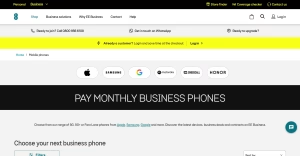
EE is a strong option for businesses that depend heavily on mobile connectivity, particularly sales teams, field employees and companies with staff working from several locations.
EE currently offers SIM-only contracts covering smaller data allowances through to unlimited data, with 30-day, 12-month and 24-month choices available on selected plans.
| EE Business Deal Details | Example |
| Best For | Coverage And Reliability |
| Example SIM-Only Deal | 100GB For £19 Per Month Ex VAT |
| Contract Length | 24 Months On The Example Deal |
| Calls And Texts | Unlimited |
| 5G | Included |
| Upfront Cost | £0 On The Example Deal |
| Future Price | £21.08 From April 2027 And £23.16 From April 2028 |
A current Currys Business EE offer provides 100GB of 5G data with unlimited calls and texts for £19 per month excluding VAT on a 24-month agreement. The advertised price increases to £21.08 from April 2027 and £23.16 from April 2028.
EE also sells Business Essential plans directly, with options including 10GB, 50GB, 100GB and unlimited data. Its current direct 12-month prices start at £17 excluding VAT for 10GB and reach £27 for unlimited data.
Why EE Stands Out?
- Strong Connectivity: EE remains particularly focused on network performance and business connectivity.
- Wide Data Choice: Businesses can avoid paying for unlimited data when employees only require moderate usage.
- Flexible Contract Options: Selected tariffs are available across different minimum terms.
- Business Features: Plans can include Stay Connected Data, account check-ups and additional features.
- Current Handsets: Businesses can combine airtime with modern Apple, Samsung and other business smartphones.
Verdict: EE is one of the strongest choices for businesses where dependable connectivity matters more than finding the absolute lowest monthly tariff. Companies should compare its longer-term price increases before deciding which contract offers the best overall value.
2. Vodafone – Best For International Businesses
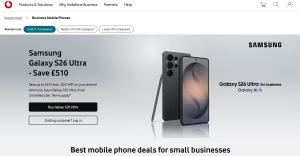
Vodafone is particularly suitable for businesses that require a combination of mobile connectivity, international options and the ability to expand from a few employees into a larger mobile fleet.
The provider separates its services between small businesses with 1 to 9 employees, medium businesses with 10 to 249 employees and larger organisations.
It also offers business SIM-only plans, multi-buy options, mobile devices, roaming services and additional business connectivity products.
| Vodafone Business Deal Details | Example |
| Best For | International And Growing Businesses |
| SIM-Only Options | Available |
| Multi-Buy SIM Plans | Available |
| Unlimited Data Options | Available |
| 5G | Available Across Business Mobile Plans |
| Roaming Options | Available |
| Pricing | Varies By Plan, business size, and current offer |
Vodafone’s current business offering is less suited to being reduced to one headline price because businesses can choose between different data levels, mobile plans, add-ons and multi-line configurations.
The provider also offers mobile add-ons covering areas such as international calling, roaming, spend management and network priority. Its business services support both physical SIM and eSIM options.
Another significant development is network integration following the Vodafone and Three combination. Vodafone’s current business handset pages state that customers can automatically use Three’s network for additional coverage at no extra cost where applicable.
Why Vodafone Stands Out?
- International Options: Roaming and international calling services can suit companies whose employees travel frequently.
- Scalable Accounts: Vodafone separates solutions according to company size, making it suitable for businesses expecting to grow.
- Multi-Line Options: Businesses requiring several SIMs can explore multi-buy plans rather than purchasing each connection separately.
- Mobile Security: Security and business add-ons are available alongside connectivity.
- Broader Business Services: Mobile, broadband, connected devices and digital workplace products can be managed within a wider business relationship.
Verdict: Vodafone is particularly attractive for growing businesses and companies operating internationally. Its value depends heavily on the exact combination of data, roaming, connections and add-ons required, so businesses should request or calculate the full contract cost rather than comparing a single headline tariff.
3. O2 – Best For Flexible Business Plans
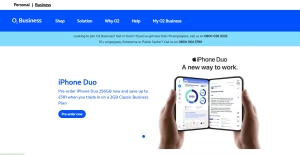
O2 provides business tariffs covering different data allowances and contract structures, with additional features that can appeal to smaller companies.
Current O2 small-business tariffs are 5G enabled. Selected tariffs also include data rollover, while larger data packages can include UK-to-EU minutes and international calling benefits.
| O2 Business Deal Details | Example |
| Best For | Flexible Plans And Business Features |
| Data Options | From Small Allowances To Unlimited |
| Calls And Texts | Unlimited On Current Listed SIM Plans |
| 5G | Enabled On Small Business Tariffs |
| Data Rollover | Available On Selected Tariffs |
| International Features | Available On Higher Plans |
| Annual Airtime Increase | £1.50 On Current Business Offers |
As an example of O2’s current handset structure, an iPhone 17 business configuration has been advertised with a 36-month device plan alongside several SIM choices.
The available SIM data levels include 2GB, 10GB, 25GB, 50GB, 100GB and unlimited data, with unlimited calls and texts included.
O2 also separates its offering into Classic, Plus and Ultimate business plans, allowing companies to pay more where additional roaming or international benefits are useful.
Current business product pages state that mobile airtime costs increase by £1.50 each year from 1 April.
Why O2 Stands Out?
- Data Choice: Businesses can select modest allowances or move up to unlimited data.
- Data Rollover: Selected plans allow unused data to be carried forward.
- 5G Access: Current small-business tariffs are 5G enabled.
- International Features: Higher allowances can provide useful UK-to-EU calling benefits.
- Multiple Business Tiers: Classic, Plus and Ultimate options allow companies to match features to actual requirements.
Verdict: O2 is a good option for businesses that want flexibility rather than a single fixed package. Its tiered plans can be particularly useful where some employees only need basic connectivity while others require roaming or international calling.
4. Three – Best For Data And Value
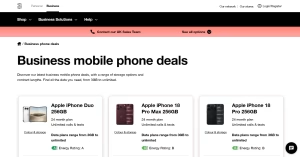
Three remains one of the most aggressive competitors for businesses that consume large amounts of mobile data.
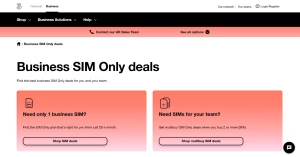
Its current business SIM-only range includes 3GB, 25GB, 80GB, 500GB and unlimited options across different contract lengths. Businesses purchasing two or more SIMs can also access multi-buy offers.
| Three Business Deal Details | Example |
| Best For | Large Data Allowances And Value |
| Unlimited Data | £19.17 Per Month On Current 24-Month Offer |
| 500GB | £18 Per Month |
| 80GB | £15 Per Month |
| 25GB | £10 Per Month |
| Calls And Texts | Unlimited On Listed Voice Plans |
| 5G | Available |
Three currently advertises an unlimited-data business SIM with Go Roam in Europe for £19.17 per month on a 24-month contract. Its 500GB plan is £18, 80GB is £15 and 25GB is £10 per month on current 24-month offers.
Its unlimited roaming deal includes 49 destinations, making it interesting for businesses that need substantial UK data while still travelling regularly within Europe.
Why Three Stands Out?
- Large Data Allowances: Even the 500GB option provides considerably more data than many employees will realistically use.
- Competitive Pricing: Current 24-month prices are strong compared with many traditional business tariffs.
- Unlimited Option: Data-heavy employees can avoid constantly monitoring their monthly allowance.
- Multi-Buy Deals: Businesses purchasing several connections can access dedicated team options.
- Roaming Choice: Selected plans include European roaming.
Verdict: Three is one of the strongest options for businesses where data usage is the priority. It can be particularly useful for remote workers, field employees and staff regularly tethering laptops to their phones.
5. Three 3GB SIM-Only – Best For Startups And Sole Traders
Not every business requires hundreds of gigabytes of data.
A sole trader who spends most of the working day connected to office or home Wi-Fi may only need mobile data for emails, messaging, maps and occasional browsing.
| Budget SIM-Only Deal Details | Example |
| Best For | Startups And Sole Traders |
| Network | Three |
| Data | 3GB |
| Monthly Cost | £8 |
| Contract Length | 24 Months |
| Calls And Texts | Unlimited |
| Upfront Cost | £0 |
Three currently lists a 3GB business voice SIM for £8 per month on a 24-month agreement, including unlimited UK texts and minutes. The advertised price increases to £8.50 from April 2027 and £9 from April 2028.
For a very small company, paying for unlimited data that employees rarely use can simply increase operating costs without providing any meaningful benefit.
Why This Deal Stands Out?
- Low Monthly Cost: The starting price is significantly below many higher-data business tariffs.
- Unlimited Calls: Small companies can still make regular business calls without monitoring a minute allowance.
- Suitable For Wi-Fi Users: 3GB may be enough where most data usage takes place through Wi-Fi.
- No Upfront Cost: The current SIM-only offer does not require an upfront payment.
Verdict: This type of low-data SIM-only package makes sense for cost-conscious sole traders and small startups that already own suitable phones. Businesses should move to a larger allowance if employees regularly use video calls, cloud apps, navigation or mobile hotspots.
How Do The Best Business Mobile Phone Deals Compare?
| Option | Best For | Example 2026 Offer | Key Strength |
| EE | Coverage And Reliability | 100GB For £19 Ex VAT | Network Performance |
| Vodafone | International And Growing Businesses | Pricing Varies By Configuration | Roaming And Scalability |
| O2 | Flexible Business Plans | Multiple Data And Business Tiers | Flexibility And Rollover |
| Three | Heavy Data Users | Unlimited From £19.17 | Large Data Allowances |
| Three Budget SIM | Sole Traders And Startups | 3GB For £8 | Low Monthly Cost |
The cheapest deal is not automatically the best one.
A £19 tariff that works reliably everywhere employees operate may deliver more business value than a £10 contract that regularly loses signal. Likewise, unlimited data provides little advantage to employees who spend every day connected to office Wi-Fi.
Which Business Mobile Deal Is Best For Your Company Size?
The number of employees should influence how a mobile contract is purchased.
A sole trader may only need one SIM and one handset. At that size, simplicity and low monthly cost usually matter more than fleet management.
Businesses with two to nine employees should begin looking at centralised billing and multi-SIM discounts. Having all employee connections under one account makes it easier to monitor expenditure and deal with lost devices.
Once a company reaches ten or more employees, the purchasing decision changes again. Account management, device replacement, shared policies, employee onboarding and security controls become increasingly important.
Large businesses should also consider whether different employees actually require the same tariff.
For example:
- Office Employees: May only require small or medium data allowances.
- Sales Teams: May benefit from higher data and stronger nationwide coverage.
- Field Workers: May require reliable navigation, cloud access and mobile hotspots.
- Executives: May need extensive international roaming.
- Remote Employees: May benefit from high-data or unlimited plans if mobile connectivity acts as backup internet.
Companies using smartphones for payments should also consider network reliability alongside their choice of card readers for small businesses, particularly where transactions take place at customer premises, markets or events.
Should You Choose SIM-Only Or A Handset Contract?
SIM-only is normally the cheaper approach where a business already owns suitable smartphones.
The business pays primarily for calls, texts and data rather than financing a new device at the same time.
This can be attractive for startups trying to control initial expenditure. However, old devices may eventually create other costs through poor battery performance, outdated security updates or increased repair requirements.
A handset contract may make more sense where employees genuinely need new phones and the business prefers to spread the hardware cost across the contract.
There is also a third approach.
Businesses can purchase SIM-free smartphones separately and then use SIM-only contracts. This separates the cost of the device from the network service and may provide more freedom when switching providers.
The right choice depends on cash flow.
A business with strong cash reserves may prefer purchasing phones outright to avoid long device commitments. A young company conserving cash may find monthly handset payments easier to manage.
How Much Does A Business Mobile Contract Really Cost?
Monthly price is only the starting point.
Businesses should calculate the complete cost across the minimum contract period.
For example, a £20 monthly tariff running for 24 months appears to cost £480. But that amount can increase once scheduled price rises, handset payments, roaming charges, insurance and additional services are included.
Companies should check:
- Monthly Airtime: The recurring network charge.
- Device Payment: Any separate handset financing cost.
- Upfront Charge: The amount payable when starting the contract.
- Scheduled Price Rises: Increases already written into the agreement.
- Roaming: Charges for using phones outside included destinations.
- International Calls: Particularly important for businesses with overseas customers or suppliers.
- Out-Of-Bundle Usage: Extra data, premium numbers and other charges.
- Insurance: Device cover may significantly increase the monthly bill.
- Early Termination: Leaving during the minimum term can be expensive.
Ofcom states that where a provider builds future increases into the contract, the amount and timing should be made clear before the customer signs.
That is particularly important in 2026 because major providers now commonly publish the future pounds-and-pence amount directly alongside the starting tariff.
Growing companies should treat these mobile costs like any other recurring expense and keep suitable records.
Businesses moving towards digital bookkeeping should also understand how Making Tax Digital affects their wider financial record-keeping.
Which UK Mobile Network Offers The Best Business Coverage?
There is no network that can be declared best for every company in every part of the UK.
Coverage varies by postcode, building construction, geography and whether employees work indoors, outdoors or while travelling.
Businesses should test the locations that actually matter to them.
That includes:
- Main Office: Check indoor and outdoor signal.
- Employee Locations: Particularly important for hybrid and remote teams.
- Customer Sites: Essential for consultants, engineers, tradespeople and field sales teams.
- Travel Routes: Check roads and rail corridors used regularly by employees.
- Warehouses: Large industrial buildings can create indoor coverage problems.
- Rural Areas: Do not assume city-level performance applies outside major urban centres.
Ofcom provides a mobile availability checker that can be used to compare coverage by location.
Companies should also consider security when employees access sensitive business systems over mobile connections.
Practical steps to keep business data secure include stronger passwords, controlled access and secure device management.
Security becomes even more important when employees carry company data outside the office. Avoiding common cybersecurity mistakes in a startup should therefore be part of the mobile purchasing decision rather than something considered only after devices have been issued.
Can Businesses Claim VAT And Tax Relief On Mobile Phones?
Business mobile costs can receive favourable tax treatment, but the answer depends on who owns the contract, how the phone is used and whether the business is VAT registered.
For a self-employed person, HMRC includes phone, mobile and internet bills among costs that can qualify as allowable business expenses. However, the private portion cannot be claimed where the service has both business and personal use.
VAT follows separate rules.
Where a VAT-registered business provides employees with mobile phones for business purposes, HMRC says VAT on purchasing or leasing the device can be treated as input tax. Line rental can also qualify.
For fixed monthly packages covering calls, SMS and data, HMRC can accept the VAT as input tax where the package is incurred for the business.
Private use can complicate the treatment, particularly where usage becomes significant.
The employee benefit rules are also important.
HMRC states that one employer-provided mobile phone can generally be exempt where the contract is between the employer and the supplier.
If an employee arranges their own monthly contract and the company simply reimburses the cost, different tax and National Insurance rules can apply.
Businesses should therefore avoid treating every phone bill as automatically 100% recoverable.
Clear invoices and records are important, particularly where several employee devices are being paid through the company.
How Can You Switch Business Mobile Providers Without Losing Your Number?
A business does not normally need to abandon established phone numbers simply because it changes mobile network.
Businesses that want to retain existing numbers can use the porting process.
For one number, a PAC can be obtained from the existing network and supplied to the new provider. Ofcom states that individual customers can request a PAC by texting PAC to 65075.
Businesses switching multiple numbers can also use the switching process for up to 24 numbers, although they may need to request the codes through the provider or online account rather than using the single-number text route.
Ofcom says the number should normally be ported within one working day after the new provider receives the PAC.
Before switching, a business should:
- Check Contract End Dates: Avoid unexpected early termination charges.
- Confirm the Final Bill: Make sure outstanding device finance or usage charges are understood.
- Request the PAC: Do this where existing numbers need to be retained.
- Check Device Compatibility: Make sure existing phones will work with the new SIM or eSIM.
- Plan Multi-Line Migration: Larger businesses should avoid moving every critical number without a migration plan.
- Back Up Important Data: Contacts, authentication details and business information should not depend solely on one device.
- Test Coverage: Ideally, test the new network in important working locations before moving a large fleet.
The switching process is relatively straightforward for one employee. Moving twenty or more business numbers deserves more planning because disruption can affect customers, authentication systems and internal communications.
Conclusion
The best business mobile phone deal is the one that matches how the company actually works.
EE is a strong option where network performance and dependable connectivity are priorities. Vodafone is well suited to businesses looking for scalable services and international capabilities.
O2 provides useful flexibility through different business tiers and data options, while Three currently offers some of the strongest value for businesses that use large amounts of mobile data.
Smaller companies should not overlook low-cost SIM-only deals. Paying £20 or £30 per employee every month makes little sense if staff primarily work over Wi-Fi and only use a few gigabytes of mobile data.
At the same time, businesses should avoid judging contracts purely on the opening monthly price. Coverage, future increases, handset costs, roaming, support, security and contract length can all change the real value of a deal.
The strongest approach is to estimate each employee’s genuine requirements first, check coverage in the places where the business operates and then compare the total cost over the complete contract period.
FAQs
What Is The Best Business Mobile Phone Deal In The UK?
There is no single best deal for every business. EE is strong for connectivity, Vodafone for scalable and international requirements, O2 for flexibility and Three for competitively priced high-data plans.
Is A Business Mobile Contract Cheaper Than A Personal Contract?
Not always. Business tariffs can provide additional support, billing and multi-line features, but sole traders should compare the total cost against equivalent personal contracts before choosing.
Can A Sole Trader Get A Business Mobile Phone Contract?
Yes. Major UK networks offer business mobile options for sole traders and very small businesses, although eligibility and credit checks may apply.
Can A Business Claim VAT Back On Mobile Phone Bills?
A VAT-registered business may be able to reclaim VAT relating to qualifying business mobile costs. Private use and the way the phone is supplied can affect the treatment, so proper records should be kept.
Which Network Is Best For Business Mobile Coverage?
Coverage depends on location. Businesses should check the office, employee locations, customer sites and common travel routes rather than relying solely on national network claims.
Is SIM-Only Better For A Small Business?
SIM-only can offer better value when the company already owns suitable smartphones. It removes the handset financing element and can substantially reduce the monthly cost.
Can You Keep Your Existing Number When Switching Business Networks?
Yes. Businesses can normally retain existing numbers by requesting a PAC and giving it to the new provider. Multiple-number business switches may require additional coordination with the networks.

Blogger | Business Writer | Sharing startup advice on UK business blogs
Related Articles in Startup
View All →
Newscivil Com: Can This Digital News Platform Help UK Startups Spot Emerging Trends?
For startup founders, staying informed is no longer simply about reading the business pages each morning. Artificial intelligence, changing consumer habits, technology developments, government decisions and wider social…

Meet the Startup Turning Screen Time Into a New Way to Make Money
Britain does not exactly have a shortage of side hustles. You can deliver takeaways, sell clothes online, start freelancing, walk dogs, tutor in the evenings or attempt to…

8 Best Coworking Spaces for Bootstrapped London Startups to Launch and Scale in 2026
Bootstrapped founders don’t have the luxury of a fitted-out HQ from day one. What you need is a London coworking space that flexes with you: a hot desk…