
Best Business To Start In The UK: Top 15 Ideas For 2026


UK Startup Blog Archive
Table of Contents
Starting a business in the UK can mean anything from providing a local service with a few hundred pounds of equipment to developing a software product that serves customers internationally.
The strongest opportunity is not necessarily the one attracting the most attention. It is the one where customer demand, your skills, startup costs and a workable revenue model come together.
AI automation consultancy is one of the strongest growth-oriented businesses to consider in 2026, particularly for founders with technical and business-process skills. It can be started without physical premises and developed into recurring support, implementation or industry-specific services.
For beginners with less technical experience, online tutoring, specialist cleaning, virtual assistance, pet care and digital marketing can be easier to test without committing substantial capital.
The right choice depends on your priorities:
- Best Technology Business: AI Automation Consultancy
- Best Online Service: Digital Marketing Agency
- Best For Beginners: Online Tutoring
- Best Local Service: Specialist Cleaning
- Best Low-Cost Business: Virtual Assistant Services
- Best Scalable Product Business: Micro-SaaS
- Best Recurring-Revenue Business: Bookkeeping
- Best Sustainability Opportunity: Green Home Services
- Best Home-Based Business: Digital Products And Online Courses
Last Updated: 08.09.2026
What Makes A Business Worth Starting In The UK?
A strong business idea should offer more than just good profit potential. It needs clear customer demand, manageable startup costs and a realistic way to attract customers without overspending.
Businesses with repeat purchases, recurring contracts or the ability to scale are often more attractive because they can provide more predictable income over time.
The best business to start in the UK will also depend on your skills, experience, available budget and how much time you can commit.
A low-cost service business may suit a first-time founder, while someone with technical knowledge or more capital may prefer a scalable digital or technology-based business.
Which Types Of Businesses Are Strongest In 2026?
In 2026, some of the strongest business opportunities are being driven by artificial intelligence, digital transformation, sustainability and growing demand for flexible local services.
AI automation, Micro-SaaS, digital marketing and online products offer strong scalability, while businesses such as cleaning, tutoring, bookkeeping and pet care continue to benefit from consistent customer demand.
There is also growing potential in green home services, elderly technology support and specialised local businesses. Rather than following trends alone, founders should look for opportunities where demand is already visible and where their skills can create a clear advantage over existing competitors.
Top 15 Best Businesses To Start In The UK
1. AI Automation Consultancy
AI automation consultancy is one of the most relevant business opportunities for 2026 because many small and medium-sized businesses want to use AI without employing their own specialist technical teams.
Rather than developing complex AI models from scratch, a consultant can help clients identify repetitive tasks and connect tools already available to them.

Potential services include:
- Customer Enquiry Automation
- Lead Qualification
- Appointment Scheduling
- Internal Reporting
- Email Follow-Ups
- Document Processing
- CRM Automation
- Meeting Summaries
- Knowledge Bases
- Staff AI Training
The strongest positioning is usually industry-specific. For example, an automation consultant could focus on recruitment agencies, accountants, property businesses or professional services instead of offering generic AI support.
Revenue can come from initial audits, implementation projects, training and ongoing monthly support.
Indicative Startup Budget: £500–£5,000
Revenue Model: Projects, audits, training and recurring support
Best For: Technically confident founders
Growth Potential: Very High
2. Digital Marketing And Social Media Agency
A digital marketing business remains attractive because companies continue to compete for customers through search engines, social media, email and paid advertising.
A founder does not need to launch as a full-service agency. Specialising can make the business easier to market.

Examples include:
- Local SEO For Tradespeople
- Paid Advertising For E-Commerce Businesses
- LinkedIn Marketing For B2B Companies
- Social Media Management For Restaurants
- Email Marketing For Online Retailers
- Content Marketing For Professional Services
Recurring monthly retainers can make agency income more predictable, while audits and one-off campaigns can help acquire new customers.
Client acquisition is often the biggest initial challenge. Once the website and portfolio are established, being visible where prospective customers actively compare providers can help a new agency build its pipeline.
Suitable digital marketing agency directories can therefore become part of the agency’s wider customer acquisition strategy.
Indicative Startup Budget: £300–£3,000
Revenue Model: Retainers, projects and campaign fees
Best For: Marketing, advertising and creative professionals
Growth Potential: High
3. Online Tutoring And Skills Coaching
Online tutoring is one of the easiest knowledge-based businesses to start because the initial equipment requirements can be minimal.
Academic tutoring remains an obvious option, but the market extends much further.

A tutor could specialise in:
- GCSE Mathematics
- English
- Sciences
- A-Level Subjects
- Coding
- Languages
- Music
- Professional Exams
- Business Skills
- Software Training
- Interview Preparation
The simplest model is one-to-one teaching. Once demand has been proven, group sessions can increase revenue per hour.
Tutors can also develop recorded courses, revision resources, workshops and memberships to reduce their dependence on selling individual hours.
A clear niche normally works better than offering every subject to every learner.
Indicative Startup Budget: £100–£1,500
Revenue Model: Hourly lessons, group classes and digital resources
Best For: Teachers, graduates and skilled professionals
Growth Potential: High
4. Carpet And Specialist Cleaning Business
Cleaning is already one of the most accessible local service businesses, but specialising can make the offer more valuable.
Rather than competing only for ordinary domestic cleaning work, a founder could focus on:
- Carpet Cleaning
- Upholstery Cleaning
- End-Of-Tenancy Cleaning
- Oven Cleaning
- Commercial Cleaning
- Holiday-Let Changeovers
- Post-Construction Cleaning
- Deep Cleaning
- Office Contracts
Specialist equipment increases startup costs compared with basic domestic cleaning, but it can also support higher-value jobs.
Recurring office contracts, landlord relationships and property-management partnerships can produce more stable demand.
General cleaning businesses do not normally require a dedicated cleaning licence, although waste handling, chemicals, employment, insurance and specialist work can create additional responsibilities.
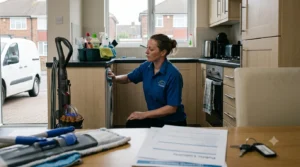
Founders should understand the relevant cleaning business licence requirements before expanding into regulated or higher-risk services.
Indicative Startup Budget: £800–£6,000
Revenue Model: Individual jobs and recurring contracts
Best For: Practical local entrepreneurs
Growth Potential: High
5. Virtual Assistant And Remote Business Support
Virtual assistance is one of the cheapest businesses to start from home.
Small businesses often need administrative support without being ready to recruit a permanent employee. A virtual assistant can provide flexible help remotely.

Services can include:
- Inbox Management
- Diary Management
- Customer Support
- Data Entry
- CRM Updates
- Invoice Administration
- Research
- Meeting Preparation
- Supplier Communication
- Social Media Scheduling
A general VA may face significant price competition. Specialising can create a stronger proposition.
For example, a founder could become a virtual assistant for:
- Property Professionals
- Coaches
- Accountants
- E-Commerce Businesses
- Consultants
- Recruitment Agencies
Monthly packages can create predictable revenue, while hiring subcontractors provides a potential route towards building a remote operations agency.
Indicative Startup Budget: £100–£1,000
Revenue Model: Hourly work and monthly packages
Best For: Highly organised people
Growth Potential: High
6. Niche E-Commerce And Subscription Brand
E-commerce is still capable of producing highly scalable businesses, but simply opening a general online store is unlikely to provide much competitive advantage.
A better approach is to build around a clearly defined customer or problem.

Potential niches include:
- Specialist Pet Products
- Hobby Supplies
- Sustainable Household Products
- Professional Equipment
- Personalised Gifts
- Craft Products
- Specialist Food Products
- Subscription Boxes
- Home Organisation Products
Subscription models can be particularly attractive where products need regular replacement or customers value convenience.
The major risk is buying too much inventory before demand has been established.
A founder can reduce this risk through:
- Small Initial Product Runs
- Pre-Orders
- Customer Interviews
- Marketplace Testing
- Limited Launches
- Samples
The aim should be to prove that customers will buy before committing significant money to inventory, packaging and storage.
Indicative Startup Budget: £1,000–£10,000+
Revenue Model: Product sales, bundles and subscriptions
Best For: Product-focused entrepreneurs
Growth Potential: Very High
7. Digital Products And Online Courses
Digital products are attractive because a product can potentially be sold repeatedly without manufacturing another physical unit each time.
Products could include:
- Online Courses
- Business Templates
- Design Assets
- Spreadsheet Templates
- Educational Resources
- Membership Content
- Digital Planners
- Professional Toolkits
- Industry Checklists
However, low production costs do not automatically mean easy profits. Competition can be intense and customers need a strong reason to choose one product over free alternatives.

Expertise and audience knowledge, therefore, matter.
A professional who repeatedly solves the same problem for clients may be well positioned to turn that knowledge into a digital product.
Indicative Startup Budget: £100–£2,000
Revenue Model: Individual purchases, bundles and subscriptions
Best For: Specialists, educators and creators
Growth Potential: Very High
8. Pet Care, Dog Walking And Pet Sitting
Pet services can provide strong recurring demand because many customers require support every week rather than once.
A founder can start with one service and expand gradually.

Possible services include:
- Individual Dog Walking
- Group Walks
- Puppy Visits
- Pet Sitting
- Cat Visits
- Overnight Care
- Holiday Pet Care
- Pet Transport
- Basic Grooming
Customer trust is critical. Owners may provide keys to their homes and place animals directly in the business owner’s care.
Insurance, secure customer records and clear emergency procedures should therefore be established early.
Once demand exceeds the founder’s available hours, additional walkers or sitters can help turn the operation into a larger local pet-care business.
Indicative Startup Budget: £300–£2,500
Revenue Model: Walks, visits, packages and overnight care
Best For: Reliable animal lovers
Growth Potential: Medium To High
9. Bookkeeping And Cloud Finance Services
Bookkeeping can provide reliable B2B demand because every serious business needs accurate financial records.
Cloud accounting software also allows much of the work to be delivered remotely.

Services might include:
- Transaction Recording
- Bank Reconciliation
- Invoice Management
- Expense Processing
- Accounts Receivable Support
- Basic Management Reports
- Payroll Administration
- Cloud Accounting Setup
Unlike one-off creative projects, bookkeeping commonly involves work every month. This makes recurring client relationships a major attraction.
Accuracy and confidentiality are essential, and founders need appropriate knowledge before taking responsibility for other businesses’ records.
Understanding practical bookkeeping for small businesses can also help founders identify where routine record keeping ends and more specialist accounting or tax work begins.
Indicative Startup Budget: £300–£2,500
Revenue Model:Monthly retainers and project fees
Best For: Financially organised professionals
Growth Potential: High
10. Green Home And Energy-Efficiency Services
Energy efficiency creates opportunities for businesses that help households and landlords improve buildings and reduce wasted energy.
The exact business model will depend heavily on qualifications.

Potential opportunities include:
- Energy-Efficiency Assessments
- Insulation Services
- Draught-Proofing
- Smart Heating Setup
- Retrofit Coordination
- Energy-Efficient Lighting
- Heat-Pump Support Services
- Solar Maintenance And Cleaning
A founder does not need to personally carry out every technical installation. A business could instead specialise in assessments, customer acquisition, project management or coordinating qualified trades.
Regulated electrical, heating and installation work must be handled by appropriately competent professionals.
Indicative Startup Budget: £1,000–£15,000+
Revenue Model: Assessments, installations and project fees
Best For: Founders with property, construction or sustainability experience
Growth Potential: High
11. Micro-SaaS And Niche Software Business
Micro-SaaS involves creating a focused software product that solves one specific problem for a defined market.
Instead of attempting to compete with major software platforms, a founder can build something narrower.

Examples include:
- Scheduling Software For A Specific Trade
- Reporting Tools For Agencies
- Quote Systems For Contractors
- Compliance Trackers
- Customer Reminder Platforms
- Specialist Calculators
- Workflow Tools
- Industry Dashboards
Subscription pricing can create recurring revenue once a stable customer base has been established.
The difficult part is usually not building the first version. It is proving that enough customers have the same problem and are prepared to pay to solve it.
A basic product should therefore be tested with potential users before significant development work begins.
Indicative Startup Budget: £1,000–£20,000+
Revenue Model: Monthly or annual subscriptions
Best For: Developers and technically capable founders
Growth Potential: Very High
12. Event Planning And Event Management Services
Businesses and individuals regularly outsource event organisation because coordinating venues, suppliers, schedules and guests can become time-consuming.
A new business does not need to handle major conferences immediately.

It could specialise in:
- Corporate Events
- Weddings
- Private Celebrations
- Product Launches
- Business Networking Events
- Community Events
- Workshops
- Sustainable Events
- Small Conferences
Revenue can come from fixed planning fees, coordination fees or complete event-management packages.
A strong supplier network becomes an important competitive advantage. Reliable venues, caterers, photographers, decorators and entertainment providers can make delivery more consistent.
Indicative Startup Budget: £500–£4,000
Revenue Model: Planning fees and management packages
Best For: Highly organised and sociable founders
Growth Potential: High
13. Home-Based Catering And Artisan Food Business
A food entrepreneur does not necessarily need to begin by opening a café or restaurant.
Starting smaller can reduce risk while allowing customers to validate the concept.

Potential models include:
- Celebration Cakes
- Dessert Boxes
- Office Lunches
- Corporate Catering
- Specialist Baked Products
- Cultural And Regional Meals
- Sauces And Preserves
- Meal Preparation
- Grazing Tables
- Event Catering
Pre-orders can reduce waste and make ingredient purchasing more predictable.
Pricing must account for more than ingredients. Founders also need to include preparation time, packaging, utilities, delivery, equipment and food waste.
Food registration, hygiene, allergen and labelling requirements also need to be addressed before trading.
Indicative Startup Budget: £500–£8,000+
Revenue Model: Orders, catering contracts and wholesale supply
Best For:Experienced cooks and bakers
Growth Potential: High
14. Gardening And Home Maintenance Services
Property maintenance can provide steady local demand from homeowners, landlords and property managers.
Services could include:
- Lawn Maintenance
- Hedge Cutting
- Garden Clearances
- Pressure Washing
- Painting
- Furniture Assembly
- Shelving
- Minor Property Repairs
- Rental Property Maintenance
Recurring garden maintenance and landlord contracts can provide greater predictability than individual jobs.
Founders must also know where their competence ends. Gas, major electrical, structural and other regulated work should be passed to appropriately qualified tradespeople.

Once customer demand increases, the business can expand by employing additional maintenance workers or partnering with specialist trades.
Indicative Startup Budget: £800–£8,000
Revenue Model: Individual jobs and maintenance contracts
Best For: Practical founders
Growth Potential: High
15. Elderly Technology Support Services
As everyday services become increasingly digital, some older customers need practical help using technology confidently.
This creates an unusual local service opportunity that is still less crowded than many traditional technology businesses.

Services could include:
- Smartphone Setup
- Video Calling Setup
- Tablet Support
- Smart TV Assistance
- Printer Setup
- Home Wi-Fi Help
- Software Updates
- Digital Photo Organisation
- Online Appointment Support
- Basic Cybersecurity Education
Trust is particularly important because the business may work inside customers’ homes and around personal devices.
The service should avoid handling passwords, financial credentials or sensitive information unnecessarily.
Partnerships with community organisations, retirement developments and local businesses could provide customer referrals.
Indicative Startup Budget: £200–£2,000
Revenue Model: Home visits, support packages and training sessions
Best For: Patient, technically capable entrepreneurs
Growth Potential: Medium To High
Comparison Of The Top 15 Businesses To Start In The UK
The startup-cost ranges below are indicative planning figures rather than fixed industry averages. Actual costs vary significantly according to equipment, qualifications, insurance, stock, marketing and whether employees or premises are required.
| Business Idea | Indicative Startup Budget | Speed To Launch | Recurring Revenue | Scalability | Best For |
| AI Automation Consultancy | £500–£5,000 | Medium | High | Very High | Technical Founders |
| Digital Marketing Agency | £300–£3,000 | Fast | High | High | Marketing Professionals |
| Online Tutoring | £100–£1,500 | Fast | Medium | High | Teachers And Experts |
| Specialist Cleaning | £800–£6,000 | Fast | High | High | Practical Founders |
| Virtual Assistant | £100–£1,000 | Fast | High | High | Organised Beginners |
| E-Commerce Brand | £1,000–£10,000+ | Medium | Medium–High | Very High | Product Entrepreneurs |
| Digital Products | £100–£2,000 | Medium | Medium | Very High | Creators And Experts |
| Pet Care | £300–£2,500 | Fast | High | Medium–High | Animal Lovers |
| Bookkeeping | £300–£2,500 | Medium | Very High | High | Finance Professionals |
| Green Home Services | £1,000–£15,000+ | Medium | Medium | High | Property Professionals |
| Micro-SaaS | £1,000–£20,000+ | Slow | Very High | Very High | Developers |
| Event Planning | £500–£4,000 | Medium | Medium | High | Organised Founders |
| Catering And Food | £500–£8,000+ | Medium | Medium | High | Food Entrepreneurs |
| Gardening And Maintenance | £800–£8,000 | Fast | High | High | Practical Founders |
| Elderly Technology Support | £200–£2,000 | Fast | Medium–High | Medium | Patient Tech-Savvy Founders |
Best Businesses To Start By Budget
Your available capital can quickly narrow down which opportunities are realistic.
Under £500
Online tutoring, virtual assistance, digital products and basic elderly technology support are among the easiest ideas to test with minimal capital if you already own a computer and other essential equipment.
£500 To £2,000
AI consultancy, digital marketing, pet care, bookkeeping, event planning and some cleaning services can often be tested at this level without taking on expensive premises.
£2,000 To £10,000
This budget opens opportunities such as specialist cleaning, gardening services, catering, e-commerce and more professional agency setups.
More Than £10,000
Micro-SaaS development, larger green home services and inventory-heavy e-commerce businesses can require substantially greater capital.
Funding should follow a realistic business plan rather than replace one. Some founders may qualify for UK business start-up grants, although availability, eligibility and award amounts vary by programme.
Which Businesses Can Start Making Money Quickly?
Service businesses generally have a shorter route to revenue because founders do not need to manufacture products or develop complex technology before making a sale.
| Business | Initial Revenue Potential | Why |
| Virtual Assistant | Fast | Can sell existing administrative skills |
| Online Tutoring | Fast | Simple service with limited setup |
| Pet Care | Fast | Clear local customer demand |
| Gardening | Fast | Easy-to-understand local service |
| Specialist Cleaning | Fast | Customers can book individual jobs immediately |
| Elderly Tech Support | Fast | Service can be delivered directly in customers’ homes |
| Digital Marketing | Medium | Requires portfolio and client acquisition |
| Bookkeeping | Medium | Trust and professional credibility matter |
| E-Commerce | Medium | Product sourcing and marketing take time |
| Micro-SaaS | Slow | Product must be built and validated |
Speed should not be the only consideration. Businesses that take longer to launch can sometimes create stronger recurring revenue or greater scalability.
Which Business Is Best For You?
| Your Priority | Businesses To Consider |
| Start With Very Little Money | VA, Tutoring, Digital Products |
| Work Entirely From Home | Digital Products, Tutoring, Bookkeeping |
| Build Recurring Revenue | Bookkeeping, Cleaning, VA |
| Start A Local Business | Cleaning, Gardening, Pet Care |
| Use Technology Skills | AI Automation, Micro-SaaS |
| Build A Highly Scalable Business | SaaS, E-Commerce, Digital Products |
| Work With Businesses | Marketing, AI, Bookkeeping |
| Work With Consumers | Pet Care, Tutoring, Catering |
| Use Practical Skills | Cleaning, Gardening, Green Home Services |
| Build A Side Business First | Tutoring, VA, Digital Products |
What New Business Owners Need To Know In 2026?
Choosing an idea is only one part of starting a business. Founders also need to understand the tax, registration and record-keeping rules that apply to their chosen structure.
Making Tax Digital For Income Tax
Making Tax Digital for Income Tax started applying from 6 April 2026 to qualifying sole traders and landlords whose qualifying self-employment and property income was more than £50,000 based on their 2024/25 tax return.
The threshold falls to more than £30,000 from 6 April 2027 and more than £20,000 from 6 April 2028. Those affected need compatible software for digital records and quarterly updates.
Founders starting as sole traders should therefore consider bookkeeping processes early rather than waiting until their business becomes complicated.
Companies House Identity Verification
Identity verification has also become part of company administration.
From 18 November 2025, new directors need to provide their Companies House personal code when incorporating a company or when being appointed. Existing directors provide their code in connection with their next confirmation statement during the transition period.
Anyone unsure about structures, registration, bookkeeping and other setup requirements can work through the wider process of starting a business in the UK before deciding whether to operate as a sole trader or limited company.
VAT Registration
The UK VAT registration threshold remains £90,000 of taxable turnover. Businesses need to monitor turnover because registration can become compulsory once the relevant threshold test is met.
Voluntary VAT registration may also be available below the threshold, although whether it is beneficial depends on the business and its customers.
Licences And Sector-Specific Rules
Not every small business has the same compliance burden.
A virtual assistant may mainly need to think about tax, contracts, data security and insurance, while food businesses, property services, trades and specialist cleaning can face additional regulation.
Before spending heavily, check:
- Business Registration
- Tax Responsibilities
- Insurance
- Local Authority Requirements
- Professional Qualifications
- Health And Safety
- Data Protection
- Employment Rules
- Sector-Specific Licences
How To Test A Business Idea Before Investing Heavily?
A promising idea still needs proof that customers will pay for it.
1. Define One Customer Group
- Avoid starting with everyone as your target customer.
- A bookkeeping service for independent tradespeople is easier to understand and market than bookkeeping for every UK business.
2. Research Existing Businesses
Competitors are useful evidence that demand already exists.
Look at:
- Pricing
- Customer Reviews
- Services
- Geographic Coverage
- Complaints
- Marketing
- Waiting Times
3. Speak To Potential Customers
- Ask customers what they currently use, what problems they experience and what would persuade them to change providers.
4. Build A Simple Offer
- Do not launch with twenty services.
- Create one clear offer that solves one recognisable problem.
5. Try To Make A Sale
- A paying customer is considerably stronger evidence than likes, survey responses or friends saying an idea sounds good.
6. Improve Before Expanding
- Use early customers to improve pricing, delivery and positioning before investing significantly in staff, stock or premises.
How To Choose The Right Business Idea?
Use Skills You Already Have
Your existing experience can substantially reduce the difficulty of getting started.
Someone with ten years of finance experience may have a stronger foundation for bookkeeping than for opening an e-commerce store.
Likewise, an experienced professional may be able to convert industry knowledge into a specialised consultancy. Clear positioning is particularly important when starting a consulting business because customers usually pay for expertise in solving a specific problem.
Choose A Problem Customers Already Pay To Solve
The presence of competitors does not automatically make a market unattractive.
In many cases, it proves customers are willing to spend money.
The better question is whether you can offer something meaningfully better through specialisation, convenience, quality, price, speed or customer service.
Look For Recurring Revenue
A single sale is useful.
A customer who pays every month can be significantly more valuable.
Recurring models include:
- Marketing Retainers
- Bookkeeping Packages
- Cleaning Contracts
- Pet Care Packages
- SaaS Subscriptions
- Product Subscriptions
- Virtual Assistant Retainers
Understand The Full Cost
Startup costs are only the beginning.
Your calculations should include:
- Equipment
- Insurance
- Software
- Travel
- Marketing
- Stock
- Packaging
- Payment Fees
- Professional Fees
- Employee Costs
- Tax
- Working Capital
Consider Whether It Can Scale
Some founders want a profitable self-employed career. Others want to build a company that operates without them delivering every service personally.
Neither objective is wrong.
What matters is choosing a model aligned with your goal.
How To Start A Business In The UK?
Once an idea has been validated, the startup process becomes more practical.
- Choose A Specific Business Idea
- Define Your Target Customer
- Research Competitors
- Validate Customer Demand
- Calculate Startup Costs
- Create A Basic Business Plan
- Choose A Legal Structure
- Complete Required Registrations
- Arrange Suitable Insurance And Licences
- Set Up Bookkeeping And Payments
- Create A Website Or Basic Online Presence
- Start Selling
- Collect Customer Feedback
- Track Revenue, Costs And Cash Flow
- Scale Only When Demand Is Proven
Do not spend months perfecting logos, offices and websites before determining whether customers are willing to buy.
A simple business serving real paying customers is further ahead than an elaborate brand without demand.
Conclusion
There is no universal answer to the best business to start in the UK.
For someone with technical expertise, AI automation or Micro-SaaS may provide the greatest long-term opportunity.
Digital marketing, bookkeeping and virtual assistance are attractive for founders who want recurring B2B revenue without large physical overheads.
For local entrepreneurs, specialist cleaning, pet care, gardening and elderly technology support offer services that can be tested directly with customers.
E-commerce, digital products and online courses provide greater geographical reach, while green home services and event management can suit founders with specialist experience and strong professional networks.
The strongest starting point is to choose a business that matches your skills, solves a problem customers already recognise and can be tested without creating unnecessary financial risk.
Prove the demand first. Expand after customers give you a reason to.
Frequently Asked Questions
What Is The Most Profitable Business To Start In The UK?
AI consulting, specialist professional services, digital marketing and software businesses can achieve strong margins because physical overheads can be relatively low. Profitability still depends on customer demand, pricing and operating costs.
What Business Can I Start With £1,000 In The UK?
Virtual assistance, online tutoring, digital products, pet care, consulting and some basic marketing or technology-support services can often be tested with £1,000 or less.
What Is The Easiest Business To Start In The UK?
Service businesses such as tutoring, VA work, cleaning and pet care are generally among the easiest to test because they can start without substantial stock or commercial premises.
Which Business Is Best For Beginners?
Online tutoring, virtual assistance and specialist cleaning are good beginner options because their business models are straightforward and founders can begin with a small number of customers.
What Is The Best Online Business To Start In The UK?
Digital marketing, digital products, online tutoring, niche e-commerce and Micro-SaaS are among the strongest online models. The best choice depends on whether the founder’s strengths are in services, content, products or technology.
Can I Start A Business While Working Full-Time?
Yes. Many low-cost service and online businesses can initially be tested alongside employment. Check your employment contract for restrictions relating to competing work, confidentiality and intellectual property.
Do I Need A Limited Company To Start A UK Business?
No. Many founders initially operate as sole traders. A limited company is a separate legal structure with additional administration and may be more appropriate depending on risk, customers, investment plans and long-term objectives.

Expert Blogger | Strategic thinker anticipating future directions for UK business
Related Articles in Business
View All →
Chick-fil-A Franchise Cost in 2026: UK Investment, Fees, Profits and Requirements
The Chick-fil-A franchise cost in the UK is approximately £10,000, making it an unusually accessible entry point into the international fast-food franchise market. In the United States, the…

The Best Digital Marketing Agencies for Enterprise Brands in the UK
When it comes to enterprise-scale marketing campaigns, the toughest challenge is ensuring coordination between the different channel teams. It’s understandable when you consider the complexity, with teams targeting…

Pass the Keys Franchise Cost: Investment, Fees and Profit Potential in 2026
The Pass the Keys franchise cost is currently best understood as a two-part investment: the franchise entry cost and the wider capital needed to launch and operate the…