
Best CRM for Small Business Growth in 2027: Which CRM Fits Your Business?


UK Startup Blog Archive
Table of Contents
The best CRM for small business growth is not necessarily the platform with the most features. It is the system that helps a company convert enquiries into paying customers, retain existing clients and control sales costs as the business expands.
For UK startups, freelancers, consultancies, tradespeople and growing SMEs, customer relationship management (CRM) software can turn scattered emails, spreadsheets and customer conversations into a structured sales operation.
Our analysis of CRM capabilities, published customer experiences and business costs identifies HubSpot, Pipedrive, Zoho CRM, Capsule CRM, Freshsales and monday CRM as practical options for different growth models in 2027.
Rather than treating CRM selection as a software popularity contest, we focus on whether each platform can improve sales performance without creating unnecessary financial commitments.
Which CRM Is Best for Different Small Business Needs?
Before purchasing software, identify how customers enter your business and how long it takes them to buy.
| Business requirement | CRM to consider | Main business advantage |
| New startup with limited funding | HubSpot | Free entry-level CRM |
| Small team managing complex sales opportunities | Pipedrive | Visual sales pipeline |
| Cost-conscious SME needing flexibility | Zoho CRM | Broad feature selection |
| UK consultancy or professional services firm | Capsule CRM | Client and relationship management |
| Growing team requiring sales automation | Freshsales | Communication and workflow tools |
| Agency managing sales alongside projects | monday CRM | Customisable workflows |
There is no universally suitable system. A local plumbing company and a B2B software startup might generate similar revenue but require entirely different customer-management processes.
Businesses already using marketing tools should also check whether their existing software includes a CRM before adding another subscription.
How Can a CRM Actually Help a Small Business Grow?
A CRM should solve an identifiable commercial problem.
Without a structured system, an enquiry may remain unanswered, a quotation may be forgotten or a potential customer may receive no follow-up after an initial conversation.
We identified four areas where effective customer relationship management can support growth.
Improving Sales Conversion
Consider a consultancy receiving 100 qualified enquiries each month.
| Monthly sales performance | Before CRM | Illustrative improved outcome |
| Qualified enquiries | 100 | 100 |
| Conversion rate | 20% | 25% |
| New customers | 20 | 25 |
| Contribution per customer | £150 | £150 |
| Total contribution | £3,000 | £3,750 |
A five-percentage-point improvement would generate £750 in additional monthly contribution before CRM costs.
This is an illustrative financial scenario, not a claimed industry average or guaranteed CRM result. Actual gains depend on lead quality, staff adoption and sales execution.
Reducing Administrative Work
Automated reminders, email logging and task assignments can reduce repetitive administration.
For example, saving 15 minutes per working day across three employees could release approximately 15 working hours in a four-week month.
At an illustrative labour value of £20 per hour, this represents £300 in potential productive capacity, although it is not necessarily a cash saving.
Connecting Marketing With Revenue
A CRM can help businesses understand which advertising channels produce customers rather than just clicks.
This is particularly important when combining business advertising with external lead generation.
Increasing Customer Retention
Maintaining purchase histories, renewal dates and service records allows businesses to identify opportunities for repeat sales.
A reliable retention strategy supports the long-term financial discipline that established businesses often develop over time.
Which CRM Platforms Deserve Consideration for 2027?
HubSpot: For Startups Building Their First Sales System
HubSpot is a practical starting point for founders who need organised contact records, deal tracking and a path towards integrated marketing.
Its free CRM offering supports up to two users, making it worth considering for early-stage businesses.
As of November 2026, HubSpot also offers paid Starter and higher-tier products. Businesses should check promotional terms, paid-seat requirements and automation limits before upgrading.
The main financial consideration is future expansion. A company that begins with free contact management may eventually require more sophisticated reporting, marketing automation or additional paid users.
Suitable for: Small B2B startups, new agencies and founder-led businesses.
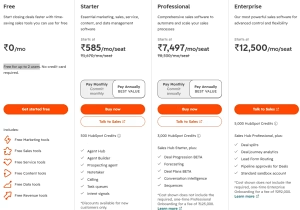
HubSpot’s official Sales Hub pricing page showing the free two-user offering and paid subscription options.
Pipedrive: For Businesses With a Defined Sales Pipeline
Pipedrive is designed around managing opportunities as they progress through sales stages.
For property businesses, recruitment agencies, IT service providers and B2B consultancies, this can make it easier to identify stalled deals and schedule follow-ups.
Its paid plans include Lite and more advanced options, with higher tiers adding capabilities such as email synchronisation and automation.
The financial advantage is operational visibility. Managers can identify which opportunities need attention without searching through individual employees’ inboxes.
However, businesses requiring extensive marketing functionality should examine add-on costs and integrations.
Suitable for: Sales-driven teams with regular quotations, proposals and negotiations.
Zoho CRM: For Growing Businesses Managing Software Costs
Zoho CRM offers a free edition for up to three users alongside paid subscription tiers.
Its wider ecosystem makes it particularly relevant to businesses that want CRM, accounting, communication and other operational systems to work together.
A growing company may benefit from its customisation and automation capabilities, but implementation requires planning.
From a financial perspective, feature availability matters more than the headline subscription price. Companies should verify whether the specific workflow they require is included in their chosen edition.
Suitable for: Budget-conscious SMEs, distributors and growing service companies.
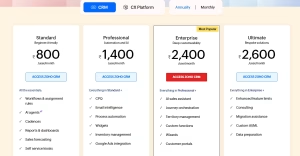
Official Zoho CRM pricing showing the three-user free edition and available paid plans.
Capsule CRM: For UK Professional Services and Client-Focused Businesses
Capsule CRM is particularly relevant for accountants, consultants, designers and small professional service firms that depend on ongoing customer relationships.
Its free plan supports two users and up to 250 contacts, while paid plans offer higher limits and additional features.
For businesses that manage both prospective customers and existing client relationships, ease of adoption may be more valuable than advanced technical functionality.
Capsule also offers integrations with business software, making it worth considering for organisations already using accounting and productivity tools.
Suitable for: Accountancy practices, consultancies, freelancers and client-service businesses.
Freshsales: For Small Teams Moving Towards Automation
Freshsales combines contact management, sales pipelines and communication capabilities.
Its Growth plan was advertised from US$9 per user per month with annual billing in November 2026. More advanced functionality is available through higher-priced editions.
Businesses planning to automate follow-ups or manage substantial lead volumes should compare the capabilities included in each tier.
The important consideration is whether automation will genuinely reduce administrative work or simply introduce another process employees must maintain.
Suitable for: Growing sales teams, digital service companies and businesses managing frequent enquiries.
Monday CRM: For Agencies Connecting Sales and Delivery
monday CRM offers customisable boards, dashboards and workflow management.
It can be useful when a business needs visibility over the transition from a confirmed sale to project delivery.
For example, a digital agency might track an opportunity from enquiry to proposal, approval, onboarding and project handover.
Companies should distinguish monday CRM pricing from other monday.com products and check automation limits, contact allowances and the number of paid seats required.
Suitable for: Creative agencies, marketing firms and project-based service companies.
What Do Genuine CRM Customers Say About Daily Use?
Published customer experiences provide useful information about implementation challenges that subscription pages rarely explain.
In a March 2026 Trustpilot review, Gwen Backhouse, a Capsule CRM customer, highlighted the platform’s usability and customer support:
“It is great to have human support and a fast response”
Her review also discussed the ability to adapt Capsule to business requirements.
For sales-focused teams, Michal Kowalski described Pipedrive’s practical functionality in a July 2026 Trustpilot review:
“You can easily design a pipeline, deploy automation, sync up emails”
Importantly, his review also raised concerns about the depth of analytics as business requirements become more sophisticated.
These are individual customer experiences, not independently verified performance outcomes. They demonstrate why founders should consider both everyday usability and future reporting needs.
How Much Should a Small Business Budget for CRM Software in 2027?
Subscription prices are only one part of the investment.
CRM budgets should account for additional users, implementation, integrations, training and possible migration expenses.
Consider an illustrative five-person business paying £15 per user per month.
| CRM cost component | Illustrative first-year expense |
| Five user licences | £900 |
| Initial data migration and setup | £300 |
| Staff onboarding | £200 |
| Total first-year cost | £1,400 |
These are hypothetical planning figures, not a quotation from a particular CRM vendor.
If the company expands to ten users at the same subscription price, annual licensing alone rises to £1,800—a 100% increase.
This makes subscription scalability an important part of business planning, particularly for companies expecting to recruit additional sales employees.
Our recommendation is to compare the total cost over 12–24 months, including whether annual billing introduces contractual commitments.
How Can You Measure Whether a CRM Is Worth the Investment?
A CRM should contribute to measurable improvements rather than simply creating a more attractive dashboard.
The most useful financial and operational indicators include:
| Performance indicator | What it measures |
| Lead conversion rate | Percentage of qualified leads becoming customers |
| Customer acquisition cost | Sales and marketing cost per new customer |
| Sales-cycle length | Time between initial enquiry and completed sale |
| Customer retention rate | Percentage of customers retained |
| Pipeline value | Potential revenue from active opportunities |
| Follow-up completion rate | Percentage of scheduled follow-ups completed |
| CRM cost per customer | CRM expenditure divided by customers managed or acquired |
Suppose a business invests £1,400 in CRM software and implementation during its first year.
If better follow-up processes generate £4,000 of additional annual contribution after variable delivery costs, the illustrative return on the CRM investment would be:
ROI = (£4,000 − £1,400) ÷ £1,400 × 100 = approximately 186%
That is a scenario, not an expected return. It also assumes the £4,000 benefit is incremental and attributable to the implementation.
Business owners should monitor these metrics alongside their wider marketing strategy rather than assume every sales improvement results from CRM adoption.
Which CRM Features Matter Most for Different Industries?
A useful CRM configuration depends on the actual buying process.
| Industry | Priority CRM functionality |
| Construction and trades | Quotation reminders, job histories, mobile access |
| Accounting and consulting | Client records, recurring tasks, renewal reminders |
| Ecommerce | Customer segmentation, purchase history, retention |
| Recruitment | Candidate/client pipelines, activities, communication records |
| Digital marketing agencies | Lead tracking, campaign attribution, project handovers |
| Property services | Enquiries, appointments, deal progression, follow-ups |
For ecommerce businesses operating a direct-to-consumer model, customer segmentation and repeat purchases may be more important than complex B2B deal forecasting.
Meanwhile, local businesses investing in Instagram advertising should ensure their enquiry forms and campaign data can connect with the selected CRM.
This industry-specific approach helps avoid purchasing software features that employees will rarely use.
What Should UK Businesses Check Before Moving Customer Data?
Data protection and operational continuity must be considered before CRM migration.
A CRM provider’s security credentials do not automatically make its customers compliant with UK data protection law.
Businesses should assess:
- Where customer data is stored and whether international transfers require safeguards.
- Whether appropriate data-processing agreements are available.
- How access permissions, multifactor authentication and backups operate.
- Whether contact records and sales histories can be exported.
- Whether marketing communications comply with UK GDPR and PECR requirements.
- How long customer information is retained and who can delete it.
For direct marketing, the Information Commissioner’s Office explains that consent or legitimate interests may be relevant depending on the circumstances, while PECR imposes additional requirements for electronic communications.
Before migrating, create an export of current records, remove duplicates and test the new system using a limited data sample.
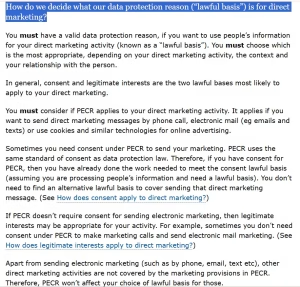
Official ICO guidance explaining lawful bases and privacy requirements for direct marketing.
How Should a Startup Implement Its First CRM?
A small business does not need an elaborate implementation programme. A structured 30-day rollout can establish whether the software is commercially useful.
| Period | Action | Expected outcome |
| Days 1–7 | Define sales stages and clean customer records | Reliable starting database |
| Days 8–14 | Import contacts and connect email or enquiry forms | Centralised communication |
| Days 15–21 | Train staff and establish follow-up rules | Consistent daily usage |
| Days 22–30 | Review data quality, pipeline and reporting | Initial evidence of adoption |
Before automating anything, ensure employees understand the existing sales process.
This is especially important for new businesses that have not yet developed a repeatable method of acquiring and retaining customers.
In 2027, AI-assisted CRM features may offer further efficiency opportunities, but businesses should verify how each feature handles customer information, what it costs and whether employees must approve generated content or actions.
When Should a Small Business Upgrade or Change Its CRM?
Changing platforms should be a commercial decision, not a reaction to a new product announcement.
Consider upgrading when contact or user limits prevent normal operations, reporting cannot support management decisions, integration costs become excessive or employees consistently duplicate work across systems.
However, poor CRM adoption is not always a software problem. Unclear sales responsibilities, inconsistent data entry and weak follow-up procedures can undermine even an advanced platform.
For businesses focused on sustainable growth, improving internal processes before migrating can be more effective than purchasing additional features.
Final Thoughts
The best CRM for small business growth in 2027 is the platform that supports the company’s actual sales process, fits its budget and remains manageable as customer numbers increase.
Our findings suggest that early-stage founders should prioritise simplicity and affordability, while expanding teams should examine automation, reporting and integration costs.
A well-implemented CRM is not merely a customer database. It can become an important operational tool for protecting sales opportunities, strengthening relationships and improving the financial visibility of a growing business.
Frequently Asked Questions
What is the best free CRM for small businesses in 2027?
HubSpot and Zoho CRM are practical starting options. Capsule CRM also offers a limited free plan. Check current user, contact and feature limits before selecting one.
Which CRM is suitable for a UK sole trader?
A sole trader may prefer a lightweight CRM such as Capsule or HubSpot, depending on whether the priority is relationship tracking or sales and marketing integration.
Can CRM software increase small business sales?
A CRM can support sales growth through better follow-ups, improved pipeline visibility and more consistent communication. Results depend on how effectively the business uses it.
Do small businesses need AI-powered CRM software?
Not necessarily. Accurate customer records, reliable reminders and clear reporting often deserve priority over advanced AI features.
Is CRM software suitable for businesses with fewer than five employees?
Yes. Even a small team can benefit when enquiries, quotations or client communications are difficult to manage manually.
Can a CRM replace accounting software?
Generally, no. CRM platforms manage customer relationships and sales activity, while accounting software handles financial records and transactions. Integrations can connect the two.
How long does CRM implementation take?
A straightforward implementation may take a few weeks. Complex migrations, custom integrations and larger datasets can require considerably more planning.

Startup mentor & Blogger | Sharing leadership tips for UK business owners
Related Articles in Startup
View All →
Newscivil Com: Can This Digital News Platform Help UK Startups Spot Emerging Trends?
For startup founders, staying informed is no longer simply about reading the business pages each morning. Artificial intelligence, changing consumer habits, technology developments, government decisions and wider social…

Meet the Startup Turning Screen Time Into a New Way to Make Money
Britain does not exactly have a shortage of side hustles. You can deliver takeaways, sell clothes online, start freelancing, walk dogs, tutor in the evenings or attempt to…

8 Best Coworking Spaces for Bootstrapped London Startups to Launch and Scale in 2026
Bootstrapped founders don’t have the luxury of a fitted-out HQ from day one. What you need is a London coworking space that flexes with you: a hot desk…