
Best Fuel Card for Small Business UK: Top Options Compared for 2026


UK Startup Blog Archive
Table of Contents
Finding the best fuel card for a small business is not simply about choosing the card with the largest number of filling stations.
A good fuel card should match where the business actually drives, how much fuel it buys, whether it needs credit, how predictable fuel costs need to be and how much administration the owner wants to remove.
For many sole traders and small fleets, fuelGenie is one of the strongest options for supermarket fuel and simple administration, while Allstar One stands out for nationwide coverage.
Businesses that cannot or do not want to pass a credit check may prefer The Fuel Store Prepaid Card, while WEX Esso Europe is more relevant to firms regularly travelling outside the UK.
There is no universally best fuel card. The right choice depends on the business.
Last verified: 2 September 2026
What Are the Best Fuel Cards for Small Businesses in the UK?
Here is a quick comparison before looking at each card in more detail.
| Fuel Card | Best For | Pricing Style | Coverage/Network | Main Consideration |
| fuelGenie | Sole traders and supermarket fuel | Pump price | Tesco, Morrisons and wider fuelGenie+ network | Low-spend fee can apply |
| Allstar One | Nationwide UK coverage | Pump/discount network depending on site | Around 90% of UK fuel sites | Additional fees may apply |
| The Fuel Store Card | General small fleets | Fixed/commercial pricing | 3,500+ locations | Pricing is quotation-based |
| The Fuel Store Prepaid | Startups and weaker credit | Prepaid | 3,500+ locations | Funds must be loaded first |
| WEX Esso National | Branded nationwide network | Discounts at selected stations | 3,600+ UK sites | Best value depends on routes |
| WEX Esso Europe | Businesses driving into Europe | Network/card-specific | 13,300+ sites across 7 European countries | Less relevant to UK-only firms |
| Keyfuels Pay As You Go | Predictable commercial diesel costs | Fixed weekly commercial price | 3,500+ locations | More fleet-focused |
| BP Supercharge | Maximum UK flexibility | Pump price | More than 7,600 UK sites | Pump price may not always be cheapest |
| Shell Card | Mixed fuel, services and EV requirements | Product/market-specific | Large international network | Pricing generally requires a quote |
Coverage and pricing can change, so businesses should check the current quotation, fee schedule and local station availability before opening an account.
Which Fuel Card Is Best Overall for a Small Business?
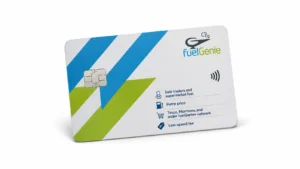
For a small business that mainly operates locally and has Tesco or Morrisons forecourts nearby, fuelGenie is one of the easiest options to understand.
The standard fuelGenie card charges the pump price rather than applying a separate weekly commercial fuel rate. It offers digital account management and VAT-supporting invoices, and individual drivers may continue collecting qualifying supermarket loyalty points when they use their own loyalty card.
It can also be used by businesses running only one vehicle, making it particularly relevant to tradespeople, contractors, delivery businesses and other small operators.
However, it is important to check the fees rather than assuming fuelGenie is completely free.
Current fuelGenie terms state that the standard account can attract a £3 + VAT monthly charge where monthly account spend is below £500.
Pros
- Suitable for businesses with only one vehicle
- Transparent pump-price model
- Supermarket fuel can be competitively priced
- Consolidated VAT information
- Online account management
- Loyalty points may still be collected at participating supermarkets
- No standard transaction charge on the core fuelGenie product
Cons
- Standard network is more restricted than very large multi-brand cards
- Low-spend fee can affect businesses buying little fuel
- Credit approval is required
- Wider fuelGenie+ access carries additional charges
- Not necessarily the best choice for drivers heavily dependent on motorway stations
The official fuelGenie pages should be checked immediately before publication or application because some of its pages currently display differing figures for fuelGenie+ fees. The latest application terms should therefore take priority over older marketing material.
Is Allstar One Better for Nationwide Coverage?
Allstar One is particularly attractive when drivers travel throughout the UK and cannot be restricted to one supermarket or branded network.
Allstar states that its One network covers roughly 90% of UK fuel sites, including major oil brands and supermarkets such as Tesco, Morrisons, Sainsbury’s and Asda. Its Discount Diesel network includes more than 1,600 participating locations.
That breadth reduces one of the hidden costs of using a restrictive fuel card: drivers having to leave their normal route simply to find an accepting forecourt.
Allstar also provides an online reporting platform and HMRC-compliant invoicing.

Pros
- Around 90% UK fuel-site coverage
- Major supermarkets and fuel brands included
- Strong choice for businesses travelling nationwide
- Discount Diesel locations
- Online reporting and card controls
- Consolidated HMRC-compliant invoices
- Cards can be allocated to a vehicle or individual driver
Cons
- Businesses need to examine the full fee schedule
- Other fees can apply depending on the product and account
- The largest network does not automatically mean the lowest fuel price
- Small local businesses may not need such extensive coverage
Allstar also offers Allstar Supermarket+, aimed more directly at businesses looking for supermarket fuel, while businesses gradually adding electric vehicles may consider its combined fuel and charging products.
Is The Fuel Store Card Good for Small Fleets?
The Fuel Store provides several different fuel-card products rather than forcing every customer into the same model.
Its main Fuel Store Card advertises access to more than 3,500 filling stations, including supermarkets, major fuel brands, motorway services and HGV locations. It also uses commercial fuel pricing and includes online management and HMRC-compliant invoicing.
That makes it particularly useful for businesses wanting a balance between broad coverage and more predictable commercial fuel pricing.
Pros
- More than 3,500 locations
- Cars, vans, HGVs and mixed fleets supported
- Broad supermarket and branded coverage
- Commercial fuel pricing
- Online fuel-spend monitoring
- HMRC-compliant invoices
- Additional fraud and fleet-management services available
Cons
- Exact pricing normally requires a quotation
- Commercial pricing should always be compared with actual local pump prices
- Add-on services can increase overall account cost
- Some small operators may not need its wider fleet-management functions
Small businesses should therefore compare the weekly card price against forecourt prices they would realistically pay without a card rather than assuming a commercial rate is automatically cheaper.
What Is the Best Fuel Card With No Credit Check?
For a new business, poor business credit history can create a problem because most traditional fuel cards are credit products.
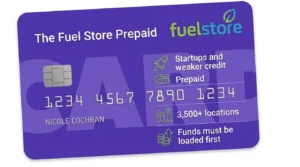
The Fuel Store Prepaid Fuel Card addresses this by requiring the business to load money before the driver spends it.
The provider states that no credit check is required and that its prepaid product can be used at more than 3,500 sites, including hundreds of HGV locations.
Pros
- No credit check
- Particularly suitable for startups and businesses with weak credit histories
- No fuel debt builds up
- Spending cannot exceed available funds
- Broad multi-brand network
- Online top-ups
- Fuel-spend tracking
- HMRC-compliant invoicing
Cons
- Money must be loaded before it can be spent
- Provides less short-term cash-flow flexibility than credit
- Businesses need to monitor the available balance
- Running out of prepaid funds could inconvenience a driver
This makes prepaid fuel cards especially useful where cost control is more important than obtaining additional working-capital flexibility.
Is WEX Esso a Good Fuel Card for Small Businesses?
WEX operates the Esso Card range in the UK.
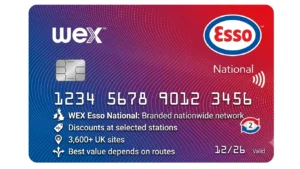
The Esso Card National currently advertises access to more than 3,600 UK filling stations, including partner sites, together with online reporting, HMRC-compliant invoices and discounts on qualifying Esso fuel.
Esso also allows drivers to collect Nectar points at participating Esso-branded service stations, giving it an additional attraction for drivers who already use the scheme.
Pros
- 3,600+ UK locations
- Esso, Shell and BP-branded locations included in the wider network
- Nectar points at participating Esso locations
- Detailed fuel reporting
- PIN security
- Vehicle or driver-level controls
- HMRC-compliant invoicing
- European option available
Cons
- Exact account pricing needs checking
- A brand-heavy network is not always cheaper than supermarket fuel
- European capabilities may be unnecessary for local operators
For companies with drivers regularly crossing borders, Esso Card Europe is considerably more relevant. WEX states that the European version gives access to over 13,300 sites in seven countries, including locations on major roads, ports and border routes.
Is Keyfuels Better for Businesses That Want Fixed Fuel Prices?
Keyfuels takes a more commercial fleet-oriented approach.
Its Pay As You Go option operates across more than 3,500 sites and uses a fixed weekly commercial fuel price based on factors such as fuel volume and services required.
This can be attractive to businesses that value predictability.
If diesel prices move during the week, the business knows the commercial rate it has agreed instead of dealing with a different forecourt price at every locations.

Pros
- Fixed weekly commercial price
- 3,500+ locations
- Easier fuel-cost forecasting
- Particularly useful for higher-mileage commercial fleets
- Suitable for businesses that want a centralised fuel strategy
Cons
- Less straightforward for an occasional one-vehicle user
- Fixed prices are not guaranteed to beat every local forecourt
- Pricing depends on volume and account requirements
- More fleet-focused than some supermarket cards
Keyfuels is therefore more likely to suit a growing commercial fleet than a sole trader buying only a few tanks each month.
Is BP Supercharge Good for Businesses That Need Maximum Flexibility?
BP Supercharge takes a different approach.
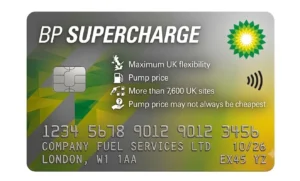
BP states that the card gives access to more than 7,600 UK locations, representing more than 90% of UK fuel sites, including major fuel brands, supermarkets and motorway locations. The card uses the forecourt pump price rather than restricting drivers to a narrow branded network.
Pros
- More than 7,600 UK locations
- More than 90% of UK fuel sites
- Major brands and supermarkets
- Strong option for travelling staff
- Straightforward pump-price model
- Useful as a backup card where network availability is critical
Cons
- Paying pump price does not automatically mean paying the cheapest price
- Motorway forecourts can be significantly more expensive
- Businesses should compare total account costs and terms
This is a good example of why coverage and savings should not be confused. A card accepted almost everywhere may offer excellent convenience while another card could deliver a lower price at a smaller number of locations.
Is Shell Card Worth Considering?
Shell Card is more relevant to businesses that want fuel payments, wider road services and potentially EV charging within the same mobility system.
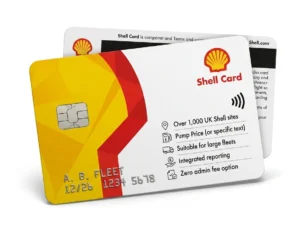
Shell describes its card as a combined solution for fuel, charging and other on-road purchases, with consolidated invoicing, account controls and fraud-management features.
The Fuel Store also distributes a Shell Fleet product in the UK and currently lists access to more than 3,800 sites together with Shell Go+ rewards.
Pros
- Strong branded fuel network
- Useful for mixed fuel and EV fleets
- Card-management controls
- Consolidated billing
- Loyalty/reward options on eligible products
- Useful for businesses operating internationally
Cons
- Pricing varies by agreement and product
- Small local businesses may not need its broader mobility features
- Large network convenience should still be compared against local supermarket pricing
Is The Right Fuel Card Company Still Worth Considering?
The Right Fuel Card Company should be understood differently from providers such as BP or fuelGenie.
It is a fuel-card reseller, rather than a single proprietary forecourt network, and is part of the Edenred group.
Its role is therefore more about matching businesses to suitable fuel-card arrangements and providing account support.
This can make it useful for an owner who does not want to research every network independently.
Pros
- Suitable for sole traders through to larger fleets
- Access to multiple fuel-card products
- More personalised comparison process
- Consolidated invoicing and fuel-management support
- Useful when the business is unsure which network it needs
Cons
- Businesses must compare the underlying card’s actual terms
- Fees and fuel prices can differ between recommended products
- It should not be treated as one single fuel-card network
A quote should always be checked against a direct application to the underlying card provider where possible.
How Does Fuel Card Pricing Work?
One of the biggest mistakes a business can make is comparing fuel cards only by their advertised fees.
The fuel-pricing model can have a much greater effect on total costs.
There are three common approaches.
Weekly Fixed or Commercial Pricing
With commercial pricing, the provider sets a fuel rate for a defined period, commonly one week.
The rate may be influenced by wholesale markets, expected volume and the card’s network.
Keyfuels explicitly uses a fixed weekly commercial price for its Pay As You Go model, while Radius also describes commercial pricing as a rate set independently of the local pump price.
This can make budgeting easier.
However, a weekly rate is not necessarily cheaper than every station in the country. A nearby supermarket could occasionally be below the card rate.
Pump-Price Fuel Cards
A pump-price card charges the amount displayed at the filling station.
fuelGenie and BP Supercharge are examples.
The main advantage is transparency: the driver can see exactly what the fuel costs before filling up.
The disadvantage is that the business remains exposed to local forecourt price differences.
Pump-Saver Pricing
Pump-saver cards use the station’s displayed price and then deduct an agreed number of pence per litre.
Radius, for example, describes Pump Saver as a fixed pence-per-litre discount off eligible forecourt prices.
This is easy to understand because the saving can be calculated directly against the price the driver sees.
Is a Credit or Prepaid Fuel Card Better?
Small businesses should also decide whether they actually want credit.
| Feature | Credit Fuel Card | Prepaid Fuel Card |
| Credit check | Usually yes | Usually no |
| Pay for fuel | Later | Before use |
| Cash-flow benefit | Higher | Lower |
| Overspending risk | Higher | Lower |
| Spending control | Good | Very strong |
| Suitable for poor credit | Less likely | Yes |
| Suitable for startups | Depends on credit | Often |
| Debt created | Potentially | No |
Credit cards can protect short-term working capital because fuel can be bought before the invoice is collected.
Prepaid cards do the opposite. Money leaves the business sooner, but overspending and credit exposure are reduced.
For a new startup with uncertain income, that control may be more valuable than a credit facility.
Who Can Apply for a Business Fuel Card?
A common misconception is that only VAT-registered businesses can apply for fuel cards.
That is not a universal rule.
Fuel cards are normally business products, but VAT registration and fuel-card eligibility are separate issues.
For example, fuelGenie says businesses can apply from just one vehicle upward. Limited-company applications are subject to business credit checks, while non-limited companies and sole traders can have the credit check carried out against the individual.
A provider may ask for:
- Business or trading name
- Business address
- Company registration information where applicable
- Director, partner or proprietor details
- Bank account information
- Number of vehicles
- Estimated monthly fuel spend
- Expected monthly litres
- Vehicle types
- Credit information
Businesses with little trading history or poor credit may have fewer credit-card options, which is where prepaid products become useful.
Does a Business Need to Be VAT Registered to Get a Fuel Card?
No, not necessarily.
A sole trader or limited company can potentially obtain a fuel card even if it is below the VAT-registration threshold.
VAT registration instead determines whether the business is able to reclaim eligible VAT.
Businesses approaching the threshold can read more about becoming VAT registered in the UK.
Can a Business Reclaim VAT on Fuel Card Spending?
A fuel card can make VAT administration easier, but it does not automatically make every litre of fuel reclaimable.
HMRC states that VAT-registered businesses can reclaim VAT on eligible business expenditure, provided they have appropriate records and valid VAT invoices. Where an expense has both business and personal use, normally only the appropriate business element can be reclaimed unless another permitted VAT treatment applies.
For vehicle fuel, HMRC provides several possible treatments.
If a vehicle is used entirely for business purposes, the business may be able to reclaim the VAT on the fuel.
Where the vehicle is also used privately, the business may instead:
- reclaim all VAT and account for the appropriate fuel scale charge;
- reclaim only VAT relating to business journeys and maintain the required mileage records; or
- choose not to reclaim VAT on fuel.
The detailed HMRC rules are available in the official VAT guidance for business fuel expenses.
HMRC also provides specific guidance on fuel bought by employees and the records required to support VAT recovery.
That is why HMRC-compliant consolidated invoicing is a genuine benefit of fuel cards. Instead of collecting dozens of forecourt receipts from drivers, the business may receive a detailed central invoice.
For sole traders looking at fuel alongside other deductible costs, the site’s explanation of allowable self-employed business expenses is closely related.
Businesses operating vans can also compare fuel-card administration with the tax treatment of self-employed van expenses and mileage.
Can Drivers Still Earn Tesco, Nectar or Other Loyalty Points?
Sometimes.
Fuel cards and retailer loyalty schemes are not always mutually exclusive.
fuelGenie says drivers can collect reward points using their own supermarket loyalty cards at participating locations. Its network relationships include Tesco and Morrisons, with wider locations available through fuelGenie+.
Esso Card also advertises Nectar-point collection at eligible Esso-branded stations.
Depending on the card and filling station, this can mean access to schemes such as:
- Tesco Clubcard
- Morrisons More
- Sainsbury’s Nectar
- Nectar at participating Esso stations
- Shell Go+ on eligible Shell products
However, businesses should check the individual card and loyalty terms before treating points as a guaranteed benefit.
Loyalty rewards should also remain secondary to the underlying fuel price. Saving several pence per litre is normally worth considerably more than choosing an expensive station simply to earn points.
Are Supermarket Fuel Cards Cheaper Than Motorway Fuel Cards?
Location can matter just as much as the card.
The Competition and Markets Authority reported in 2026 that supermarkets remained the cheapest type of fuel retailer on average, while motorway service stations were the most expensive.
Its analysis found substantial differences between motorway and non-motorway fuel prices during parts of 2026.
This has an important practical consequence for businesses.
Imagine that one card provides extensive motorway coverage while another encourages employees to use supermarkets close to their routes. Even if the motorway card sounds more convenient, the overall fuel bill could still be higher.
Businesses should therefore consider:
Network coverage + actual fuel price + route deviation = real cost
The CMA’s road fuel monitoring information also reinforces why businesses should compare local prices rather than assuming every station in a card network costs the same.
How Should a Small Business Choose a Fuel Card?
A practical fuel-card comparison should consider at least six factors.
Where Do Drivers Actually Travel?
A business operating exclusively around one town may not need 7,000 filling stations.
Map regular routes first.
Look at where drivers:
- start work
- finish work
- visit customers
- use motorways
- cross borders
- stay overnight.
Then compare the accepting network.
What Is the Real Fuel Price?
Do not judge the card only by its monthly fee.
Compare:
- weekly commercial rate
- pump price
- pump discount
- local supermarket prices
- motorway pricing
- petrol and diesel separately.
A “free” card with expensive fuel may cost considerably more than a card carrying a modest account fee.
What Other Fees Apply?
Ask for a complete fee schedule.
Possible charges can include:
- card fees
- account fee
- low-use fees
- replacement-card fees
- paper invoice charges
- failed Direct Debit fees
- network charges
- transaction charges
- account-change charges.
The cost should be calculated across an entire year.
How Long Is the Credit Period?
Credit terms influence cash flow.
A company buying thousands of pounds of diesel each month may benefit significantly from delaying payment until after customer invoices have been collected.
A sole trader spending £200 per month may care far less.
How Good Are the Management Tools?
Useful functionality can include:
- card freezing
- per-driver limits
- per-vehicle limits
- fuel-type restrictions
- mileage capture
- transaction alerts
- unusual-activity detection
- online invoices
- driver reporting
- fuel-efficiency analysis.
These features become increasingly valuable as the number of vehicles increases.
Does the Card Produce Suitable VAT Records?
A small business should check whether the card provides detailed VAT documentation rather than simply saying it offers “online invoices”.
The invoice should make bookkeeping and VAT reconciliation easier.
Which Fuel Card Is Best for Different Types of Small Business?
The answer becomes clearer when the cards are segmented by actual use case.
| Business Type | Strong Option to Compare |
| Sole trader with one van | fuelGenie |
| New startup | Fuel Store Prepaid |
| Poor or limited credit history | Fuel Store Prepaid |
| Nationwide service business | Allstar One |
| Business wanting supermarket fuel | fuelGenie / Allstar Supermarket+ |
| Business wanting loyalty rewards | fuelGenie / Esso |
| High-mileage commercial fleet | Keyfuels |
| Business wanting fixed weekly pricing | Keyfuels / Fuel Store |
| Drivers frequently using different brands | BP Supercharge / Allstar One |
| UK and European travel | WEX Esso Europe |
| Mixed fuel and EV fleet | Shell Card / Allstar combined products |
| HGV-focused fleet | Keyfuels / Fuel Store / specialist BP options |
| Business wanting guided card comparison | Right Fuel Card |
These are starting points rather than automatic recommendations. The best card should still be tested against the business’s actual locations and fuel volumes.
How Much Could a Small Business Save With a Fuel Card?
Rather than relying on headline advertising, businesses can estimate potential savings themselves.
Use:
Annual savings = annual litres × saving per litre − annual card/account fees
For example, suppose a business buys 1,000 litres per month.
Annual consumption would be:
1,000 × 12 = 12,000 litres
If the effective saving were 5p per litre:
12,000 × £0.05 = £600
If card and account costs totalled £100 per year:
£600 − £100 = £500 estimated net annual saving
A simple comparison table shows how fuel volume changes the result:
| Monthly Fuel Use | 3p/L Saving | 5p/L Saving | 8p/L Saving |
| 500 litres | £180/year | £300/year | £480/year |
| 1,000 litres | £360/year | £600/year | £960/year |
| 2,000 litres | £720/year | £1,200/year | £1,920/year |
These figures are illustrations rather than guaranteed savings.
Businesses should enter the real difference between the card price and the price they would otherwise have paid, rather than the largest advertised discount.
What Are the Biggest Fuel Card Mistakes to Avoid?
The first is choosing a card because it advertises the largest network.
Coverage is only useful when those stations are close to the routes employees actually drive.
Another mistake is looking only at the headline fee.
A card charging no monthly fee could still be expensive if the fuel pricing model is poor. Conversely, paying a small fee may be worthwhile if the business consistently saves several pence per litre.
Businesses should also avoid:
- assuming commercial prices always beat supermarket pump prices
- ignoring non-usage or replacement-card fees
- giving every employee unrestricted card access
- failing to cancel cards immediately when employees leave
- assuming all private fuel can be reclaimed for VAT
- choosing motorway stations purely for convenience
- ignoring prepaid cards because they do not provide credit
- comparing diesel rates but forgetting petrol
- failing to re-shop the fuel-card account each year.
A fuel card should be treated like insurance or a business energy contract: it needs periodic comparison rather than being left unchanged indefinitely.
Should Diesel Advance Be Included in the Comparison?
Older and third-party fuel-card lists sometimes refer to products such as a Diesel Advance Prepaid Card.
However, a sufficiently clear, current official product page and up-to-date pricing structure could not be verified during this September 2026 review.
For that reason, it is better not to rank it alongside currently verifiable products using potentially outdated information.
That approach is preferable to repeating a fee, network size or eligibility requirement that may no longer apply.
Is a Fuel Card Worth It for a Sole Trader?
It can be.
A sole trader does not need a fleet of 20 vans to benefit from a fuel card.
A one-vehicle business could gain from:
- simpler expense records
- fewer paper receipts
- clearer fuel budgeting
- easier VAT records where VAT registered
- spending restrictions
- fuel-price savings
- loyalty points on eligible schemes.
However, the numbers still need to make sense.
If a sole trader spends only £100 per month on fuel and the card introduces monthly account fees, the administrative convenience may be greater than the actual cash saving.
Is a Fuel Card Worth It for a Small Business?
For a business with regular vehicle expenditure, a fuel card can be worthwhile when it reduces the combined cost of fuel, administration and uncontrolled employee spending.
The mistake is thinking that a fuel card is automatically a discount card.
Some products are primarily about saving money. Others are about network access, reporting, VAT administration, credit or spending control.
For a supermarket-focused sole trader, fuelGenie may be a strong starting point. A company with drivers operating throughout Britain may find Allstar One or BP Supercharge more practical.
A startup unable to obtain fuel credit can consider The Fuel Store’s prepaid option, while European fleets have stronger reasons to look at WEX Esso Europe.
The final decision should be based on the business’s own litres, routes and fees.
Before signing up, compare at least three quotations and ask each provider for:
- The exact pricing model
- Current fuel rate or discount
- Full card and account fees
- Credit terms
- Accepting stations near regular routes
- Replacement-card charges
- Non-use charges
- VAT invoice arrangements
- Card-control functionality
- Contract and cancellation terms
That comparison will reveal the best fuel card for the small business itself, rather than simply the card with the strongest marketing claim.
FAQs About the Best Fuel Cards for Small Businesses
What is the best fuel card for a sole trader?
fuelGenie is worth comparing for sole traders because businesses can apply with one vehicle and it offers supermarket-focused pump pricing. The Fuel Store Prepaid Card is another option where credit approval is an issue.
Can a new business get a fuel card?
Yes. Approval depends on the provider. Traditional credit fuel cards may require credit checks, while prepaid fuel cards can be available without one.
Can a business get a fuel card without being VAT registered?
Yes. VAT registration is not a universal requirement for obtaining a business fuel card. It mainly affects whether the business can reclaim eligible VAT.
What is the best fuel card with no credit check?
The Fuel Store currently offers a prepaid business fuel card that does not require a credit check.
Which fuel card has the widest UK coverage?
Allstar One and BP Supercharge are among the broadest options reviewed here, both advertising access to around 90% or more of UK fuel locations.
Which fuel card is best for supermarket fuel?
fuelGenie is particularly focused on supermarket filling stations, while Allstar also includes major supermarket chains within its network.
Do fuel cards always save money?
No. Savings depend on fuel prices, card fees, network availability and the business’s usual forecourts. Businesses should calculate the total annual cost rather than relying on headline discounts.
Can fuel cards be used for petrol as well as diesel?
Many can, but the products and pricing can differ. Businesses should confirm whether petrol, diesel, premium fuels, AdBlue and other products are permitted before applying.
Can employees earn loyalty points when using a fuel card?
Some cards allow it. fuelGenie supports qualifying supermarket loyalty points, while Esso Card can support Nectar points at participating Esso locations.
Can VAT be reclaimed from fuel-card purchases?
VAT-registered businesses may be able to reclaim VAT relating to eligible business fuel, but HMRC rules on private use, mileage records and fuel scale charges still apply.

Blogger & Content creator | An insightful writer sharing practical advice for UK entrepreneurs
Related Articles in Startup News
View All →
Former Zego Head of Search Tom Riley Leaves to Launch His Own Agency, HAKKEN
Tom Riley, the former head of search at insurtech unicorn Zego and widely rated as one of the UK’s top SEOs in his sector, has left the company…

What Makes Leeds a Great UK Startup Hub?
Leeds might not be the official county town of Yorkshire, but perhaps it should be. It’s the largest economy in the Northern Powerhouse, and in fact the largest…

HMRC Late Payment Interest Rates 2025: How Much It Is?
Are you running a startup and wondering why your tax bill seems higher than expected? Have you received an HMRC statement with unexpected interest added or credited? Whether…