
Buying Property Through A Limited Company: 2026 Guide


UK Startup Blog Archive
Table of Contents
Buying property through a limited company has become an established option for UK landlords and property investors, particularly those planning to build portfolios or reinvest rental profits.
Instead of the individual owning the property, the limited company becomes the legal owner. The company pays the deposit, takes out the mortgage, receives the rental income, pays property expenses and accounts for tax on its profits.
The structure can offer advantages, particularly around mortgage interest and retaining profits for future investment.
However, company ownership can also mean higher borrowing costs, additional administration, property purchase taxes and further tax when profits are withdrawn personally.
The rules affecting landlords and companies have also changed significantly by 2026, making it increasingly important to look beyond Corporation Tax alone when deciding whether company ownership is worthwhile.
How Does Buying Property Through A Limited Company Work?
A limited company is legally separate from its directors and shareholders. This means the company can own property, borrow money, enter contracts and receive rental income in its own name.
When a property is bought through a limited company:
- The Company Is Named As The Buyer
- The Property Is Registered In The Company’s Name
- The Company Provides The Deposit
- The Mortgage Is Usually Issued To The Company
- Rental Income Belongs To The Company
- Property Expenses Are Paid By The Company
- The Company Pays Corporation Tax On Its Taxable Profits
- Directors Or Shareholders Must Use An Appropriate Method To Withdraw Money
Many property investors use a special purpose vehicle, commonly known as an SPV. This is usually a limited company established primarily for property investment activities.
Common SIC codes used by property companies include 68100 for buying and selling own real estate and 68209 for other letting and operating of own or leased real estate.
An existing trading company can sometimes purchase property, but combining property investment with another business can create additional risks. If the trading business encounters financial difficulties, property held within the same company may also be exposed.
For this reason, investors planning a dedicated buy-to-let portfolio often consider keeping property activities within a separate company.
Should You Buy Property Personally Or Through A Limited Company?
Neither structure is automatically better.
Buying personally can be simpler and may provide access to a wider range of mortgage products. Buying through a company can become more attractive where profits will remain within the business and be reinvested.
The main differences include:
| Factor | Personal Ownership | Limited Company |
| Legal Owner | Individual | Company |
| Rental Income | Belongs To Individual | Belongs To Company |
| Tax On Rental Profit | Income Tax Rules Apply | Corporation Tax Applies |
| Mortgage Interest | Residential Finance Cost Rules Apply | Qualifying Interest Can Generally Be Deducted |
| Mortgage Availability | Usually Wider | Specialist Company Products |
| Administration | Generally Lower | Company Accounts And Filings Required |
| Taking Profits | Directly Available To Owner | Must Be Withdrawn Properly |
| Reinvesting Profits | After Personal Tax | Profits Can Remain In Company |
| Selling Property | CGT May Apply | Gain Normally Falls Within Corporation Tax |
A higher-rate taxpayer with several mortgaged properties may find the company structure more attractive than an investor buying one property without significant borrowing.
However, the headline Corporation Tax rate should never be considered in isolation.
If all rental profits are withdrawn as dividends, the shareholder may have personal dividend tax to pay after the company has already paid Corporation Tax.
Company mortgage rates, accountancy costs and purchase taxes must also be included in the comparison.
The structure can therefore be more attractive for someone who intends to retain profits to fund future deposits than for someone who needs all rental income for personal spending.
How To Buy Property Through A Limited Company?
The ownership structure should ideally be decided before an offer is made.
Changing the buyer from an individual to a company halfway through a transaction can result in new mortgage checks, revised legal documents and delays.
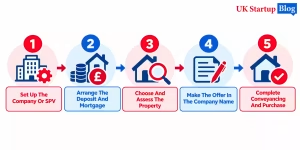
1. Set Up The Company Or SPV
The first step is normally to create the company that will purchase the property.
The company will require:
- A Company Name
- A Registered Office
- At Least One Director
- At Least One Shareholder
- Details Of People With Significant Control
- Appropriate Articles Of Association
- Suitable SIC Codes
- A Registered Email Address
In 2026, Companies House identity verification is also an important part of company compliance. Compulsory identity verification for directors and people with significant control started on 18 November 2025, with transitional requirements continuing through 2026.
The structure should be established early enough for banking, mortgage and legal checks to be completed before the property transaction progresses too far.
2. Arrange The Deposit And Mortgage
A company can receive its deposit funding from several sources.
These may include:
- Director’s Loans
- Shareholder Funding
- Share Capital
- Retained Company Profits
- Joint Venture Funding
- Bridging Finance
- Property Development Finance
A director’s loan is commonly used where an investor is funding the deposit from personal savings. The money is lent to the company and recorded through the director’s loan account.
The source of funds needs to be clear because mortgage lenders, solicitors and banks may request evidence as part of anti-money-laundering and affordability checks.
Most company buy-to-let purchases also require a specialist limited company mortgage rather than an ordinary residential mortgage.
Lenders may consider:
- Deposit Size
- Expected Rental Income
- Rental Coverage
- Property Value
- Director Credit History
- Existing Borrowing
- Landlord Experience
- Company Structure
- Property Type
- Portfolio Size
Many lenders also require directors to provide personal guarantees. Limited company ownership therefore does not necessarily remove an investor’s personal financial exposure to the mortgage.
3. Choose And Assess The Property
A company purchase should be assessed as an investment rather than simply looking at the asking price.
Important calculations include:
| Calculation | Purpose |
| Gross Rental Yield | Compares Annual Rent With Purchase Price |
| Net Rental Yield | Measures Return After Operating Expenses |
| Monthly Cash Flow | Shows Cash Remaining After Regular Costs |
| Loan-To-Value | Measures Mortgage Against Property Value |
| Interest Coverage | Tests Whether Rent Covers Finance Costs |
| Return On Cash Invested | Measures Profit Against Cash Invested |
The calculation should account for mortgage costs, insurance, maintenance, letting fees, service charges, void periods, licensing requirements, accountancy costs and potential repairs.
Investors should also investigate local rental demand, comparable rents, tenant demographics, transport, employment, licensing schemes and competing rental stock.
A property with an attractive headline yield may perform poorly once financing, maintenance and periods without tenants are included.
4. Make The Offer In The Company Name
The company should normally be identified as the purchaser when the offer is submitted.
The estate agent may request:
- Company Name
- Company Number
- Proof Of Deposit
- Mortgage Position
- Director Details
- Solicitor Details
Submitting an offer personally and attempting to substitute the limited company later can cause problems because the company is legally a different buyer.
This is particularly important when buying at auction because contracts may become legally binding immediately after a successful bid.
5. Complete Conveyancing And Purchase
A solicitor experienced with company property transactions should carry out the legal work.
Checks may include:
- Property Title
- Restrictive Covenants
- Lease Conditions
- Planning Matters
- Building Regulations
- Service Charges
- Existing Tenancies
- Property Licensing
- Rights Of Access
- Mortgage Conditions
The lender will normally arrange a valuation, although investors may also want an independent survey to identify structural or maintenance problems.
Once the legal checks, funding and mortgage offer are ready, contracts can be exchanged.
At completion, the remaining purchase funds are transferred, ownership passes to the company and the solicitor deals with property registration and the relevant transaction tax.
How Have Property Laws Changed In 2026?
Several changes affect property companies and landlords in 2026. Some relate directly to running the company, while others affect what happens after an investment property is let.
Companies House Identity Verification
Identity verification became compulsory for company directors and people with significant control from 18 November 2025.
The change forms part of reforms intended to improve the accuracy of company records and make it harder to use UK companies for fraudulent purposes.
Property investors forming an SPV in 2026 therefore need to consider identity verification alongside the traditional company formation requirements.
Existing companies have also been moving through the transitional verification process, meaning property investors should not assume that historic company appointments require no further action.
Renters’ Rights Act Changes
Major parts of the Renters’ Rights Act came into force in England on 1 May 2026.
One of the most significant changes was the abolition of Section 21 no-fault eviction for affected private rented sector tenancies.
The reforms also moved most private assured tenancies towards an assured periodic tenancy model rather than the previous system of fixed-term assured shorthold tenancies.
These changes affect limited company landlords in the same way as other private landlords. Owning the property through a company does not create an exemption from residential tenancy law.
Changes To Tenancies And Landlord Responsibilities
The 2026 reforms changed several areas of day-to-day property management in England.
Key changes include:
- Section 21 No-Fault Evictions Have Been Abolished
- Most Private Assured Tenancies Operate As Periodic Tenancies
- Rent Increases Are Generally Limited To Once A Year
- Landlords Must Follow The Required Procedure For Rent Increases
- Rental Bidding Above The Advertised Rent Is Prohibited
- Initial Rent In Advance Is Restricted
- Discrimination Against Applicants With Children Or Receiving Benefits Is Prohibited
- Pet Requests Must Be Reasonably Considered
These rules make property management and tenant procedures an increasingly important part of investment planning.
Investors should therefore consider legal compliance costs and management responsibilities before purchasing rather than treating them as an issue to deal with after completion.
The Renters’ Rights Act changes discussed here apply to England. Scotland, Wales and Northern Ireland operate different housing and tenancy systems.
What Taxes Apply When A Limited Company Buys Property?
Tax is one of the main reasons investors consider company ownership, but it is also one of the areas where oversimplified comparisons can cause expensive mistakes.
The total position should include tax when purchasing, tax during ownership, tax when withdrawing profits and tax when eventually selling.
Stamp Duty Land Tax
A limited company buying residential property in England or Northern Ireland will normally be subject to the higher residential SDLT rates where the relevant conditions are met.
Companies purchasing residential properties costing more than £500,000 can also potentially fall within the special 17% corporate SDLT regime.
However, relief can be available for certain qualifying commercial property rental, development and trading activities.
Investors should therefore not assume that every company purchase above £500,000 automatically produces the same SDLT result.
Scotland uses Land and Buildings Transaction Tax and Wales uses Land Transaction Tax, so investors purchasing outside England or Northern Ireland need to calculate the relevant local property transaction tax instead.
Purchase tax should be calculated before making an offer because it affects the total cash required to complete the transaction.
Corporation Tax And Mortgage Interest
A limited company normally pays Corporation Tax on its taxable property profits.
For the 2026 financial year, qualifying companies with profits of £50,000 or less can fall within the 19% small profits rate.
The main Corporation Tax rate is 25% for profits above £250,000, with Marginal Relief potentially applying between those levels.
The thresholds can be reduced where companies are associated with other companies.
One important difference between company and personal ownership is mortgage interest.
A company paying Corporation Tax can generally claim qualifying interest on property loans as an allowable business expense when calculating taxable property profits.
An individual residential landlord is subject to different finance cost rules.
This difference can be particularly important for highly leveraged investors, although mortgage interest deductibility should not be treated as proof that a company is automatically the cheaper structure overall.
Tax On Taking Profits Out Of The Company
Rental income received by the company belongs to the company.
After Corporation Tax has been considered, shareholders cannot simply treat the remaining company cash as personal money.
Common ways of accessing money include:
- Dividends
- Salary
- Director’s Loan Repayments
- Reimbursement Of Genuine Business Expenses
Dividends are particularly important when comparing company and personal ownership.
For the 2026/27 tax year, the ordinary dividend rate is 10.75%, the upper dividend rate is 35.75% and the additional dividend rate remains 39.35%. The dividend allowance remains £500.
This creates a potential second layer of tax where company profits are paid out to shareholders.
By contrast, an investor who leaves profits inside the company may be able to use the retained cash towards future property purchases without first withdrawing all of it personally.
This is why the investor’s long-term plan matters as much as the Corporation Tax rate.
Can You Transfer An Existing Property Into A Limited Company?
Moving an existing personally owned buy-to-let into a company is not normally a simple change of name.
The individual and the company are separate legal persons. In many cases, the company effectively acquires the property from the existing owner.
Potential costs can include:
- Capital Gains Tax
- SDLT, LBTT Or LTT
- Mortgage Early Repayment Charges
- New Company Mortgage Fees
- Property Valuation Costs
- Conveyancing Fees
- Accountancy And Tax Advice
- Changes To Tenancy Documentation
The transfer may also require the existing personal mortgage to be replaced with a company mortgage.
Incorporation Relief can potentially apply where the legal conditions are met when a genuine business is transferred to a company in exchange for shares.
However, owning rental properties does not automatically mean every landlord qualifies.
Transferring property after it has increased substantially in value can therefore be expensive.
Investors who already know they intend to build a company-owned portfolio should compare structures before buying the first property rather than assuming properties can be moved into a company cheaply later.
What Happens When The Company Sells The Property?
When a company sells property for more than its allowable cost, the resulting gain will generally form part of the company’s Corporation Tax calculation.
Allowable acquisition costs, qualifying capital expenditure and disposal costs can affect the taxable gain.
The important distinction is that the money received from the sale belongs to the company.
For example, selling a £400,000 company property does not mean the shareholder personally receives £400,000.
The company may first need to:
- Repay The Outstanding Mortgage
- Pay Selling Costs
- Account For Corporation Tax
- Settle Other Company Liabilities
If the shareholder then wants the remaining cash personally, further tax consequences can arise depending on how the money is extracted.
This makes the eventual exit strategy particularly important.
Property investors should consider not only how they will buy and operate the property but also what they expect to do with the sale proceeds years later.

What Are The Main Risks And Costs?
Buying through a limited company can provide benefits, but it also creates costs and responsibilities that do not disappear simply because the company is separate from its owner.
One major risk is focusing only on tax rates.
A 19% or 25% Corporation Tax rate can appear attractive compared with an individual’s higher Income Tax rate, but the full calculation may also include dividend tax, mortgage pricing and company administration.
Other risks include:
- Higher Mortgage Interest Rates
- Larger Deposit Requirements
- Specialist Mortgage Fees
- Personal Guarantees
- Accountancy Costs
- Company Filing Responsibilities
- Higher Property Purchase Taxes
- Tenant Compliance Costs
- Property Licensing Requirements
- Tax On Extracting Company Profits
- Costs When Transferring Or Selling Property
Cash flow also needs careful management.
A profitable rental property can still create financial pressure if several tenants leave at once, major repairs are required or interest costs rise.
Company owners should therefore maintain suitable cash reserves rather than investing every available pound into additional deposits.
Another risk is mixing personal and company finances. Rent should normally be paid to the company and genuine company expenses should be recorded through the company’s accounts.
Using the company bank account as a personal spending account can create accounting and tax problems.
Is Buying Property Through A Limited Company Worth It In 2026?
Buying through a limited company can be worth considering for investors who plan to build larger portfolios, use significant mortgage finance and reinvest profits into additional properties.
It may also suit investors who do not need to withdraw all rental profits personally each year.
The case for company ownership can be less convincing where someone is buying a single property, intends to use most of the rental profit personally or can obtain substantially cheaper borrowing through personal ownership.
A useful way to compare the options is to consider the complete investment lifecycle.
| Stage | Costs To Consider |
| Purchase | Deposit, Property Tax, Legal Fees And Mortgage Costs |
| Ownership | Interest, Maintenance, Insurance, Compliance And Tax |
| Profit Withdrawal | Dividend, Salary Or Other Extraction Taxes |
| Sale | Corporation Tax, Selling Fees And Mortgage Charges |
| Final Exit | Cost Of Removing Remaining Money Or Property From The Company |
The tax environment also continues to change.
From April 2027, separate property Income Tax rates of 22%, 42% and 47% are scheduled to apply to relevant property income in England, Wales and Northern Ireland under the new property income framework.
That could make the personal-versus-company calculation increasingly important for some landlords, particularly higher-rate taxpayers.
It does not mean limited company ownership will automatically become the best structure because company profits can still face tax when eventually extracted.
The most suitable structure depends on the purchase price, borrowing, expected rental income, other personal income, portfolio plans and how the investor intends to use the profits.
FAQs
Can A New Limited Company Buy Property?
Yes. A newly formed company can buy property, although lenders may assess the directors’ credit history, income, deposit and experience.
How Much Deposit Does A Limited Company Need?
Deposit requirements vary, but many limited company buy-to-let mortgages require around 20% to 25% or more depending on the lender and property.
Do Limited Companies Pay More Stamp Duty?
In many cases, yes. Companies buying residential property usually pay the higher SDLT rates, with additional rules applying to certain high-value purchases.
Can A Limited Company Deduct Mortgage Interest?
Yes. Qualifying mortgage interest can generally be deducted as a business expense when calculating the company’s taxable property profit.
Is An SPV Better For Buying Property?
An SPV is often preferred for property investment because its activities are focused on property and many specialist lenders are familiar with this structure.
Can I Transfer My Existing Buy-To-Let Into A Company?
Yes, but the transfer can trigger Capital Gains Tax, SDLT or other transaction taxes, refinancing costs and conveyancing fees.
Can I Live In A Property Owned By My Limited Company?
It is possible, but personal occupation can create tax, mortgage and benefit-in-kind issues, so company ownership is usually more suitable for investment property.

Startup mentor & Blogger | Sharing leadership tips for UK business owners
Related Articles in How To Invest
View All →
Can You Buy Bitcoin With Chime in 2026?
As cryptocurrency becomes increasingly integrated into everyday finance, many people are exploring alternative banking services to fund digital asset purchases. One question that continues appearing in 2026 is…

Is It Wise to Invest in a Second Hand Mini Bus?
Many organisations and businesses, from churches and community organisations to senior centres and day-care facilities, require a convenient form of transport for their clients and/or members. A minibus…

How to Invest in Sustainable Companies? | Smart Green Choices!
Welcome to our guide on investing in sustainable companies! In today’s world, where environmental sustainability and social responsibility are crucial, investing in companies that prioritize these values has…