
What Makes Digital Business Cards Relevant in 2026?

UK Startup Blog Archive
Table of Contents
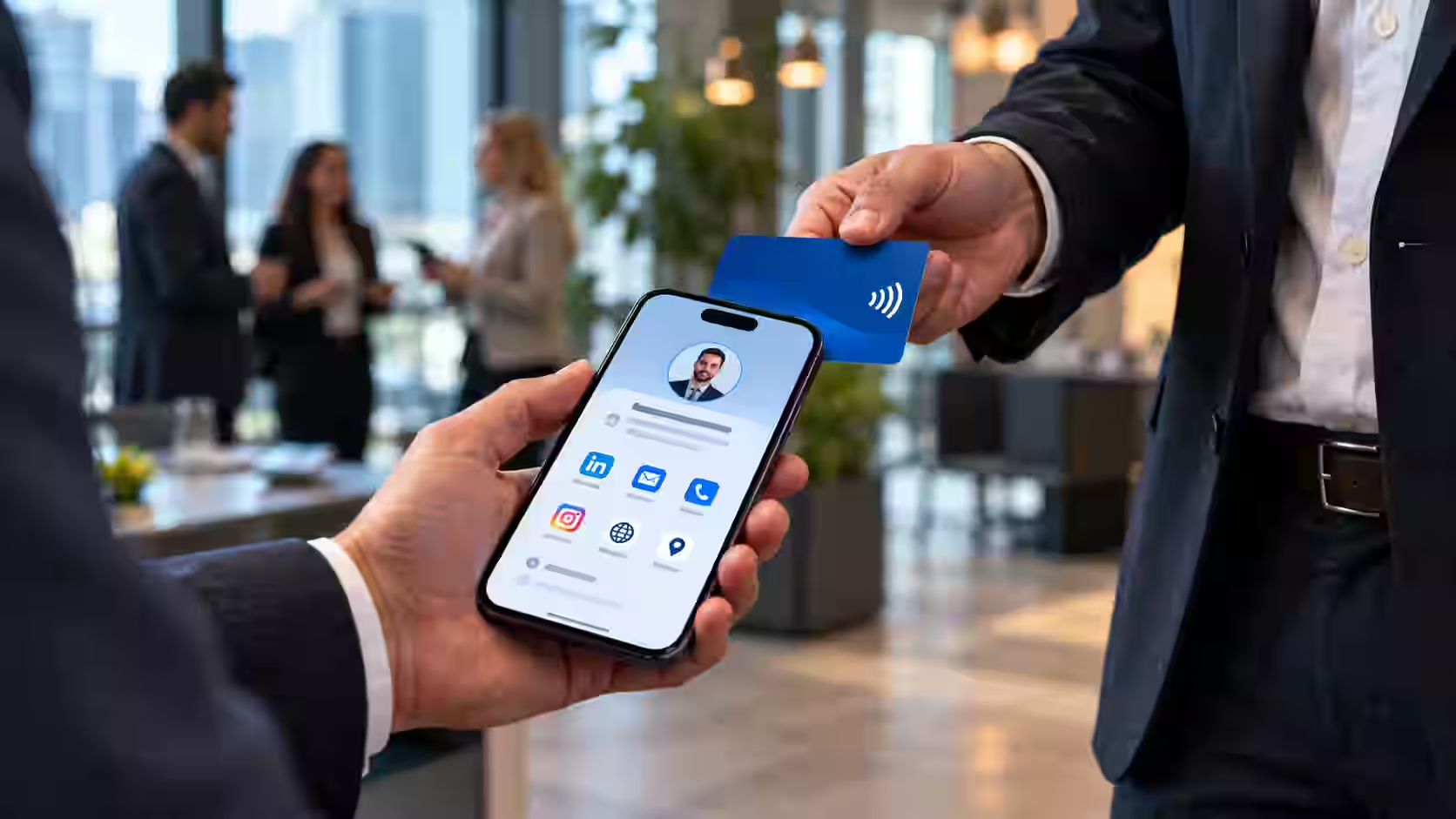
A digital business card is a flexible professional profile that can combine contact details, company information, social links, QR codes, NFC sharing and other useful resources in one place.
Unlike a printed card, the details can usually be updated without reprinting, making it useful for founders, employees and growing businesses.
It can also support a consistent professional identity as companies build a stronger brand across online and offline interactions.
Its biggest advantage is convenience. A single scan, tap or link can give someone access to your latest contact information, website and professional profiles, helping turn a brief introduction into a connection that is easier to save and follow up.
Why Do You Still Need a Business Card in 2026?
The technology has changed, but the fundamental networking problem has not. When you meet somebody useful, you still need an easy way for that person to remember who you are and contact you later.
A business card gives the conversation somewhere to go next.
For someone who is learning how to start a business in the UK, a digital card can become part of the basic professional setup alongside a business email address, website, social profile and other customer-facing material.
The strongest reasons for keeping a business card in 2026 include:
- Faster Sharing: A QR scan or NFC tap can open your contact information within seconds.
- Easier Updating: Contact information can usually be changed without producing another physical card.
- Professional Presentation: A structured profile can make an early-stage business look more established.
- More Information: A digital card can contain links that would never fit comfortably on a printed card.
- Lead Capture: Some platforms let the person you meet share their information with you.
- Follow-Up: CRM and automation tools can help move a conversation into an organised sales process.
- Event Networking: A single reusable card can be carried to conferences, exhibitions and meetings.
- Measurability: Some platforms provide data on card views, scans, contacts and engagement.
Physical presentation should not be dismissed either. Small details such as signage, branded materials, name badges and other low-cost physical touches that make a business look established can influence first impressions at networking events.
An NFC card effectively combines that physical impression with a digital destination.
Networking can also lead to much more than immediate sales. It can create relationships with potential partners, advisers and investors.
The role of networking is already important when founders explore creative solutions for funding new ventures, where personal connections can help open doors that online outreach alone may not.
The same applies when founders are trying to get investors for a business.
A digital card will not secure investment by itself, but making it easy for someone to save your details, visit your website and reconnect after an initial conversation can remove unnecessary friction.
Are Business Cards Becoming More or Less Popular?
The answer depends on whether we are talking about traditional paper cards or digital cards.
Available evidence suggests the use of traditional physical business cards has weakened, while digital alternatives are growing.
An Ipsos survey of 1,089 adults aged 16 to 75 in Great Britain, conducted in January 2024, found that only 23% had ever handed out a physical business card.
Among those who had used physical cards, only 23% had done so during the previous year, while 52% said they had stopped more than four years earlier.
Interestingly, Ipsos did not find that younger people had completely rejected the concept.
Among 16 to 34-year-old business card users surveyed, 47% said they were likely to use physical business cards in two years, compared with 10% among those aged 55 to 75.
Ipsos also found that 20% of adults were interested in digital business cards, rising to 37% among 16 to 34-year-olds.
That suggests the business card may be changing rather than disappearing.
The commercial market for digital cards points in the same direction.
Mordor Intelligence estimates the global digital business card market at $217.04 million in 2026, rising to an estimated $331.78 million by 2031.
That represents a projected compound annual growth rate of 8.86%. It also reports that SMEs accounted for 38.51% of the market in 2025.
Freemium digital card services are projected by the same research to grow particularly quickly, with a forecast CAGR of 10.66% between 2026 and 2031.
There is no single authoritative statistic showing exactly how many UK professionals personally possess a business card in October 2026.
However, the available evidence supports a clear broader pattern:
- Paper Use: Traditional card use has declined among many professionals.
- Digital Interest: Digital alternatives have gained interest, particularly among younger professionals.
- Market Growth: Commercial spending on digital business card platforms is forecast to continue increasing.
- Hybrid Use: NFC cards are combining a physical object with a continuously updateable digital profile.
For many professionals, therefore, the choice is no longer simply “business card or no business card”. It is increasingly a choice between paper, digital-only, NFC or a combination of these formats.
Are Digital Business Cards Useful in the Age of AI?
Yes. AI can automate emails, meeting notes, lead research and follow-ups, but it does not replace the initial human connection made through meetings, referrals, conferences or networking events.
Digital business cards can connect that first interaction with the tools used afterwards.
Platforms such as V1CE, Blinq and Popl now include AI-powered features such as contact enrichment, meeting notes, suggested follow-ups and CRM integration.
The process can move from a simple exchange of contact details to Meet → Share → Capture → Enrich → Follow Up.
This can be especially useful for founders, consultants and agency owners starting a digital marketing agency, where building and following up with new connections is an important part of business growth.
AI therefore does not make business cards unnecessary. Instead, it can make the information collected through them easier to organise, understand and act on.
Top 10 Digital Business Cards In The UK For 2026
The following shortlist considers publicly available features, pricing, sharing methods and business use cases available in October 2026.
It should not be treated as a claim that every platform has been personally tested by UK Startup Blog. Pricing and features can change, so businesses should confirm current terms before purchasing.
1. V1CE
V1CE is particularly relevant to UK professionals because its current pricing includes GBP options and its product combines a physical NFC card with a digital profile.
Its Smart Card currently starts from £75 as a one-time purchase.
V1CE also offers a Free Forever software level with its cards, including NFC and QR sharing, a digital page, vCard contact saving, wallet passes and basic insights.
Its more advanced ClientCapture OS is currently listed at £49.99 per month after a 30-day trial and adds CRM, AI networking assistance, follow-ups, booking tools and other sales features.
- Best For: UK consultants, advisers and professionals who network face-to-face.
- Strength: Strong combination of NFC hardware, digital profile and follow-up tools.
- Pricing: Smart Card from £75, advanced ClientCapture OS £49.99 per month.
- Pros: NFC, QR, Apple and Google Wallet, CRM, AI tools and lead capture.
- Cons: The full ClientCapture OS costs considerably more than many simple digital card subscriptions.
2. Mobilo
Mobilo combines digital profiles with physical NFC cards and places a strong emphasis on teams, events and lead capture.
Its current pricing pages list NFC card options alongside software plans, with team software advertised from around $4 per user per month when billed annually.
Mobilo also supports branded QR codes, digital wallet cards, analytics, lead capture forms and integrations through Zapier.
- Best For: Event-heavy businesses and teams wanting custom NFC hardware.
- Strength: Wide choice of physical card materials and strong team controls.
- Pricing: Software and hardware pricing vary, with Teams advertised from $4 per user per month annually.
- Pros: NFC, QR, wallet support, lead capture, analytics and integrations.
- Cons: Total cost depends on both the card selected and the software features required.
3. Uniqode
Uniqode is a strong digital-first option for organisations that want centrally managed cards, analytics and business integrations.
Its Free plan provides one card, limited analytics and up to five leads. The Team plan is currently $6 per user per month when billed annually, while Business+ uses custom pricing.
Team subscribers receive unlimited lead generation, advanced customisation and integrations, while Business+ adds wider enterprise controls and integrations including Salesforce and HubSpot.
- Best For: Growing companies that need centrally controlled digital cards.
- Strength: Team management, analytics, security controls and integrations.
- Pricing: Free plan available, Team from $6 per user per month billed annually.
- Pros: QR sharing, wallet support, analytics, lead generation and enterprise controls.
- Cons: Paid plans are annual rather than flexible month-to-month subscriptions.
4. Popl
Popl has expanded beyond a basic digital card and now places significant emphasis on event lead capture.
Individuals can create a free card, while Popl’s published individual pricing currently lists Pro at around $7.99 per month, with a lower effective monthly rate when billed annually.
Popl supports digital cards, QR codes, NFC accessories, lead collection, analytics and CRM integrations.
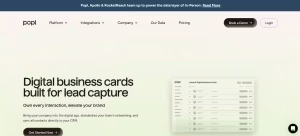
Its event-focused products go further by supporting badge scanning, AI enrichment and direct CRM workflows. Team pricing is custom rather than publicly fixed.
- Best For: Exhibitions, conferences and businesses collecting large numbers of event leads.
- Strength: Lead capture and event workflow capabilities.
- Pricing: Free individual tier available, Pro currently listed from $7.99 per month.
- Pros: QR, NFC, analytics, lead capture, CRM integrations and AI enrichment.
- Cons: Larger organisations need to request team pricing.
5. Wave Connect
Wave Connect stands out because its Free plan already includes many features that competing services reserve for paid tiers.
The Free plan currently includes a digital card, email signature, unlimited sharing, unlimited contacts, QR sharing,
Apple and Google Wallet support, a lead capture form and analytics. Pro is listed at $7 per month, while Teams starts from $5 per user per month with a minimum of three seats.
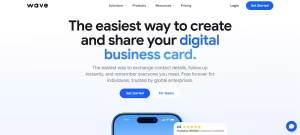
Wave also supports NFC sharing and states that recipients can open cards without installing an app.
- Best For: Freelancers, founders and small businesses wanting strong free functionality.
- Strength: Generous free tier.
- Pricing: Free, Pro from $7 per month and Teams from $5 per user per month.
- Pros: QR, NFC, wallet support, lead capture and analytics.
- Cons: Advanced branding and CRM syncing require a paid plan.
6. Blinq
Blinq combines straightforward digital cards with increasingly advanced contact and AI tools.
Its Free plan currently includes two cards, unlimited sharing and Apple or Google Wallet support. Premium costs $9.99 per month, or $7.33 per month when billed annually.
Business costs $6.99 per user per month on monthly billing, or $4.99 when billed annually.
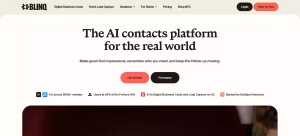
Blinq also sells NFC cards, and users can pair supported NFC accessories with their digital profile.
- Best For: Individuals wanting a polished free card with room to upgrade.
- Strength: Easy sharing combined with newer AI contact tools.
- Pricing: Free, Premium from $9.99 monthly and Business from $6.99 per user monthly.
- Pros: QR, NFC, wallet support, AI Notetaker and contact enrichment.
- Cons: Some of the most useful business features sit behind paid plans.
7. HiHello
HiHello is another strong digital-first option with a substantial free plan.
Its Personal plan currently includes four free digital cards, QR sharing, email and SMS sharing and Apple or Google Wallet compatibility.
Professional costs $6 per month when billed annually, while Business is listed at $5 per user per month annually.
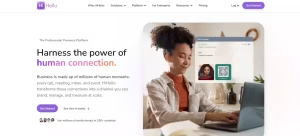
HiHello can also work with programmable NFC tags and its business products integrate with platforms including Salesforce, HubSpot and Microsoft Dynamics 365.
- Best For: Professionals wanting a digital-first card without needing branded physical hardware.
- Strength: Strong free plan and mature business integrations.
- Pricing: Free Personal plan, Professional from $6 per month annually.
- Pros: QR, wallet support, NFC compatibility and CRM integrations.
- Cons: Some central management and integration capabilities require Business or Enterprise plans.
8. Haystack
Haystack combines digital business cards with card scanning, contact management and business integrations.
Its Personal plan remains free and currently includes unlimited digital cards and card sharing.
Pro is listed from $4.50 per user per month on its annual pricing view and adds customised designs, permissions, links, email signatures and CRM integrations.
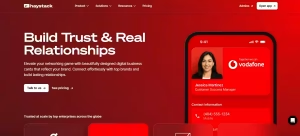
Haystack also supports sharing through QR codes, links and NFC, while paid business users can connect contacts to CRM platforms through direct integrations, Zapier and webhooks.
- Best For: Cost-conscious small teams.
- Strength: Affordable combination of cards, scanning and integrations.
- Pricing: Free Personal plan, Pro currently shown from $4.50 per user per month.
- Pros: QR, NFC, card scanning, CRM options and team controls.
- Cons: Advanced organisational features require paid subscriptions.
9. OVOU
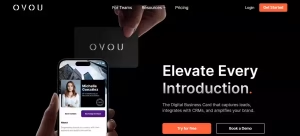
OVOU takes a physical-and-digital approach, with its Smart Card included in its individual offering.
Current pricing information shows an individual option around $39, with features including a digital profile, Apple and Google Wallet compatibility, QR sharing and contact management.
OVOU also supports lead capture, analytics and CRM automation through Zapier, while direct CRM integrations are available on higher business tiers.
- Best For: Professionals wanting a simple smart card with an accompanying digital profile.
- Strength: Straightforward physical-to-digital networking experience.
- Pricing: Individual option currently shown around $39.
- Pros: NFC smart card, QR, wallet support, lead capture and analytics.
- Cons: More advanced CRM features are aimed at higher business plans.
10. Tapni
Tapni provides NFC cards for individuals alongside a dedicated platform for organisations.
Its standard Tapni Card is currently listed at $29.90 as a one-time purchase, with NFC and QR sharing, a personal profile, custom design and wallet functionality.
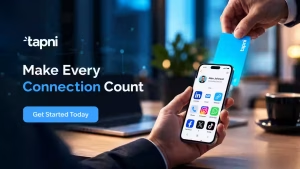
Tapni Business is listed at $59.90 per user per year.
- Best For: Individuals who want an affordable physical NFC card.
- Strength: Clear one-time hardware price for individual users.
- Pricing: Card from $29.90, Business from $59.90 per user per year.
- Pros: NFC, QR, digital profile, wallet compatibility and business options.
- Cons: Businesses should compare the depth of its integrations and automation against more sales-focused competitors.
Top 10 Digital Business Cards Comparison Table
Prices below are publicly advertised prices checked in October 2026. Taxes, currencies, annual billing discounts, promotions, hardware and enterprise agreements can change the actual cost.
| Platform | Best For | Free Plan | Starting Paid Price | NFC | QR Code | CRM | Team Features |
| V1CE | UK Professionals | With Card | Smart Card From £75 | Yes | Yes | Built-In On Paid Plan | Yes |
| Mobilo | Events And NFC | Limited/Hardware-Based | Teams From $4/User/Month | Yes | Yes | Yes | Yes |
| Uniqode | Managed Teams | Yes | $6/User/Month | Not Core Focus | Yes | Yes | Yes |
| Popl | Event Lead Capture | Yes | Pro From $7.99/Month | Yes | Yes | Yes | Yes |
| Wave Connect | Free Value | Yes | Pro From $7/Month | Yes | Yes | Yes | Yes |
| Blinq | Individuals And AI Tools | Yes | Premium From $9.99/Month | Yes | Yes | Business Plans | Yes |
| HiHello | Digital-First Networking | Yes | Professional From $6/Month Annually | Supported | Yes | Business Plans | Yes |
| Haystack | Small Teams | Yes | Pro From $4.50/User/Month | Yes | Yes | Paid Plans | Yes |
| OVOU | Physical And Digital Card | Trial/Plan Dependent | Around $39 Individual | Yes | Yes | Yes | Yes |
| Tapni | Affordable NFC | Profile With Card | Card From $29.90 | Yes | Yes | Business Options | Yes |
Current provider pricing and functionality are supported by each platform’s published 2026 information.
How To Choose The Best Digital Business Card?
The “best” card depends much more on how you network than on which provider has the longest feature list.
A freelancer who meets ten potential clients per month has different needs from a 200-person sales organisation attending international conferences.
Consider these factors before choosing:
- Sharing Methods: Check whether the platform supports QR, NFC, wallet passes, links, email signatures and other methods you actually use.
- Recipient Experience: Ideally, the other person should not have to install an app or create an account.
- Free Plan Limits: Check whether branding, analytics, lead exports or integrations disappear unless you upgrade.
- Lead Capture: Decide whether you only need to share your details or also need to collect information from the people you meet.
- CRM Integration: Sales teams should check whether contacts can move directly into their existing CRM.
- Analytics: Look for useful measurements rather than vanity statistics.
- Team Management: Businesses may need templates, locked fields, central editing and employee onboarding or offboarding controls.
- Branding: Check whether you can remove the provider’s branding and use your own colours, fonts and domain.
- Total Cost: Include subscriptions, physical NFC cards, additional users and advanced integrations.
The ability to measure outcomes matters particularly when the card is being used as part of marketing. Businesses already considering how to advertise a business effectively
should apply the same principle to networking. Views and scans are useful, but leads, meetings and customers are more meaningful.
New founders should also avoid paying for enterprise-level functionality they do not need. When seeking help to start a business,
it is usually better to build a simple marketing and networking system first and upgrade tools when the volume of contacts justifies the cost.
What Are The Pros And Cons Of Digital Business Cards?
Digital business cards solve several weaknesses of traditional cards, but they are not automatically better in every situation.
Pros
- Easy Updates: Details can normally be changed without replacing the card.
- Fast Sharing: QR codes and NFC can make exchanging information quick.
- More Content: Profiles can contain websites, portfolios, booking links and social channels.
- Lead Capture: Some platforms let both people exchange details.
- CRM Integration: Contacts can move directly into sales workflows.
- Analytics: Businesses can measure views, scans and captured contacts.
- Reusable: One NFC card can potentially be used across hundreds of meetings.
- Brand Consistency: Teams can keep layouts and company information controlled centrally.
- AI Integration: Newer platforms can enrich contacts, summarise conversations or assist with follow-ups.
Cons
- Technology Dependence: QR and NFC sharing normally rely on a smartphone.
- Internet Dependence: Some profiles need connectivity, although several platforms provide limited offline options.
- Subscription Costs: Advanced functionality can create an ongoing expense.
- Platform Dependence: Your card may rely on a third-party provider remaining available.
- Feature Restrictions: Free plans often restrict branding, exports or integrations.
- Learning Curve: Advanced CRM and automation tools may be unnecessary for occasional networking.
- Less Tangible: Some people still prefer receiving a physical card.
- Compatibility Differences: NFC behaviour can vary between devices and settings.
The most practical solution for many professionals is therefore not purely digital or purely physical. An NFC card with a printed QR code offers both a tangible item and multiple ways to reach the same digital profile.
Digital Business Card Vs Traditional Business Card In 2026
| Factor | Digital Business Card | Traditional Paper Business Card |
| Updating Details | Can Usually Be Updated Online | Requires Reprinting |
| Sharing | QR, Link, Wallet Or NFC | Physical Exchange |
| Information Capacity | High | Limited |
| Lead Capture | Available On Some Platforms | Manual |
| Analytics | Available On Some Platforms | Very Limited |
| CRM Integration | Possible | Requires Manual Entry Or Scanning |
| Recurring Cost | Possible Subscription | Reprinting Costs |
| Physical Impression | Stronger With NFC Card | Strong |
| Remote Sharing | Easy | Difficult |
| Offline Simplicity | Depends On Method | Excellent |
| Best Use | Modern, Measurable Networking | Simple Face-To-Face Introductions |
Paper still has advantages.
There is no battery, account or platform involved. You can simply hand someone a card. In industries where physical meetings are frequent and technology is not central to the sales process, that simplicity can still work.
Digital cards become more compelling when your information changes regularly, you attend many events, work remotely, need lead capture or want contacts to flow into a CRM.
A hybrid approach can therefore make more sense than declaring paper “dead”. An NFC card or physical card containing a QR code preserves the ritual of exchanging something in person while directing the recipient towards information that stays current.
Is It Worth Having A Business Card In 2026?
Yes, particularly for professionals who regularly meet customers, investors, partners or industry contacts. The format has changed, but the need to exchange professional information quickly still exists.
Traditional paper cards may be used less often, while digital and NFC cards offer a more flexible alternative.
They can make it easier to save contact details, update information, track engagement and follow up after meetings or events.
For people who rarely network in person, LinkedIn and email may be enough.
However, founders, consultants, recruiters and sales professionals can still benefit from having a simple way to turn a face-to-face introduction into a contact that can be saved and followed up.
In 2026, a business card is therefore less about carrying a piece of paper and more about creating an easy connection between real-world networking and digital follow-up.
Frequently Asked Questions
What Is A Digital Business Card?
A digital business card is an online professional profile containing contact details, company information and useful links that can be shared through QR codes, links, mobile wallets or NFC.
Are Digital Business Cards Worth It In 2026?
They can be worthwhile for people who network regularly because details are easy to update, cards can be shared in several ways and some platforms support lead capture, analytics and CRM integration.
Are Business Cards Becoming Obsolete?
Traditional paper card use has declined among many people, but business cards appear to be evolving rather than disappearing. Digital, QR and NFC alternatives are becoming more prominent.
What Is The Best Digital Business Card In The UK?
There is no single best option for everyone. V1CE is particularly relevant for UK NFC networking, while platforms such as Blinq, HiHello, Wave, Popl and Uniqode suit different individual and team requirements.
What Is The Best Free Digital Business Card?
Wave Connect, Blinq, HiHello, Uniqode, Haystack and Popl all provide free starting options, although the features and restrictions differ between platforms.
Do Recipients Need An App?
Usually not. Many leading digital card platforms let recipients open the profile through a browser after scanning a QR code or tapping an NFC card.
Are Digital Business Cards Better Than Paper Business Cards?
Digital cards are stronger for updates, remote sharing, analytics and lead capture. Paper cards remain useful when simplicity, physical presentation and completely offline use are more important.

Expert Blogger | Strategic thinker anticipating future directions for UK business
Related Articles in Business
View All →
Shell Petrol Station Franchise Cost in the UK: Real Investment, Income and Process
If you are searching for the Shell petrol pump franchise cost in the UK, the first thing to understand is that Shell does not currently advertise its UK…

Is Raising Cane’s Opening in the UK? | London Locations Revealed
Yes, Raising Cane’s is officially coming to the UK. The American chicken restaurant brand plans to open its first UK restaurant at 22 Coventry Street in London’s West…
Best Parking App UK: 10 Startup-Led Parking Apps Compared for 2026
For most drivers, JustPark is the best parking app UK users can consider in 2026 because it combines parking search, advance booking and app-based payments in one platform.…