
Government Funded NVQ Level 3 Health and Social Care 2027: Free Courses, Eligibility and Funding


UK Startup Blog Archive
Table of Contents
A government funded NVQ Level 3 Health and Social Care qualification can help eligible adults in England develop their careers without paying the full cost of professional training.
Depending on their circumstances, learners may qualify for free Level 3 courses, apprenticeship funding or employer-supported qualifications.
For 2027, the important development is that government funding continues to support recognised adult care qualifications, although the course names, eligibility requirements and available funding routes have changed.
Under England’s national 2026–2027 Adult Skills Fund rules, the annual gross earnings threshold increased to £26,800, potentially helping more low-paid care workers qualify for fully funded training.
Meanwhile, employers can access the Learning and Development Support Scheme, which offers reimbursement of up to £835 per eligible Level 3 Diploma in Adult Care, subject to the scheme’s conditions.
However, the traditional NVQ Level 3 terminology can create confusion. Many modern qualifications are now awarded as Level 3 Diplomas in Adult Care under the Regulated Qualifications Framework.
Our analysis of the current funding arrangements shows that applicants should establish three things before enrolling: whether their chosen qualification is approved, whether the training provider has a funded place and whether their personal circumstances meet the relevant eligibility rules.
Can You Get a Government Funded NVQ Level 3 Health and Social Care in 2027?
Yes. Eligible learners can access government-funded Level 3 health and social care qualifications in England during 2027, although availability depends on the course, funding programme, training provider and applicant’s circumstances.
The government’s Free Courses for Jobs programme includes health and social care among its supported subjects.
Eligible learners may receive funding covering 100% of their approved course fees.
However, government funding is not automatically available for every qualification advertised as an NVQ Level 3 in Health and Social Care.
| Funding option | Who can benefit | Financial support | Main consideration |
| Free Courses for Jobs | Eligible adults aged 19+ | Full course-fee funding | Income, qualification and residency rules |
| Level 3 legal entitlement | Eligible adults aged 19–23 without a first full Level 3 | Full funding | Qualification must be approved |
| Adult care apprenticeship | Eligible employed apprentices | Funded training under apprenticeship rules | Requires qualifying employment and training |
| Learning and Development Support Scheme | Eligible adult care employers | Up to £835 reimbursement for listed Level 3 diplomas | Employer claims and conditions apply |
| Advanced Learner Loan | Eligible adults aged 19+ | Loan towards course fees | Repayment obligations apply |
| Employer sponsorship | Existing care employees | Full or partial training costs | Depends on employer agreement |
The most suitable route depends on whether someone is already working in adult care or wants to enter the profession.
For example, an unemployed adult may find a fully funded course through Free Courses for Jobs, whereas an experienced care worker may benefit from a qualification arranged by their employer.
People exploring other qualifications can also investigate government funding for training courses to understand how grants, subsidised training and education loans differ.
What Qualification Replaces the Traditional NVQ Level 3 in Health and Social Care?
The term NVQ Level 3 Health and Social Care remains widely used in care-sector recruitment and training searches.
However, the original NVQ qualification framework has been replaced, and modern qualifications generally have different official titles.
For those working with adults in residential care, domiciliary care or supported living, one of the most directly relevant qualifications is the Level 3 Diploma in Adult Care.
Other Level 3 qualifications may be appropriate for learners preparing to enter the sector or pursue further education.
| Qualification | Main purpose | Suitable learners |
| Level 3 Diploma in Adult Care | Demonstrating occupational competence | Existing adult care workers |
| Level 3 Technical Occupational Entry in Adult Care | Preparing learners for adult care employment | New entrants and developing professionals |
| Level 3 Extended Diploma in Health and Social Care | Broader health and social care education | Students and career changers |
| Lead Adult Care Worker Level 3 Apprenticeship | Developing practical care and supervisory capabilities | Employed apprentices |
| Level 3 Residential Childcare Diploma | Supporting children in residential settings | Residential childcare workers |
These qualifications are not interchangeable in every employment situation.
An academic Health and Social Care Diploma may develop useful theoretical knowledge without necessarily demonstrating the workplace competencies required for an experienced senior care worker.
Likewise, adult care qualifications should not be confused with Level 3 childcare courses, which focus on different occupational requirements.
Why the Official Qualification Number Matters?
Every regulated qualification has an identifying number that helps learners verify exactly what they are studying.
For example:
- City & Guilds Level 3 Diploma in Adult Care: 610/7031/2
- NCFE CACHE Level 3 Technical Occupational Entry in Adult Care: 610/6203/0
Both appear in the government’s approved qualification database with Free Courses for Jobs funding approval extending into 2027.
However, an approved qualification does not guarantee that every college or training provider will offer a funded place.
Before applying, request the qualification title, awarding organisation and qualification number.
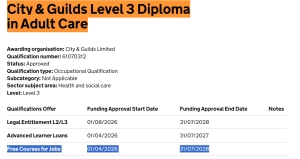
Official qualification record showing the City & Guilds Level 3 Diploma in Adult Care, qualification number and funding approval dates.
Who Qualifies for Free Level 3 Health and Social Care Training?
Funding eligibility is determined by several factors, including age, annual earnings, employment status, residency and existing qualifications.
For England’s national Adult Skills Fund arrangements in 2026–2027, the relevant gross earnings threshold is £26,800 a year.
This threshold applies to specified national funding arrangements. Local rules may differ in devolved areas.
Eligibility by Age and Employment Status
| Applicant circumstances | Potential eligibility | Important condition |
| Aged 19–23 without a full Level 3 | Fully funded | Must select a qualification within the approved entitlement |
| Aged 19–23 with an existing Level 3 | May qualify | Low earnings or unemployment may provide eligibility |
| Aged 24+ earning below £26,800 | Fully funded under qualifying national provision | Approved course and residency conditions |
| Unemployed adults aged 19+ | Potentially fully funded | Subject to funding and residency rules |
| Self-employed adults on low earnings | May qualify | Income evidence and relevant eligibility checks |
| Adults earning £26,800 or more | Other funding routes may be available | Apprenticeship, employer funding or loan |
| Adults with a previous degree | May still qualify under certain routes | Previous education does not automatically prevent every form of support |
One particularly important distinction concerns younger adult learners.
People aged 19 to 23 who have not completed a first full Level 3 qualification can qualify for free training under the relevant statutory entitlement, even if their earnings exceed the ordinary threshold.
For applicants aged 24 and above, low earnings or unemployment can provide a route through Free Courses for Jobs where the course and other conditions qualify.
There is no general upper age limit for this adult education offer.
Someone considering a career change later in life can examine funded courses for over 25s or training opportunities for over 40s.
What If You Already Have a Level 3 Qualification?
Holding an existing Level 3 qualification does not automatically prevent someone from accessing another funded course.
Under the Free Courses for Jobs arrangements, eligible low-paid or unemployed adults may qualify for approved training even if they already have a Level 3 qualification.
However, previous qualifications can restrict other funding routes.
For example, a person aged 22 with an existing full Level 3 qualification may no longer qualify under the first-full-Level-3 statutory entitlement, although they could still qualify through low-income funding.
Training providers should examine the complete funding position before requesting payment.
Does Universal Credit Affect Eligibility?
People receiving Universal Credit may be able to study an approved health and social care qualification while receiving benefits.
However, whether someone can continue claiming depends on their personal circumstances, the type and intensity of their course and the requirements attached to their claim.
Claimants should discuss their training plans with their work coach before starting full-time education.
A course that improves employment prospects may be supported, but Universal Credit entitlement is not automatic simply because the training is government-funded.
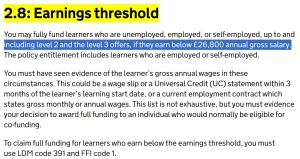
Government Adult Skills Fund 2026–2027 rules confirming the £26,800 earnings threshold and eligibility for Free Courses for Jobs.
What Changed in Government Funding During 2026?
The changes introduced for the 2026–2027 funding year are important because someone applying in January or February 2027 will need to consider the funding arrangements already in operation.
Our analysis identifies four developments affecting adult care qualifications.
Higher Earnings Threshold
The national Adult Skills Fund earnings threshold increased from £25,750 to £26,800 for 2026–2027.
This widens the income range within which eligible adults may receive full funding.
For an employed care assistant whose annual earnings previously exceeded the earlier limit, the increase may make another eligibility assessment worthwhile.
However, regional funding authorities can operate different criteria.
Updated Level 3 Qualifications
The approved qualification list includes newer occupational qualifications alongside existing health and social care diplomas.
For example, the NCFE CACHE Level 3 Technical Occupational Entry in Adult Care has Free Courses for Jobs approval from 1 August 2026 to 31 July 2028.
This makes the qualification particularly relevant for applicants planning training during 2027.
Continued Employer Reimbursement
The government’s Learning and Development Support Scheme continues into the 2026–2027 financial year.
Eligible adult social care employers can obtain reimbursement for listed training programmes and qualifications, subject to the available funding and claim requirements.
The reimbursement arrangements are particularly relevant to independent care providers looking to improve staff skills while controlling expenditure.
Updated Apprenticeship Standards
The Lead Adult Care Worker Level 3 Apprenticeship was updated in 2026.
The approved standard provides an employment-based training pathway and includes a Level 3 adult care qualification.
For employers, apprenticeships can provide a structured alternative to arranging a separate privately funded diploma.
Important for 2027 applicants: The 2026–2027 adult skills funding year ends on 31 July 2027. Applicants intending to start later in 2027 should check the rules and qualification approvals for the subsequent funding year rather than assuming all current conditions will remain unchanged.
Which Level 3 Adult Care Qualifications Have Funding Approval for 2027?
Our examination of the government’s qualification database identifies several recognised Level 3 options with funding approvals extending into 2027.
| Qualification | Awarding organisation | Free Courses for Jobs approval until |
| Level 3 Diploma in Adult Care | City & Guilds | 31 July 2027 |
| Level 3 Technical Occupational Entry in Adult Care | NCFE CACHE | 31 July 2028 |
| Level 3 Extended Diploma in Health and Social Care | NCFE CACHE | 31 July 2028 |
These dates relate to qualification funding approval, not guaranteed availability at every training provider.
They also should not be interpreted as an undertaking that the same funding route will remain available indefinitely.
For someone already employed in care, the workplace-focused Diploma in Adult Care may provide the most relevant practical progression.
A career changer may instead benefit from an occupational-entry qualification or a broader course offering supervised practical experience.
The final decision should depend on the qualification required by prospective employers, not simply the course title that appears most frequently in advertisements.
Can Care Employers Claim Government Funding for Level 3 Training?
Yes. Eligible adult social care employers in England may access the Learning and Development Support Scheme (LDSS) to recover certain staff training costs.
The scheme is particularly valuable because it supports employers developing existing staff rather than focusing exclusively on new entrants.
For qualifying Level 3 Diplomas in Adult Care, the published maximum reimbursement is £835 per learner for eligible expenditure paid between 1 April 2025 and 31 March 2027.
The amount reimbursed is limited to the employer’s evidenced eligible expenditure and the relevant scheme cap. It is not an automatic payment for every learner.
How Employer Reimbursement Works?
The scheme operates through claims submitted by eligible employers.
For qualifying diplomas, reimbursement is divided into two stages.
| Claim stage | Reimbursement allocation | When employers claim |
| Qualification started and paid for | 60% of the applicable reimbursable amount | Within the prescribed three-month period |
| Qualification successfully completed | Remaining 40% | Within three months of completion |
Employers must obtain approval for the initial qualification claim before submitting the completion claim.
For example, a residential care provider enrolling staff members on recognised Level 3 Diplomas may be able to recover part or all of the eligible tuition expenditure up to the published maximum.
However, the organisation still needs to manage the initial payment, maintain supporting evidence and meet all relevant funding conditions.
Reimbursement is also subject to the availability of scheme funds.
What Employers Must Check?
Eligible organisations generally need to meet the scheme’s adult social care employer requirements and maintain an up-to-date Adult Social Care Workforce Data Set record.
The training must concern eligible staff and qualifications, and employers must retain appropriate evidence.
Important documents can include:
- The employee’s qualification details and National Insurance number.
- The awarding organisation and approved course title.
- Evidence that the qualification has started.
- Proof of payment and the training provider’s details.
- Evidence of successful qualification completion for the final claim.
Importantly, the LDSS is not intended to reimburse qualifications undertaken through an apprenticeship. Employers should use the relevant apprenticeship funding arrangements instead.
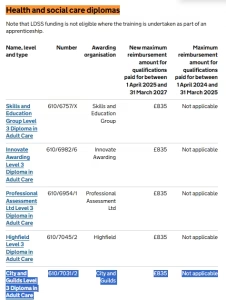
Government Learning and Development Support Scheme showing the £835 maximum reimbursement for recognised Level 3 Diplomas in Adult Care.
Is a Level 3 Care Apprenticeship Better Than a Separately Funded Diploma?
An apprenticeship may be more suitable for someone who wants to develop professionally while remaining in paid employment.
The Lead Adult Care Worker Level 3 Apprenticeship provides structured workplace learning linked to an occupational standard.
The current standard lists a typical duration of 18 months and a maximum training funding band of £4,000.
This maximum is a cap on eligible apprenticeship training and assessment funding, not a cash grant paid directly to the apprentice.
Apprenticeships are particularly relevant to residential homes, domiciliary care providers and supported living services that need experienced staff capable of mentoring colleagues or taking greater responsibility.
| Consideration | Level 3 Diploma | Level 3 Apprenticeship |
| Main focus | Occupational qualification | Employment-based occupational development |
| Employment requirement | Depends on qualification and provider | Requires qualifying apprenticeship employment |
| Course funding | Free Courses for Jobs, employer support or other route | Apprenticeship funding |
| Workplace assessment | Required for competence-based diplomas | Integrated into occupational training and assessment |
| Duration | Provider and learner dependent | Typically 18 months |
| Employer responsibility | Supporting learning and assessment | Employment, training and supervision obligations |
For care businesses, the commercial decision should consider existing staffing arrangements, available supervision, course content and the employee’s likely future responsibilities.
A small care provider may benefit from developing a reliable senior care worker rather than repeatedly recruiting externally.
However, employers should not use an apprenticeship solely because government support is available. The employee must be undertaking genuine occupational development that meets the apprenticeship requirements.
Can You Complete NVQ Level 3 Health and Social Care Online?
Many Level 3 adult care programmes use online learning systems, remote tutor support and digital portfolios.
Nevertheless, a workplace competence-based diploma cannot normally be completed through online theory alone.
Learners must demonstrate their practical skills in appropriate care settings.
Some qualifications are designed for people already working in care, whereas other health and social care qualifications may have different practical or placement requirements.
How Workplace Assessment Usually Operates?
For competence-based adult care diplomas, assessment may include:
- Direct observation of professional practice.
- Written assignments and reflective accounts.
- Professional discussions with an assessor.
- Workplace documents and portfolios.
- Witness statements where permitted.
- Evidence of meeting the relevant occupational standards.
For example, a senior care assistant may need to demonstrate how they support person-centred care, communicate effectively, maintain safeguarding procedures and follow their employer’s health and safety requirements.
Digital learning platforms can simplify portfolio management, but they do not replace appropriate practical assessment.
Care employees working irregular shifts should confirm whether assessors can accommodate their working patterns before enrolling.
How Long Does the Qualification Take?
The duration depends on the qualification specification, previous experience, workplace access and the provider’s assessment arrangements.
Work-based Level 3 adult care diplomas are often delivered over approximately 9 to 18 months, although individual courses may be shorter or longer.
Learners with significant existing competence may progress differently from those entering the profession for the first time.
A provider advertising a very short course should explain how all required learning and competence assessments will be completed.
What Skills Do Learners Develop at Level 3?
A recognised Level 3 adult care qualification aims to establish knowledge and practical competence relevant to more responsible care roles.
The exact units depend on the qualification specification, but typical subject areas include safeguarding, communication, person-centred practice, health and safety, duty of care and professional development.
| Skill area | Practical application in care work |
| Safeguarding adults | Recognising concerns and following reporting procedures |
| Person-centred care | Supporting individual choices, independence and dignity |
| Communication | Working effectively with individuals, relatives and colleagues |
| Health and safety | Identifying risks and maintaining safe working practices |
| Duty of care | Understanding responsibilities and professional boundaries |
| Equality and inclusion | Delivering respectful and appropriate support |
| Record keeping | Maintaining accurate and confidential care records |
| Professional development | Reflecting on performance and improving competence |
The value of this training goes beyond completing assignments.
A qualified care worker may become better prepared to recognise changes in an individual’s needs, support colleagues and contribute to consistent service delivery.
For employers, these capabilities can strengthen internal progression and support quality assurance.
However, a Level 3 diploma does not independently authorise every specialist clinical or medication-related task. Workers must still receive appropriate training, assessment and authorisation for their duties.
How Do You Find and Apply for a Free Level 3 Health and Social Care Course?
The most reliable approach is to identify a recognised qualification and then confirm whether an approved provider can offer it with government funding.
Applicants should not begin by paying a deposit to an online training company.
Step 1: Search for Approved Adult Care Training
Start with the National Careers Service course finder.
Search for terms such as “Level 3 Diploma in Adult Care”, “Level 3 Health and Social Care” or “adult care”.
Check the available learning methods, location, course start date and qualification level.
Official course finder: https://nationalcareers.service.gov.uk/find-a-course

National Careers Service course finder showing how applicants can search for Level 3 adult care training and identify available providers.
Step 2: Verify the Qualification
Ask the chosen training provider for the exact qualification title and awarding organisation.
Use the government-approved qualifications database to check whether the course is recognised for the relevant funding offer.
A provider describing its programme as a government-funded NVQ should be able to identify the actual qualification being delivered.
Step 3: Confirm Personal Funding Eligibility
The training provider will usually examine the applicant’s circumstances.
They may request:
- Proof of identity and age.
- Evidence of residency or immigration status.
- Employment and earnings information.
- Previous qualification details.
- Evidence of eligibility for a particular funding programme.
- Workplace information where practical assessment is required.
An applicant earning below the national threshold should still obtain confirmation that the selected course is funded in their area.
Step 4: Ask About All Training Costs
Before enrolling, request written confirmation of:
- Course fees and the amount covered by government funding.
- Awarding-body registration and assessment charges.
- Any additional learning materials.
- Potential reassessment charges.
- Workplace placement requirements.
- Cancellation and withdrawal conditions.
A course described as “fully funded” should not leave eligible learners unexpectedly liable for ordinary course tuition.
However, assistance with travel, childcare and other living expenses must be assessed separately.
Step 5: Receive Written Confirmation and Enrol
Once eligibility has been checked, the provider can explain the next available start date and enrolment requirements.
Learners should retain written confirmation of their funding arrangement and qualification details.
This is particularly important where the course starts close to the end of a funding year or the applicant is relying on employer support.
How Can Care Businesses Benefit Financially From Level 3 Staff Training?
For adult care businesses, workforce development should be treated as an operational investment rather than simply an education expense.
Care providers depend on trained employees who can deliver consistent support, follow safeguarding procedures and respond appropriately to the needs of vulnerable people.
Skills for Care’s 2026 workforce findings show that the adult social care vacancy rate in England fell to approximately 6.2% in 2025–2026, representing around 96,000 vacancies.
Although recruitment conditions improved, staffing pressures remain an important financial challenge.
Professor Oonagh Smyth, Chief Executive of Skills for Care, made the point in her October 2026 workforce commentary that “investing in people works.”
From a business perspective, training can support retention, internal promotion and workforce stability when combined with competitive pay, effective supervision and manageable working conditions.
Training Existing Employees Instead of Recruiting Externally
An independent homecare provider needing a senior care worker may choose between recruiting someone already qualified or developing an experienced employee.
The external recruitment route can involve advertising, interviews, onboarding, initial supervision and the risk of a poor appointment.
Developing an existing employee may reduce some of these costs and preserve knowledge of the organisation’s clients and working practices.
However, training also requires staff time, assessor access and management support.
The financial case is strongest when a qualification addresses a genuine operational requirement and provides a realistic progression opportunity.
Anyone planning to start a care agency should consider staff qualifications alongside safeguarding, CQC registration, recruitment and workforce planning.
Understanding the Full Cost of Training
Government reimbursement does not necessarily eliminate the employer’s overall expenditure.
A care agency may still need to fund:
| Cost category | Financial consideration |
| Qualification fees | May be funded or reimbursed |
| Employee study time | Depends on employment and training arrangements |
| Replacement staffing | May be needed during training |
| Management supervision | Creates an operational commitment |
| Travel and equipment | Not necessarily included in funding |
| Reassessment | Depends on provider terms |
These commitments should be considered alongside the wider cost of starting a care agency.
Our assessment is that publicly supported staff development offers the most meaningful financial advantage when it improves employee capability without creating unsustainable operational costs.
What Career Opportunities Are Available After Level 3 Health and Social Care?
A Level 3 adult care qualification can support progression into more experienced care positions.
Potential roles include senior care assistant, lead adult care worker, senior support worker and other supervisory positions, depending on experience and employer requirements.
The National Careers Service lists an indicative annual salary range of £24,000 to £29,000 for senior care workers.
This is a career-profile range rather than a guaranteed salary for everyone completing a Level 3 diploma.
| Career pathway | Typical responsibilities | Progression potential |
| Care assistant | Providing direct personal and practical support | Senior care worker |
| Senior care assistant | Supporting complex needs and helping colleagues | Team leader |
| Lead adult care worker | Providing experienced frontline care and guidance | Supervisory positions |
| Care team leader | Coordinating staff and care activities | Deputy management |
| Deputy care manager | Supporting service management and oversight | Registered manager |
A Level 3 qualification may support promotion, but employment experience, leadership capability and the requirements of a specific role remain important.
For experienced professionals aiming to manage a care service, a Level 5 Diploma in Care Leadership and Management may provide the next stage of professional development.
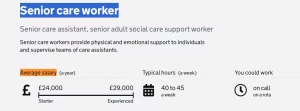
National Careers Service salary and career progression information for senior care workers in the UK.
Are Government Funded Health and Social Care Courses Available Throughout the UK?
Government-funded adult education is not administered through identical arrangements across England, Scotland, Wales and Northern Ireland.
The Free Courses for Jobs arrangements discussed above apply to England.
Within England, certain regional authorities manage devolved adult skills budgets and may operate different eligibility conditions.
| Nation | Funding approach |
| England | Adult Skills Fund, Free Courses for Jobs, apprenticeships and other eligible schemes |
| Scotland | Scottish further education and skills funding arrangements |
| Wales | Welsh Government-funded further education and apprenticeship programmes |
| Northern Ireland | Further education and training programmes administered through relevant Northern Ireland authorities |
Applicants should check the funding rules for their home nation and local area.
A course advertised as free to eligible residents in England should not be assumed to be automatically funded for someone living elsewhere in the UK.
For mature learners planning to change careers, government funded courses for over 50s may also provide useful alternatives.
What Should You Check Before Paying for an NVQ Level 3 Course?
Some training advertisements use phrases such as “fully funded NVQ”, “government recognised” and “free health and social care diploma” without clearly explaining what the learner will receive.
These terms do not all mean the same thing.
A qualification may be nationally recognised but not free.
Another provider may offer instalment payments or a government-backed loan rather than a government grant.
Potential warning signs include:
- Advertising a free course while requiring substantial unexplained tuition payments.
- Failing to disclose the actual qualification number.
- Claiming every applicant qualifies regardless of circumstances.
- Offering a competence-based diploma without explaining workplace assessments.
- Promising automatic promotion or guaranteed employment.
- Failing to identify the awarding organisation.
- Treating an Advanced Learner Loan as non-repayable funding.
- Refusing to provide written confirmation of the funding arrangement.
The most important question is not whether a course has an impressive title.
It is whether the qualification is genuine, the funding is appropriate and the course supports the learner’s intended employment outcome.
Conclusion
A government funded NVQ Level 3 Health and Social Care qualification remains an important opportunity for eligible adults and care-sector employers in 2027.
However, applicants must identify the correct modern qualification, confirm their funding eligibility and understand the practical assessment requirements.
The 2026–2027 increase in the national earnings threshold to £26,800 and continued employer training support can make recognised care qualifications more accessible.
For care businesses, effective staff development can strengthen workforce capability and support long-term retention.
Learners should prioritise approved qualifications, transparent funding arrangements and clear career progression before committing to a course.
Frequently Asked Questions
Is NVQ Level 3 Health and Social Care free in 2027?
It can be free for eligible adults in England studying approved qualifications through Free Courses for Jobs or another qualifying funding route. Eligibility and course availability must be confirmed by the training provider.
Can I get a funded Level 3 care qualification without previous experience?
Possibly. Some qualifications are designed for people entering adult care, while workplace competence-based diplomas normally require access to suitable practical experience. Check the entry requirements before applying.
Can I do NVQ Level 3 Health and Social Care while working full-time?
Yes, many providers offer flexible learning and workplace-based assessment. Online theory and digital portfolios may fit around working hours, but practical competence still needs to be demonstrated.
Is Level 3 Health and Social Care equivalent to A levels?
Level 3 qualifications are at the same qualification level as A levels in England, but they have different purposes, content and assessment methods. A vocational care diploma should not be treated as academically identical to particular A levels.
Can I receive government funding if I already have a degree?
Possibly. An existing degree may affect certain funding entitlements, but low-income funding, eligible apprenticeships and employer-supported training may still be available depending on the circumstances.
Does NVQ Level 3 qualify me to become a care manager?
A Level 3 adult care qualification can support progression into senior and supervisory positions. Registered management roles generally require broader experience, appropriate leadership competence and may benefit from a Level 5 leadership qualification.
Can my employer pay for my Level 3 care diploma?
Yes. Employers may fund eligible qualifications directly or use available apprenticeship arrangements. Qualifying adult social care employers may also claim reimbursement under the Learning and Development Support Scheme.
Will the £26,800 funding threshold remain in place throughout 2027?
The £26,800 threshold applies under the national 2026–2027 Adult Skills Fund rules. Applicants starting during the subsequent funding year should check for published changes. Regional arrangements may also differ.

Blogger | Business Writer | Sharing startup advice on UK business blogs
Related Articles in Startup
View All →
Newscivil Com: Can This Digital News Platform Help UK Startups Spot Emerging Trends?
For startup founders, staying informed is no longer simply about reading the business pages each morning. Artificial intelligence, changing consumer habits, technology developments, government decisions and wider social…

Meet the Startup Turning Screen Time Into a New Way to Make Money
Britain does not exactly have a shortage of side hustles. You can deliver takeaways, sell clothes online, start freelancing, walk dogs, tutor in the evenings or attempt to…

8 Best Coworking Spaces for Bootstrapped London Startups to Launch and Scale in 2026
Bootstrapped founders don’t have the luxury of a fitted-out HQ from day one. What you need is a London coworking space that flexes with you: a hot desk…