
Government Grants For Solar Panels UK 2026: Eligibility, Funding And How To Apply

UK Startup Blog Archive
Table of Contents
Government support for solar panels is still available in the UK in 2026, but there is no single solar grant open to every household.
In England, the Warm Homes: Local Grant is one of the main routes for low-income households living in energy-inefficient privately owned or rented homes. Solar panels can be included as part of a wider package of energy improvements.
The scheme is expected to run until March 2028.
ECO4 can also fund solar PV for qualifying households in Great Britain, although ECO4 is technically an energy supplier obligation rather than a government cash grant. It has been extended to 31 December 2026.
Other support includes the Welsh Government Nest scheme, Scottish energy-efficiency programmes, 0% VAT on qualifying solar installations and the Smart Export Guarantee.
| Support | Where Available | Main Purpose | 2026 Status |
| Warm Homes: Local Grant | England | Energy efficiency, solar and low-carbon heating | Open |
| ECO4 | England, Scotland and Wales | Whole-home energy improvements including eligible solar PV | Open Until 31 December 2026 |
| ECO4 Flex | Participating Areas | Support for low-income and vulnerable households | Open With ECO4 |
| Nest | Wales | Free home energy improvements including solar | Open |
| Home Energy Scotland Support | Scotland | Grants and loans for eligible energy improvements | Available |
| 0% VAT | UK | Reduces installation cost | Until 31 March 2027 |
| Smart Export Guarantee | Great Britain | Pays for exported solar electricity | Ongoing |
Last Updated: 19.09.2026
Government Solar Panel Grants And Support Available In 2026
The amount and type of help available depend heavily on where you live, your household circumstances and the energy efficiency of your property.
Warm Homes: Local Grant
The Warm Homes: Local Grant is currently one of the most important schemes for households in England.
To qualify, the property must generally:
- Be In England: The scheme does not cover Scotland, Wales or Northern Ireland
- Be Privately Owned: This can include owner-occupied and privately rented homes
- Have An EPC Of D To G: More energy-efficient properties will normally fall outside the scheme
- Meet Financial Criteria: Household income will usually need to be £36,000 a year or less, although benefit and postcode-based routes can also apply
Eligible households can receive improvements such as insulation, solar panels, smart controls and low-carbon heating.
The council assesses the property and decides which measures are appropriate rather than allowing applicants to simply select a free solar system.
Households can check their circumstances through the official Warm Homes: Local Grant eligibility service. GOV.UK states that councils will usually contact applicants within 10 working days to gather more information and arrange a home survey.
The scheme is already delivering significant amounts of solar.
Official statistics covering activity reported to the end of July 2026 show around 11,250 measures across approximately 5,470 households, with solar PV accounting for 38% of reported installations. Batteries represented another 18%.
ECO4 And ECO4 Flex
The Energy Company Obligation, or ECO4, is another potential route to receiving solar panels.
One important distinction is that ECO4 is not technically a grant scheme. Energy suppliers have obligations to improve qualifying homes and decide which projects and measures they will fund.
ECO4 now runs until 31 December 2026, following a nine-month extension from its previous March 2026 end date.
Households receiving qualifying benefits may be eligible. ECO4 Flex can broaden access to households that do not meet the normal benefits route.
Under ECO4 Flex, eligibility can include:
- Low Household Income: Combined gross annual household income below £31,000
- Health Conditions: Certain long-term conditions that are made worse by living in a cold home
- Fuel Poverty: Other local eligibility routes can identify households struggling with energy costs
- Poor Energy Efficiency: ECO4 focuses on properties with lower energy-performance ratings
Solar PV is an eligible ECO4 measure in suitable circumstances. However, qualification does not guarantee that an energy company will install solar panels or cover the entire cost.
Ofgem advises consumers to review any proposed work and contract carefully because the amount of support can vary between suppliers and installers. Current eligibility and consumer guidance is available through Ofgem’s ECO information for homeowners and tenants.
Solar Support In Scotland, Wales And Northern Ireland
Solar funding rules differ outside England.
In Wales, the Welsh Government’s Nest programme can provide qualifying households with a package of free energy-efficiency improvements. Solar panels can be included where appropriate.
Applicants generally need to own or privately rent their home and either receive a qualifying means-tested benefit or meet the programme’s low-income criteria. EPC requirements also apply.
In Scotland, homeowners can explore support through Home Energy Scotland and Warmer Homes Scotland.
It is important not to assume that the standard Home Energy Scotland Grant and Loan provides a grant for conventional rooftop solar PV.
Current funding includes support for technologies such as heat pumps, insulation, solar thermal and qualifying hybrid solar PV and water-heating systems.
Households in Northern Ireland should check current energy-efficiency assistance separately because ECO4 and the Warm Homes: Local Grant do not operate there.
Who Is Eligible For Government Grants For Solar Panels?
Eligibility depends on the scheme rather than solar panels themselves.
A household is more likely to qualify where several of the following circumstances apply:
- Lower Household Income: Some schemes apply specific household income limits
- Qualifying Benefits: Universal Credit, Pension Credit and certain other benefits may provide an eligibility route
- Low EPC Rating: Many schemes prioritise properties rated D, E, F or G
- High Energy Costs: Households at risk of fuel poverty can receive additional consideration
- Health Vulnerability: Some flexible schemes cover conditions affected by cold homes
- Private Property: Owner-occupiers and private tenants are covered by several major programmes
- Eligible Location: Postcode and local authority rules can affect availability
A household earning more than the headline income threshold should therefore not automatically assume it cannot qualify. Warm Homes: Local Grant, for example, can also use postcode and benefit-based eligibility routes.
Private tenants may qualify, although landlord permission will normally be required and landlords can sometimes be expected to contribute towards improvements.
Social housing residents have different funding routes.
Rather than applying for the standard Warm Homes: Local Grant, tenants should normally check with their council or housing association about planned energy-efficiency improvements.
How Much Solar Panel Funding Can You Get?
There is no standard amount that every successful household receives.
Updated Warm Homes: Local Grant rules increased the scheme’s average cost caps.
Local authorities can work within an average cap of around £16,600 per home for energy-performance improvements, with a further average cap for eligible low-carbon heating measures.
This does not mean each applicant receives a £16,600 cheque or a £16,600 solar panel grant.
Funding is used by the scheme administrator to pay for the package of measures considered suitable for the property. That package could include solar PV alongside insulation, ventilation, heating controls or other improvements.
The amount spent on one home can therefore differ from another.
Solar PV is particularly relevant because government statistics show it has become the most frequently reported measure under the Warm Homes: Local Grant in 2026.
ECO4 works differently. There is no fixed cash award. The energy supplier determines what it is prepared to fund, and some households can be asked to make a contribution.
Can Solar Grants Cover Battery Storage?
Battery storage is becoming increasingly important because batteries allow households to store electricity generated during sunny periods and use it later.
Under the Warm Homes programme, battery systems can be included in appropriate home-upgrade packages. Government data show batteries already represented 18% of reported Warm Homes: Local Grant installations by the end of July 2026.
The position under ECO4 is different. Battery storage itself is not an eligible funded ECO4 measure, even though a battery could potentially be installed separately alongside an ECO retrofit.
Solar PV remains an eligible ECO4 measure subject to the relevant scheme rules.
Households paying privately for battery storage can also benefit from the current VAT relief available for qualifying installations.
What Support Is Available If You Do Not Qualify For A Solar Grant?
Not qualifying for a fully funded installation does not necessarily mean paying the full headline cost without assistance.
0% VAT On Solar Panels
Qualifying installations of solar panels in residential accommodation currently benefit from 0% VAT until 31 March 2027.
Electrical storage batteries also qualify under the current rules.
From 1 April 2027, qualifying installations are scheduled to return to the reduced 5% VAT rate rather than the temporary zero rate.
The VAT reduction is not a grant and does not provide money directly to the homeowner. Instead, it reduces the tax charged on qualifying installations.
Smart Export Guarantee
The Smart Export Guarantee, commonly called SEG, allows eligible households with solar PV to receive payments for surplus electricity exported to the grid.
Electricity suppliers offering SEG tariffs determine their own payment rates and contract terms, although qualifying SEG tariffs must pay more than zero.
A homeowner does not necessarily need to use the same company for their electricity supply and SEG export tariff.
SEG should therefore be considered separately from installation funding. A grant may help pay for the system, while SEG can provide ongoing income after the system begins generating electricity.
Solar Finance And Government-Backed Loans
The 2026 Warm Homes Plan includes plans for government-supported low and zero-interest finance for technologies such as solar panels, batteries and heat pumps.
The government has begun developing the Warm Homes Loan Scheme, working with lenders to reduce the financing cost of energy-efficiency improvements.
Unlike income-targeted grant programmes, the loan scheme is intended to serve households that can afford repayments but face the barrier of a large upfront installation cost.
Consumers should remember that a loan is repayable and is therefore very different from receiving a fully funded installation.
How To Apply For Government Grants For Solar Panels?
The correct application process depends on the scheme and where the property is located.
For the Warm Homes: Local Grant in England, applicants can begin with the government’s eligibility checker. If the initial conditions appear to be met, information is passed to the relevant local authority.
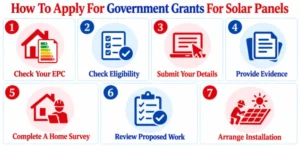
The process will generally involve:
- Check Your EPC: Find the property’s current Energy Performance Certificate or establish whether an assessment is required
- Check Eligibility: Review income, benefits, postcode and property requirements
- Submit Your Details: Apply through the official scheme route
- Provide Evidence: Income, benefits, occupancy or ownership evidence may be requested
- Complete A Home Survey: The property will be assessed to identify appropriate measures
- Review Proposed Work: The council, supplier or installer will explain what can be funded
- Arrange Installation: Approved measures can then be fitted by the scheme’s installation provider
For ECO4, applicants can approach participating obligated energy suppliers or authorised delivery partners. You do not necessarily need to receive your gas or electricity from the supplier providing the ECO support.
Applicants should avoid paying an organisation purely to “unlock” a government solar grant without first confirming which official scheme is being used.
Does Qualifying Guarantee Free Solar Panels?
No. This is one of the most important distinctions for households researching government grants for solar panels.
Passing the eligibility criteria for a scheme can mean that your household qualifies to be considered for support. It does not always mean you are automatically entitled to a rooftop solar system.
Under the Warm Homes: Local Grant, a survey determines which measures are most suitable for the property. A household could receive insulation, solar panels, heating improvements or a combination of measures.
Under ECO4, the energy supplier chooses which qualifying projects it will support and how much funding it will provide. Ofgem specifically warns that ECO eligibility does not guarantee an installation.
Factors that can affect the final decision include roof suitability, property condition, existing insulation, energy assessment results, available scheme funding and the overall retrofit package.
How To Avoid Solar Panel Grant Scams?
The growth in government-funded home improvements has also created opportunities for misleading marketing.
Be particularly cautious when a company claims that everyone in a particular postcode is automatically entitled to free solar panels.
Before agreeing to work:
- Identify the Scheme: Ask for the exact government or supplier programme being used
- Check Eligibility Independently: Use official government, council or regulator information
- Read The Contract: Confirm whether there is any homeowner contribution or finance agreement
- Check the Installer: Government-funded work should meet the relevant quality and certification requirements
- Never Rush: Do not sign an agreement simply because someone claims funding will disappear immediately
- Clarify Ownership: Make sure you know who owns the solar equipment after installation
- Keep Documents: Retain surveys, quotations, contracts, guarantees and installation certificates
Ofgem advises ECO consumers to agree to measures only after receiving a contract and understanding the proposed cost and work.
Government Solar Panel Grant Checklist For 2026
Before applying, check the following:
- Location: Identify whether you are applying in England, Scotland, Wales or Northern Ireland
- EPC Rating: Check whether your home is currently rated D to G
- Household Income: Calculate total household income using the scheme’s rules
- Benefits: Check whether anyone in the household receives a qualifying benefit
- Property Ownership: Establish whether landlord approval will be required
- Existing Measures: Note any insulation, solar panels or heating upgrades already installed
- Official Scheme: Confirm the exact funding programme before providing personal information
- Survey: Expect the final improvement package to depend on an assessment of the property
- Contribution: Check whether the offer is fully funded or requires you or your landlord to pay part of the cost
Conclusion
Government grants for solar panels remain available in 2026, but eligibility and funding vary considerably between schemes.
For eligible households in England, the Warm Homes: Local Grant is now one of the main routes to fully funded energy improvements and solar PV has become its most commonly reported installed measure.
ECO4 also remains active across Great Britain until 31 December 2026, although it is an energy supplier obligation rather than a guaranteed cash grant.
Households that do not qualify for fully funded support still have options.
The temporary 0% VAT rate can reduce installation costs, the Smart Export Guarantee can provide payments for exported electricity, and new government-backed finance is being developed through the Warm Homes Plan.
The most important step is to check the rules for your location and household circumstances before accepting any offer. Qualification for a scheme should not be confused with an automatic entitlement to free solar panels.
Frequently Asked Questions About Government Grants For Solar Panels
Can I Get Free Solar Panels From The Government In 2026?
Potentially. Eligible households may receive fully funded solar panels through programmes such as the Warm Homes: Local Grant or qualifying energy-efficiency schemes, but solar is not guaranteed for every applicant.
Can I Get A Solar Grant If I Earn More Than £36,000?
Possibly. The £36,000 figure applies to one Warm Homes: Local Grant eligibility route. Certain benefits or qualifying postcode criteria can allow households with higher income to be considered.
Do I Need To Receive Benefits To Qualify?
Not always. Some schemes offer income, postcode, vulnerability or other eligibility routes alongside qualifying benefits.
Can I Get Solar Panels If My EPC Rating Is C?
Fully funded schemes mainly target less energy-efficient properties. The Warm Homes: Local Grant generally requires an EPC rating between D and G, so an EPC C property would not normally qualify through that scheme.
Can Solar Panel Grants Include Battery Storage?
Some Warm Homes-funded improvement packages can include battery storage where appropriate. Batteries are not themselves an eligible funded ECO4 measure.
Can Pensioners Get Government Grants For Solar Panels?
Yes, age alone does not prevent someone from qualifying. Pensioners may qualify through household income, Pension Credit, property energy efficiency or other scheme-specific criteria.
When Does ECO4 End In 2026?
ECO4 has been extended and is currently scheduled to end on 31 December 2026. However, funding availability can vary because suppliers decide which projects they support, so eligibility does not guarantee an installation.

Startup mentor & Blogger | Sharing leadership tips for UK business owners
Related Articles in Business
View All →
Shell Petrol Station Franchise Cost in the UK: Real Investment, Income and Process
If you are searching for the Shell petrol pump franchise cost in the UK, the first thing to understand is that Shell does not currently advertise its UK…

Is Raising Cane’s Opening in the UK? | London Locations Revealed
Yes, Raising Cane’s is officially coming to the UK. The American chicken restaurant brand plans to open its first UK restaurant at 22 Coventry Street in London’s West…
Best Parking App UK: 10 Startup-Led Parking Apps Compared for 2026
For most drivers, JustPark is the best parking app UK users can consider in 2026 because it combines parking search, advance booking and app-based payments in one platform.…