
How to Calculate Profit Margin?


UK Startup Blog Archive
Table of Contents
Profit margin shows how much profit a business retains from its sales. To calculate it, divide the relevant profit figure by revenue and multiply the result by 100.
Profit Margin = (Profit ÷ Revenue) × 100
For example, if a business generates £50,000 in revenue and makes £10,000 in profit, its profit margin is 20%. This means the business retains 20p as profit from every £1 of revenue.
However, the result depends on whether gross profit, operating profit or net profit is used.
What Is Profit Margin?
Profit margin is a financial percentage used to measure profitability. It compares the profit generated by a business with its total sales revenue, also known as turnover.
Unlike a profit figure stated in pounds, a margin makes it easier to compare performance across different periods, products or businesses.
A company earning £100,000 in profit may appear more successful than one earning £40,000, but the smaller business could have the stronger margin if it needs considerably less revenue to generate that profit.
Profit margin can help a business assess its pricing, control costs, compare products and monitor financial performance.
Reliable calculations depend on accurate financial records, so establishing a consistent system for small business bookkeeping is an important starting point.
What Is the Formula for Calculating Profit Margin?
The standard formula is:
Profit Margin = (Profit ÷ Revenue) × 100
The calculation involves three steps:
- Find the business’s revenue for the relevant period.
- Subtract the applicable costs to determine profit.
- Divide the profit by revenue and multiply the answer by 100.
Suppose a business has annual revenue of £120,000 and total costs of £90,000.
Profit = £120,000 − £90,000 = £30,000
The profit margin is:
Profit Margin = (£30,000 ÷ £120,000) × 100 = 25%
The company therefore keeps 25p in profit from every £1 of revenue after covering the costs included in the calculation.
Which Type of Profit Margin Should a Business Calculate?
A business can calculate several types of profit margin. Each one provides a different view of financial performance.
| Margin | Formula | What It Measures |
| Gross profit margin | Gross profit ÷ Revenue × 100 | Profit after direct production or purchasing costs |
| Operating profit margin | Operating profit ÷ Revenue × 100 | Profit after direct costs and normal operating expenses |
| Net profit margin | Net profit ÷ Revenue × 100 | Final profit after all recognised expenses |
| Product margin | Unit profit ÷ Selling price × 100 | Profitability of an individual product or service |
The correct margin depends on what the business wants to understand. Gross margin is useful for analysing pricing and direct costs, while net margin provides a broader view of overall profitability.
How Do You Calculate Gross Profit Margin?
Gross profit margin measures how much revenue remains after deducting the direct cost of delivering goods or services.
The formula is:
Gross Profit Margin = (Gross Profit ÷ Revenue) × 100
Gross profit is calculated as:
Gross Profit = Revenue − Cost of Sales
The cost of sales may include materials, stock purchased for resale, manufacturing labour, packaging and other expenses directly associated with producing the sale.
Gross Margin Example
A retailer generates £200,000 in revenue and has a cost of sales of £120,000.
Gross Profit = £200,000 − £120,000 = £80,000
Gross Profit Margin = (£80,000 ÷ £200,000) × 100 = 40%
The retailer has a gross profit margin of 40%. It retains 40p from each £1 of revenue before paying overheads such as rent, administration, advertising and professional fees.
How Do You Calculate Operating Profit Margin?
Operating profit margin measures profitability after both direct costs and normal operating expenses have been deducted.
The formula is:
Operating Profit Margin = (Operating Profit ÷ Revenue) × 100
Operating expenses may include office rent, employee salaries, utilities, marketing, insurance, software and administrative costs. Interest and tax are normally excluded from operating profit.
Operating Margin Example
Assume the retailer in the previous example has a gross profit of £80,000 and operating expenses of £50,000.
Operating Profit = £80,000 − £50,000 = £30,000
Operating Profit Margin = (£30,000 ÷ £200,000) × 100 = 15%
The operating margin is 15%. This means the business retains 15p from every £1 of sales after paying its direct and operating costs.
How Do You Calculate Net Profit Margin?
Net profit margin shows the proportion of revenue left after all recognised business expenses have been deducted.
The formula is:
Net Profit Margin = (Net Profit ÷ Revenue) × 100
Net profit may account for cost of sales, operating expenses, depreciation, interest and tax. The exact presentation can vary according to the business structure and financial statements used.
Net Margin Example
Suppose the retailer has an operating profit of £30,000. Interest, tax and other recognised costs total £7,500.
Net Profit = £30,000 − £7,500 = £22,500
Net Profit Margin = (£22,500 ÷ £200,000) × 100 = 11.25%
The net profit margin is 11.25%. For every £1 of revenue, the business retains approximately 11p as net profit.
Businesses can use free accounting software to organise income and expenses and produce the figures needed for these calculations.
How Can All Three Profit Margins Be Calculated Together?
The following example shows how revenue is gradually reduced by different categories of expenditure.
| Financial Measure | Amount | Margin |
| Revenue | £80,000 | 100% |
| Cost of sales | £48,000 | 60% of revenue |
| Gross profit | £32,000 | 40% |
| Operating expenses | £20,000 | 25% of revenue |
| Operating profit | £12,000 | 15% |
| Interest, tax and other costs | £3,000 | 3.75% of revenue |
| Net profit | £9,000 | 11.25% |
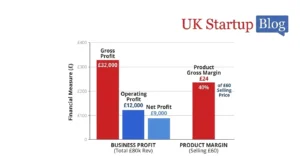
Although all three margins use the same revenue figure, each calculation answers a different question. The gross margin concentrates on direct costs, the operating margin includes the expense of running the business and the net margin reflects final profitability.
How Do You Calculate the Profit Margin on a Product?
To calculate the margin on an individual product, subtract its cost from its selling price. Divide the resulting profit by the selling price and multiply by 100.
Product Margin = ((Selling Price − Product Cost) ÷ Selling Price) × 100
Suppose a product costs £36 and sells for £60.
Unit Profit = £60 − £36 = £24
Product Margin = (£24 ÷ £60) × 100 = 40%
The product produces a 40% gross margin. The £24 profit is not necessarily the final net profit because the business may still need to cover advertising, transaction fees, wages, rent, delivery and other overheads.
A business developing its product prices should consider its costs, customer expectations and competitor positioning. An effective pricing strategy must support both sales demand and sustainable profitability.
What Is the Difference Between Profit Margin and Mark-Up?
Profit margin and mark-up are related, but they are not the same.
Profit margin calculates profit as a percentage of the selling price. Mark-up calculates profit as a percentage of the cost.
Using the previous product example:
- Product cost: £36
- Selling price: £60
- Profit: £24
The margin is:
£24 ÷ £60 × 100 = 40%
The mark-up is:
£24 ÷ £36 × 100 = 66.67%
A product with a 40% profit margin therefore has a mark-up of approximately 66.67%. Confusing these percentages can cause a business to set its selling price too low.
The conversion formulas are:
Mark-Up = Margin ÷ (100 − Margin) × 100
Margin = Mark-Up ÷ (100 + Mark-Up) × 100
How Do You Calculate a Selling Price From a Target Margin?
If a business knows its unit cost and desired profit margin, it can calculate the required selling price using the following formula:
Selling Price = Cost ÷ (1 − Target Margin)
The margin must be written as a decimal. For example, 40% becomes 0.40.
If a product costs £36 and the business wants a 40% margin:
Selling Price = £36 ÷ (1 − 0.40)
Selling Price = £36 ÷ 0.60 = £60
This calculation helps prevent the common mistake of simply adding 40% to the cost. Adding 40% to £36 would produce a selling price of £50.40, but that would only create a margin of approximately 28.57%.
Should VAT Be Included in a Profit Margin Calculation?
VAT collected from customers should generally not be treated as business revenue because it is normally payable to the tax authority. A VAT-registered business will therefore usually calculate its profit margin using sales and eligible costs excluding VAT.
For example, if a product is sold for £120 including 20% VAT, the revenue figure used for a margin calculation would generally be £100 rather than £120.
A business that is not VAT-registered may treat VAT paid on purchases as part of its costs because it cannot normally reclaim it. Consistent accounting treatment is essential when comparing margins across products or periods.
How Can Profit Margin Be Calculated in Excel?
A simple spreadsheet can calculate profit margins automatically.
If revenue is entered in cell A2 and total costs are entered in cell B2, profit can be calculated in cell C2 with:
=A2-B2
Profit margin can then be calculated in cell D2 with:
=C2/A2
Cell D2 should be formatted as a percentage.
The calculation can also be completed in one formula:
=(A2-B2)/A2
For a gross margin spreadsheet, column B should contain cost of sales rather than every business expense. Different columns can then be used for gross, operating and net margins.
What Is a Good Profit Margin?
There is no single profit margin that is suitable for every business. A good margin depends on the industry, pricing model, cost structure, maturity of the company and level of competition.
A software business may have a high gross margin because delivering an additional subscription has a relatively low direct cost.
A retailer may operate with a lower gross margin because it must purchase stock. A construction business may generate substantial revenue but face significant labour, materials and equipment costs.
Instead of relying only on a general benchmark, a business should compare its margin with:
- Its results from previous months or years
- Similar businesses operating in the same sector
- Its budget and financial targets
- Different products, services or customer groups
Market position can also affect the margin a business can achieve. Calculating business market share can help show whether changes in profitability are occurring alongside gains or losses in competitive position.
Why Can Profit Margin Change?
Profit margin can fall even when revenue increases. This can happen when costs rise faster than sales or when the business relies heavily on discounts to generate additional orders.
Changes in supplier prices, wages, energy, delivery fees, product mix and customer demand can all affect margin. A company may also record a temporary reduction after investing in marketing, technology or additional employees.
Gross and net margins should be reviewed separately. A stable gross margin accompanied by a falling net margin may indicate that overheads are increasing. A falling gross margin may point to higher direct costs, excessive discounting or prices that have not kept pace with inflation.
How Can a Business Improve Its Profit Margin?
A business can improve its margin by increasing the profit earned from each sale or reducing the costs required to generate revenue.
Raising prices may help, but the likely effect on demand should be considered. A small price increase can materially improve margin if sales volumes remain stable.
The business can also renegotiate supplier terms, reduce waste, discontinue low-margin products or encourage customers to purchase more profitable services.
Operating costs should be reviewed carefully rather than cut indiscriminately. Removing an unnecessary subscription may improve profit without affecting customers, whereas reducing essential staff or marketing could damage future revenue.
A business should also examine its break-even position. Understanding how to work out the break-even point shows how many sales are required before the company begins generating profit.
What Mistakes Can Make Profit Margin Inaccurate?
Using the wrong profit figure is one of the most common mistakes. Gross profit should not be used when the objective is to calculate net margin.
Revenue should also be recorded correctly. Refunds, discounts and sales returns normally reduce revenue, while loans and money introduced by the owner are not sales. For VAT-registered businesses, VAT collected should not normally be included as revenue.
Other frequent errors include overlooking payment-processing fees, failing to account for stock used or sold, mixing personal and business expenses and comparing margins from periods of different lengths.
Profit should not be confused with cash in the bank. A profitable company can still experience cash-flow problems if customers pay late or money is tied up in stock. Similarly, a large cash balance could include loans, VAT or money needed to pay suppliers.
How Often Should Profit Margin Be Calculated?
The appropriate frequency depends on the business. A small service business may review margins monthly, while a retailer with rapidly changing stock and supplier costs may monitor them weekly or by product line.
Monthly calculations are often useful because they reveal changes before the end of the financial year. Quarterly and annual comparisons can then show broader trends.
When a business is considering a major project or asset purchase, profit margin should be considered alongside investment measures such as the accounting rate of return. These measures answer different questions and should not be treated as interchangeable.
What Are the Most Common Profit Margin Questions?
Can a Profit Margin Be Higher Than 100%?
A conventional profit margin based on profit divided by revenue cannot normally exceed 100% because profit cannot be greater than the revenue used in the calculation unless unusual accounting items are involved. Mark-up, however, can exceed 100%.
Can a Profit Margin Be Negative?
Yes. A negative margin occurs when costs exceed revenue. If a business generates £40,000 in revenue but records a £5,000 loss, its margin is:
−£5,000 ÷ £40,000 × 100 = −12.5%
Is Profit Margin Calculated Before or After Tax?
It depends on the type of margin. Gross and operating margins are normally calculated before tax. Net profit margin may be calculated after interest and tax. The basis used should always be stated clearly.
Is a Higher Profit Margin Always Better?
A higher margin generally indicates that the business retains more profit from its revenue. However, margin should be considered alongside total profit, sales volume, cash flow, growth and risk.
A lower-margin business selling a high volume of products may generate more total profit than a high-margin business with limited sales.
What Happens if Revenue Is Zero?
A profit margin cannot be calculated when revenue is zero because division by zero is undefined. The business can still report its loss in pounds, but it cannot express that result as a conventional profit margin.
Should Owner Wages Be Included in the Calculation?
A limited company normally records a director’s salary as an expense, which reduces profit. A sole trader’s personal drawings are not generally treated as a business expense. The correct treatment depends on the legal structure and accounting records.

Blogger | Business Writer | Sharing startup advice on UK business blogs
Related Articles in Tax & Accounting
View All →
Why the Two Year Accounts Rule is Not Actually a Rule?
Ask most new business owners when they can first apply for a mortgage and the answer comes back the same way every time: two years of accounts, minimum,…

The Most Overlooked Tax Reliefs Available to UK Taxpayers
Most people know about the Personal Allowance and ISA limits, but there’s a whole range of tax reliefs that go unclaimed every year. Whether you’re employed, self-employed, or retired, you’ll likely be missing out on at least…

Rachel Reeves Back Door Death Tax | What It Means for UK Families?
For many families in the UK, home ownership is more than just a place to live. It’s a legacy, a source of pride, and often the largest financial…