
How to Calculate Staff Turnover?


UK Startup Blog Archive
Table of Contents
Staff turnover measures the percentage of employees who leave a business during a particular period. It helps employers understand workforce stability, identify retention problems and estimate how frequently roles need to be refilled.
The standard staff turnover formula is:
Staff turnover rate = (Number of employees who left ÷ Average number of employees) × 100
For example, if six employees leave during a year and the business has an average of 50 employees, its annual staff turnover rate is 12%.
Accurate calculations require more than counting resignations. The business must use a consistent reporting period, define which types of departures are included and calculate its average headcount correctly.
What Does Staff Turnover Mean?
Staff turnover, also called employee turnover, refers to employees leaving an organisation and needing to be replaced.
It can include resignations, dismissals, redundancies, retirements and the expiry of fixed-term contracts, depending on how the employer defines the metric.
Turnover may be voluntary or involuntary. Voluntary turnover happens when an employee chooses to leave, while involuntary turnover occurs when the employer ends the employment relationship.
Some level of turnover is normal. Employees retire, relocate, change careers or accept new opportunities. However, a consistently high rate can indicate problems involving management, pay, workload, workplace culture or career progression.
Turnover should not be confused with business turnover. Business turnover normally refers to the revenue generated from sales, whereas staff turnover relates to employees leaving the organisation.
How Do You Calculate Staff Turnover?
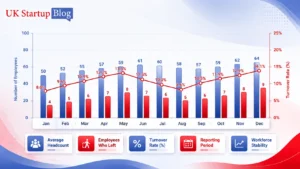
A business needs three figures to calculate staff turnover:
- The number of employees at the beginning of the reporting period.
- The number of employees at the end of the reporting period.
- The number of employees who left during the period.
The calculation involves two stages.
Step One: Calculate the Average Number of Employees
Use the following formula:
Average number of employees = (Opening headcount + Closing headcount) ÷ 2
If a business began the year with 48 employees and ended with 52, its average headcount would be:
(48 + 52) ÷ 2 = 50 employees
Step Two: Calculate the Turnover Percentage
The business can then use its average headcount in the turnover formula:
Staff turnover rate = (Number of leavers ÷ Average headcount) × 100
If seven employees left during the year:
(7 ÷ 50) × 100 = 14%
The annual staff turnover rate is therefore 14%.
What Is a Worked Example of Staff Turnover?
Consider a startup that begins the year with 30 employees. During the year, it recruits eight people and five employees leave. Its closing headcount is therefore 33.
| Calculation | Figure |
| Employees at the start of the year | 30 |
| Employees at the end of the year | 33 |
| Employees who left | 5 |
| Average headcount | 31.5 |
| Staff turnover rate | 15.87% |
The average headcount is:
(30 + 33) ÷ 2 = 31.5
The turnover rate is:
(5 ÷ 31.5) × 100 = 15.87%
The startup’s annual staff turnover rate is approximately 15.9%.
Although an average headcount can contain a decimal, it should not be rounded before completing the turnover calculation. Rounding too early can make the final result less accurate.
How Should Monthly Staff Turnover Be Calculated?
Monthly turnover is useful for businesses that recruit regularly, employ seasonal workers or experience frequent workforce changes.
The monthly formula is:
Monthly staff turnover rate = (Employees who left during the month ÷ Average headcount for the month) × 100
Suppose a company had 120 employees at the beginning of June, 124 at the end and four employees left during the month.
Its average headcount would be:
(120 + 124) ÷ 2 = 122
Its monthly turnover would be:
(4 ÷ 122) × 100 = 3.28%
The monthly staff turnover rate is therefore approximately 3.3%.
Monthly percentages should not simply be added together to calculate annual turnover.
The workforce size may change throughout the year, so the annual figure should be calculated using the total number of annual leavers and the average workforce for the full year.
How Should Annual Staff Turnover Be Calculated?
Annual turnover covers employees who leave during a 12-month period. The business may use a calendar year, financial year or another consistent reporting cycle.
For organisations with relatively stable staffing levels, the opening and closing headcounts usually provide a suitable average.
Businesses experiencing rapid growth, seasonal recruitment or major restructuring should use monthly headcounts to produce a more representative result.
The enhanced average headcount formula is:
Average annual headcount = Total of the 12 monthly headcounts ÷ 12
The annual turnover rate is then:
Annual staff turnover rate = (Total annual leavers ÷ Average annual headcount) × 100
Using monthly averages prevents a temporary increase or decrease near the end of the year from distorting the result.
Which Employees Should Be Included in the Calculation?
The employees included in the leaver count must match the employees included in the average headcount. A calculation will be misleading if the numerator and denominator cover different groups.
For example, if part-time employees are counted as leavers, they must also be included in the average workforce. Contractors should usually be excluded unless the organisation has deliberately created a separate contingent-worker turnover measure.
Employers should establish a written definition that explains whether the calculation includes:
- Permanent and fixed-term employees
- Full-time and part-time employees
- Employees on probation
- Retirements, redundancies and dismissals
- Fixed-term contracts that have naturally ended
Internal promotions should not normally count as turnover because the employee has not left the organisation. However, a transfer may be counted when calculating turnover for an individual team, department or location.
Employees taking maternity leave, shared parental leave, long-term sick leave or an agreed career break remain employed and should not be recorded as leavers.
How Can Different Types of Staff Turnover Be Measured?
An overall turnover percentage is helpful, but it does not explain why employees are leaving. Separating departures into different categories produces more useful information.
Voluntary Turnover
Voluntary turnover measures employees who choose to resign.
Voluntary turnover rate = (Voluntary leavers ÷ Average headcount) × 100
This figure can highlight concerns relating to pay, management, flexibility, development opportunities or employee experience.
Involuntary Turnover
Involuntary turnover includes dismissals, redundancies and other employer-led departures.
Involuntary turnover rate = (Involuntary leavers ÷ Average headcount) × 100
A high involuntary rate may suggest problems with recruitment decisions, role expectations, performance management or organisational planning.
New Starter Turnover
New starter turnover measures the proportion of recently hired employees who leave within a defined period, such as three, six or 12 months.
New starter turnover rate = (New starters who leave ÷ Total employees hired in the relevant cohort) × 100
A high result may point to inaccurate job descriptions, poor recruitment decisions or weaknesses in the new employee induction process.
Regrettable Turnover
Regrettable turnover covers employees the organisation wanted to retain, such as high performers, people with specialist knowledge or staff occupying business-critical positions.
There is no universal formula for deciding which departures are regrettable. The organisation should establish clear criteria and apply them consistently.
Why Should Turnover Be Calculated by Department or Role?
A company-wide percentage can conceal serious problems within individual teams. An organisation might have an acceptable overall rate while a particular department loses employees much more frequently.
Employers can calculate turnover separately by:
| Category | What It May Reveal |
| Department | Local management or workload problems |
| Job role | Difficult-to-fill or poorly designed positions |
| Location | Regional pay, travel or workplace issues |
| Length of service | Problems affecting new or experienced employees |
| Contract type | Differences between permanent and temporary staff |
| Manager | Patterns linked to leadership or communication |
| Voluntary departure reason | Pay, progression, flexibility or culture concerns |
The same basic formula applies, but only employees and leavers from the selected group should be included.
For example, if a sales department has an average of 20 employees and five leave during the year, the department’s turnover rate is 25%, even if the organisation-wide rate is much lower.
What Is the Difference Between Turnover and Retention?
Turnover measures the proportion of employees who leave. Retention measures the proportion of an original group of employees who remain.
The employee retention formula is:
Retention rate = (Employees from the original group who remain ÷ Employees at the start of the period) × 100
Suppose a business started the year with 40 employees. At the end of the year, 34 of those original employees still work there.
(34 ÷ 40) × 100 = 85%
The retention rate is 85%.
New recruits who joined during the year should not be included in this cohort-based retention calculation. Because turnover and retention may use different employee groups and denominators, retention is not always simply 100 minus the turnover percentage.
Businesses experiencing retention problems can use targeted talent retention strategies alongside the turnover data.
What Is a Good Staff Turnover Rate?
There is no single turnover percentage that is suitable for every business. Expected rates vary according to the industry, location, company size, type of work and proportion of temporary employees.
Hospitality, retail and seasonal businesses may naturally experience more movement than organisations with highly specialised positions. Startups can also record volatile percentages because one or two departures have a significant effect on a small workforce.
A business should compare its current turnover with:
- Its results from previous months and years
- Similar departments and roles
- Voluntary and involuntary departure patterns
- Employee length of service
- Recruitment and workforce plans
A rising rate is not automatically evidence of a crisis, particularly after restructuring or seasonal contracts ending.
Equally, a low rate is not always positive if poor performers remain, employees lack progression opportunities or the organisation is failing to attract new skills.
The most meaningful measure is whether the business is retaining the people and capabilities required to operate successfully.
Why Is Staff Turnover Important?
Turnover creates both direct and indirect costs. Direct expenses may include recruitment advertising, agency fees, screening, interviewing, equipment and training.
Indirect costs can arise from reduced productivity, additional pressure on remaining employees and lost customer or operational knowledge.
Tracking turnover helps an employer:
- Identify teams with recurring retention problems
- Estimate future recruitment requirements
- Evaluate management and workplace policies
- Protect important skills and organisational knowledge
- Monitor the effectiveness of retention initiatives
The figure becomes especially useful when combined with absence data, employee surveys, exit interviews, performance results and recruitment costs.
As a company expands, its people data may become more complicated. That can be a sign that the business should consider whether it needs a dedicated HR lead or a Chief Human Resources Officer.
How Can a Business Reduce Staff Turnover?

Reducing turnover begins with understanding why employees leave. Employers should avoid introducing broad benefits or salary changes before identifying the main causes.
Exit interviews can reveal recurring problems, but the information should be reviewed collectively rather than being treated as isolated comments. Employee surveys, probation reviews and stay interviews can identify concerns before they result in resignations.
Strengthen Recruitment and Onboarding
Job adverts should accurately describe the responsibilities, working arrangements, salary and progression opportunities. Unrealistic promises may encourage candidates to accept offers but can lead to early departures.
A structured induction should introduce the employee to their role, colleagues, objectives and available support. Regular check-ins during the first few months can resolve problems before they become reasons to leave.
Improve Management and Communication
Managers have a major influence on workload, recognition, development and day-to-day employee experience. They should receive appropriate support and be held accountable for retention patterns within their teams.
Clear expectations and open communication are particularly important in small businesses where roles can change quickly.
Establishing better startup communication from day one can reduce uncertainty and help employees understand how their work contributes to the company.
Review Pay and Employee Benefits
Pay should be reviewed alongside responsibilities, experience and market conditions. Employers should also assess whether their benefits are relevant to the workforce.
Flexible working, wellbeing support, pension contributions and professional development may improve the overall employment proposition. The most suitable employee benefits in the UK will depend on the workforce rather than the number of perks offered.
Create Development Opportunities
Employees may leave when they cannot see how their careers can progress. Businesses can improve retention by providing training, mentoring, increased responsibility and transparent promotion criteria.
Encouraging continuous learning for startup growth can strengthen employee skills while demonstrating that the organisation is willing to invest in its people.
Build an Inclusive Workplace
Employees are more likely to remain where they feel respected, heard and able to contribute. Fair recruitment, consistent progression decisions and suitable workplace adjustments all support retention.
Strong diversity and inclusion in the workplace can also improve belonging and reduce avoidable departures linked to unfair treatment or exclusion.
What Mistakes Can Affect a Staff Turnover Calculation?
The most common mistake is using the closing workforce instead of the average workforce. If the business has grown or reduced significantly, this can produce a distorted percentage.
Other errors include changing the definition of a leaver between reporting periods, including contractors among departures but not in the headcount, double-counting employees who leave and return, or counting internal transfers as company departures.
Employers should also avoid comparing figures covering different time periods. A monthly turnover percentage cannot be directly compared with an annual rate without considering the reporting period.
Small businesses should interpret percentages carefully. If a company with five employees loses one person, its turnover rate will be approximately 20%, even though only one departure occurred.
Showing both the percentage and number of leavers provides better context.
measurable outcome.
Final Takeaway
To calculate staff turnover, divide the number of employees who left during a chosen period by the average number of employees and multiply the result by 100.
The calculation itself is straightforward, but the quality of the result depends on consistent definitions and accurate headcount information. Businesses should separate voluntary, involuntary, new starter and regrettable turnover wherever possible.
The percentage should then be analysed by role, department, location and length of service. This turns a basic HR calculation into practical information that can improve recruitment, management, employee experience and workforce planning.
FAQs
Should Redundancies Be Included in Staff Turnover?
Redundancies can be included in the overall figure, but they should also be reported separately. Separating them prevents an employer-led restructuring programme from being mistaken for a voluntary retention problem.
Should Employees Dismissed During Probation Be Included?
Yes, if employees on probation are included in the average headcount. These departures should also be examined through a new starter turnover calculation because repeated probation failures may indicate recruitment or onboarding problems.
Can Staff Turnover Be More Than 100%?
Yes. A rate above 100% is possible when the number of departures exceeds the average number of positions. This may happen when the same roles are refilled several times during the reporting period.
How Often Should Turnover Be Calculated?
Most businesses benefit from monitoring turnover monthly and reviewing it in more detail quarterly or annually. Very small organisations may prefer quarterly reporting because monthly percentages can change dramatically after a single departure.
Is High Turnover Always Bad?
No. Some departures may remove persistent performance problems or allow the business to restructure roles. The greater concern is avoidable turnover involving capable employees the organisation wanted to retain.
What Is the Simplest Staff Turnover Formula?
The simplest formula is:
Number of employees who left ÷ Average number of employees × 100
The business must use figures from the same period and apply the same definition of an employee throughout the calculation.

Expert Blogger | Strategic thinker anticipating future directions for UK business
Related Articles in Finance
View All →
If I Take Home £1,600 a Month, What Is My Salary in the UK?
If an employee takes home £1,600 per month in the UK, their estimated gross salary is approximately £21,780 per year. This is equal to about £1,815 per month…

Why the Two Year Accounts Rule is Not Actually a Rule?
Ask most new business owners when they can first apply for a mortgage and the answer comes back the same way every time: two years of accounts, minimum,…

Snap-on Franchise Cost: Fees, Investment and Earnings
The Snap-on franchise cost in the UK is currently quoted at £166,597 to £168,487 for the franchise investment, with Snap-on stating that a new franchisee may need to…