
How to Trademark a Name in the UK: Step-by-Step Guide 2026


UK Startup Blog Archive
Table of Contents
Protecting a business name can become increasingly important as your company grows, builds recognition and invests more money in its brand. Registering a trademark can give you stronger legal rights over the name, logo or other branding elements associated with your goods or services.
In the UK, trademarks are registered through the Intellectual Property Office, commonly known as the IPO. The official UK spelling is “trade mark”, although “trademark” is also widely used by businesses and consumers.
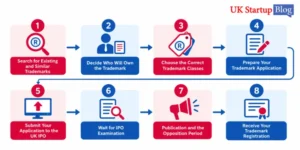
To trademark a name in the UK, you generally need to:
- Search Existing Trademarks – Check whether the same or a similar name has already been registered
- Decide Who Will Own It – Choose whether the trademark will belong to you personally or to your company
- Choose Your Trademark Classes – Identify the goods and services you want the trademark to protect
- Prepare Your Application – Provide the name, owner details and relevant goods or services
- Apply to the UK IPO – Submit a Standard or Right Start application
- Complete IPO Examination – Respond to any objections raised by the examiner
- Pass the Opposition Period – Your application is published for two months
- Receive Registration – If no unresolved objections or opposition remain, the trademark is registered
A standard online application currently costs £205 for one class, plus £60 for each additional class. If there are no complications, registration usually takes around 3 to 4 months.
Last Updated: 08.09.2026
What Is a Trademark?
A trademark is a sign that helps customers distinguish the goods or services of one business from those offered by another.
It can form an important part of a company’s intellectual property because it protects branding that customers associate with a particular business.
A trademark may include:
- Words
- Business Names
- Product Names
- Logos
- Sounds
- Colours
- Combinations Of Different Branding Elements
Once a trademark has been registered, its owner can use the registration when taking action against unauthorised use, license or sell the mark and use the ® symbol with the registered mark.
Trademark registration lasts for 10 years initially and can be renewed every 10 years.
Do You Need to Trademark Your Business Name?
You are not legally required to register every business name as a trademark.
However, registration may become increasingly valuable when the name itself is an important commercial asset.
You may want to consider registering your business name if you are:
- Building A Recognisable Consumer Brand
- Selling Products Or Services Across The UK
- Operating Primarily Online
- Investing Significantly In Advertising
- Planning To Franchise Your Business
- Licensing Your Brand To Other Companies
- Preparing To Enter New Markets
- Seeking Investment Or Planning A Business Sale
A small local business may initially rely on its established reputation and other legal rights. However, enforcing an unregistered brand can be more complicated than relying on a registered trademark.
Registration can be particularly useful if another company later adopts a similar name in the same market.
Trademark vs Company Name vs Domain Name
Registering a company at Companies House does not automatically give you registered trademark protection.
These are different forms of registration.
| Registration Type | What It Protects | Trademark Protection? |
| Companies House Name | Your registered company name | No |
| Trading Name | Name used commercially by the business | No automatic registered protection |
| Domain Name | Control of a particular web address | No |
| Registered Trademark | A mark for specified goods and services | Yes |
For example, registering Example Ventures Ltd at Companies House may prevent another company from registering an identical or certain overly similar company name, but it does not automatically prevent another business from using similar branding.
Companies House specifically explains that company names and trademarks are separate forms of protection administered by different organisations.
It is therefore sensible to check company names, domain availability and trademarks when developing a new brand.
What Can and Cannot Be Registered as a Trademark?
Not every business name or branding idea will qualify for trademark registration.
What Can Be Registered?
A trademark can potentially consist of:
- Words
- Names
- Logos
- Sounds
- Colours
- Combinations Of These Elements
The important issue is whether the mark can distinguish your goods or services from those of other businesses.
What Cannot Be Registered?
A trademark may be refused if it is:
- Purely Descriptive – Such as using a straightforward description of the goods being sold
- Too Common – Generic expressions may not distinguish one business from another
- Non-Distinctive – The mark needs to function as an identifier of commercial origin
- Misleading – It should not give consumers false information about the goods or services
- Offensive – Certain offensive material cannot be registered
- A Generic Shape – Ordinary shapes associated with particular products can be difficult to protect
- Using Protected Emblems Without Permission – Certain official emblems, hallmarks and national flags have restrictions
- Too Similar To Existing Rights – Earlier trademark owners may object where there is a relevant conflict
The IPO assesses registrability based partly on what the mark is and the goods or services for which protection is requested.
A descriptive word might therefore be unacceptable for one type of product while potentially functioning as a distinctive trademark for something completely unrelated.
Should You Trademark Your Business Name or Logo?
Business owners often assume that one application automatically protects every version of their branding.
That is not necessarily the case.
You need to decide exactly what you want your application to protect.
For example, you may want to register:
- The Business Name As Words
- The Company Logo
- A Product Name
- A Slogan
- A Combination Of Words And Design Elements
If the business name is the main element customers recognise, registering the name itself can often be an important starting point.
A business with a particularly distinctive logo may also consider protecting the logo separately. This can be useful when logos are redesigned while the underlying business name remains the same.
The right approach depends on which branding elements carry the greatest commercial value and how the business expects its branding to develop.
How to Trademark a Name in the UK?
The UK registration process is relatively straightforward for an uncomplicated application, but decisions made before filing can affect the scope of protection you ultimately receive.
Step 1: Search for Existing and Similar Trademarks
Before applying, search the UK trademark database.
Do not look only for an exact copy of your proposed name.
Check for:
- Exact Matches
- Similar Spellings
- Similar-Sounding Names
- Similar-Looking Marks
- Related Goods And Services
- Marks Registered In Relevant Classes
The IPO advises applicants to search for trademarks that are the same as or similar to their proposed mark before applying.
Finding another trademark does not automatically mean your name can never be registered. The goods, services, classes and similarity between the marks can all matter.
Where a potentially serious conflict appears, obtaining specialist advice before paying an application fee may be worthwhile.
Step 2: Decide Who Will Own the Trademark
You also need to identify the legal owner.
The trademark can generally be owned by an individual or a legal entity such as a limited company.
For startups, this decision can become important later.
Ownership may affect:
- Investment Deals
- Licensing Agreements
- Franchise Arrangements
- Business Sales
- Company Restructuring
- Intellectual Property Valuation
For example, a founder might initially own a trademark personally even though the operating company uses the brand. That arrangement may later need to be reviewed when investors or buyers carry out due diligence.
Decide on the intended ownership structure before submitting the application where possible.
Step 3: Choose the Correct Trademark Classes
Trademark protection is linked to particular categories of goods and services known as classes.
You must choose at least one relevant class and identify the goods or services, known as terms, that you intend the mark to cover.
Choose classes based on the business you genuinely operate or plan to operate within the relevant period.
The IPO specifically advises applicants to select terms relevant to their business plans for the next five years. You also cannot simply add new terms to the existing application after it has been submitted.
Step 4: Prepare Your Trademark Application
You will normally need:
- The Trademark You Want To Register
- Details Of The Proposed Owner
- Relevant Trademark Classes
- Specific Goods Or Services
- Applicant Contact Details
Check everything carefully before filing.
Your selected goods and services define an important part of the protection you are seeking.
Step 5: Submit Your Application to the UK IPO
You can submit either a Standard application or use the IPO’s Right Start route.
A Standard online application currently costs £205 for the first class.
Right Start allows the IPO to assess whether an application meets registration requirements before the applicant commits to the second part of the fee.
One point businesses should consider before filing is privacy. Application information becomes publicly available, so founders using a personal address should understand how their details may appear on public records.
The IPO also warns that application details are published online after filing, potentially allowing others to see information about a new brand.
Step 6: Wait for IPO Examination
After submission, the IPO examines the application.
The examination report is normally issued within approximately 2 to 3 weeks.
The examiner considers issues such as whether:
- The Mark Meets Registration Requirements
- The Description Of Goods And Services Is Acceptable
- Similar Existing Trademarks Have Been Identified
If objections arise, the applicant generally has two months to address them.
Step 7: Publication and the Opposition Period
Once examination issues have been resolved, the application is published in the Trade Marks Journal.
It then enters a two-month opposition period.
During this period, another party can oppose the application if they believe registration would conflict with their earlier rights.
If nobody successfully opposes the application, it can proceed towards registration.
Step 8: Receive Your Trademark Registration
If there are no outstanding objections or opposition proceedings, the IPO registers the trademark and issues a registration certificate.
An uncomplicated application can normally be registered approximately 3 to 4 months after filing.
The trademark then remains registered for 10 years, subject to the rules on continued validity and use.
How Do Trademark Classes Work?
Trademark classification determines the categories of goods and services your registration covers.
Classes 1 to 34 generally relate to goods, while classes 35 to 45 generally cover services.
Choosing the correct class is important because registering the name does not give unlimited rights over every possible industry.
For example:
| Example Business | Possible Trademark Classes |
| Clothing Brand | Class 25 for clothing |
| Online Retail Business | Class 35 for certain retail services, plus relevant product classes where appropriate |
| Restaurant | Class 43 for restaurant services |
| Marketing Agency | Class 35 for advertising and marketing services |
| Software Business | Class 9 for certain downloadable software and Class 42 for certain software or SaaS services |
The exact terms matter just as much as the broad class number.
Selecting too few may leave commercially important activities outside the registration. Selecting large numbers of unnecessary goods or services can increase costs and potentially create other problems.
The IPO warns that choosing the wrong class can result in a registration that does not provide the protection the business actually needs.
What If Your Business Name Is Already Trademarked?
Discovering the same or a similar name during your search does not automatically answer whether you can register yours.
First consider:
- Who Owns The Earlier Trademark
- Which Classes It Covers
- Which Goods And Services Are Listed
- How Similar The Names Are
- Whether Customers Could Confuse The Businesses
Two identical or similar names may sometimes coexist where their commercial activities are sufficiently different, but this should not be assumed.
If the earlier trademark creates a genuine conflict, possible options may include:
- Choosing A Different Name
- Changing The Proposed Branding
- Narrowing The Goods Or Services
- Discussing Consent Or Commercial Arrangements
- Seeking Advice From A Trademark Attorney
The IPO recommends professional advice where an applicant already knows about an identical or similar existing mark.
How Has Trademark Registration Changed Over the Years?
The fundamentals of UK trademark protection remain similar, but several important developments have changed how businesses approach registration.
Brexit and the Shift to Separate UK Protection
One of the biggest changes came following Brexit.
Before the end of the transition period, an EU Trade Mark could provide protection covering the UK alongside EU member states.
From 1 January 2021, EU Trade Marks no longer automatically provided trademark protection in the UK.
To preserve existing rights, the UK IPO created comparable UK trademarks for qualifying EU trademarks that were already registered at the end of the transition period.
Those comparable rights became separate UK rights capable of being renewed, assigned, licensed and challenged independently.
For businesses launching brands now, a UK trademark does not automatically give protection across the EU. Businesses planning European expansion therefore need to consider UK and European protection separately.
Digital Applications and 2026 Fee Changes
The trademark application process is now heavily digital, allowing applicants to search existing marks, identify classes and submit applications online.
The IPO also offers Right Start, which allows applicants to receive an initial assessment before deciding whether to pay the second part of the application fee.
Another major recent change took effect on 1 April 2026, when IPO fees for trademarks, patents and registered designs increased.
For trademarks, the standard online application fee increased to £205 for one class, while each additional class now costs £60.
These changes make it even more important to select classes carefully before applying rather than paying for unnecessary coverage.
How Much Does It Cost to Trademark a Name in the UK in 2026?
The cost depends mainly on the application route and number of classes.
Standard Online Application
| Number of Classes | Standard Application |
| 1 Class | £205 |
| 2 Classes | £265 |
| 3 Classes | £325 |
Each additional class costs £60.
Right Start Application
Right Start divides the payment into two stages.
| Number of Classes | Initial Payment | Total If Continued |
| 1 Class | £125 | £250 |
| 2 Classes | £155 | £310 |
| 3 Classes | £185 | £370 |
The second payment becomes relevant if you decide to continue after receiving the IPO’s assessment.
Applicants normally have 28 days to decide whether to proceed, challenge the decision or discuss the application after receiving the Right Start report.
Professional trademark attorney fees are separate from IPO charges.
How Long Does It Take to Trademark a Name in the UK?
An uncomplicated UK trademark application usually takes approximately 3 to 4 months.
A typical process looks like this:
| Stage | Typical Position |
| Application Submitted | Day 1 |
| IPO Examination Report | Usually Within 2–3 Weeks |
| Resolve Any Objections | Depends On The Issues Raised |
| Publication | After Examination Requirements Are Met |
| Opposition Period | 2 Months |
| Registration | Roughly 3–4 Months Overall If Unopposed |
More complicated cases can take considerably longer.
For example, delays may occur if:
- The Examiner Raises Objections
- An Earlier Rights Holder Opposes The Application
- The Goods And Services Require Amendment
- Negotiations Take Place Between The Parties
- Formal Opposition Proceedings Are Required
Registration time should therefore be treated as an estimate rather than a guaranteed deadline.
What Happens If Your Trademark Application Is Objected To?
Not every difficulty with an application is the same.
There are two important situations to distinguish.
IPO Examination Objections
The IPO examiner may identify a problem with the application.
For example, the mark may be considered too descriptive or non-distinctive, or there may be an issue with the listed goods and services.
The examination report explains the objections, and applicants normally have two months to respond.
Depending on the issue, you may be able to clarify or amend permitted parts of the application, provide arguments or decide not to continue.
Opposition From Another Trademark Owner
Opposition comes from a third party rather than the IPO examiner.
An earlier trademark owner may believe your proposed registration conflicts with their rights.
If that happens, possible routes include:
- Negotiating With The Opponent
- Changing Or Limiting Parts Of The Application Where Permitted
- Withdrawing The Application
- Defending The Opposition
- Seeking Professional Legal Advice
Formal opposition can involve legal costs, so potentially serious conflicts are best identified before filing where possible.
Can You Protect a Business Name Without Registering a Trademark?
A business may have some protection even without registered trademark rights.
In the UK, an unregistered brand can potentially be protected through the law of passing off.
A successful passing-off claim generally requires establishing:
- Goodwill Associated With The Business
- A Misrepresentation By Another Party
- Damage Or Likely Damage To That Goodwill
This can be more difficult to establish than relying on a registered trademark because the business needs evidence showing the reputation and goodwill it has built.
Trademark registration therefore provides a clearer registered right, although the strength and enforceability of any particular claim will depend on the circumstances.
What Is the Difference Between ™ and ®?
The two symbols do not mean the same thing.
™ is commonly used to indicate that a business is treating a word, logo or other sign as a trademark. It does not itself mean that the mark has been registered in the UK.
® indicates registered trademark status.
The registered symbol should only be used where the mark has the necessary registered status. Government guidance warns that falsely representing an unregistered mark as registered can be an offence.
Businesses should therefore avoid adding ® simply because they have submitted an application. Wait until the relevant registration has been granted.
Maintaining and Renewing Your Trademark
Trademark protection does not end once the registration certificate arrives.
A UK trademark is initially registered for 10 years and can then be renewed every 10 years.
As of 2026, online renewal costs:
- £245 For The Registration
- £60 For Each Additional Class
There is also an important rule concerning actual use.
A registered UK trademark can become vulnerable to revocation if it has not been genuinely used for five years after registration, or during an uninterrupted five-year period, without proper reasons for that non-use.
Businesses should therefore keep useful evidence of genuine trademark use, such as:
- Packaging
- Advertising
- Website Records
- Invoices
- Product Listings
- Marketing Materials
Renewing a trademark every 10 years does not by itself remove the risk created by prolonged non-use.
How to Protect Your Trademark From Infringement?

Registration provides rights, but businesses should still monitor how their brand is being used.
Useful steps include:
- Monitor Your Brand – Check search engines, marketplaces, Companies House records and social media
- Keep Evidence – Save screenshots, advertisements, listings and dates where potentially infringing use appears
- Assess the Situation Carefully – Similar branding does not automatically amount to infringement
- Contact the Other Party Where Appropriate – Some disputes can be resolved commercially
- Seek Professional Advice – Particularly where substantial revenue, reputation or legal costs are involved
- Consider Formal Action – Legal enforcement may be appropriate when other routes fail
Avoid immediately threatening legal proceedings without understanding the other party’s rights. Trademark disputes can involve complex questions about similarity, goods and services, earlier rights and consumer confusion.
How Do You Protect a Trademark Outside the UK?
A UK trademark registration primarily provides protection in the UK and Isle of Man. It does not automatically provide worldwide protection.
Businesses entering overseas markets may therefore need additional registrations.
Options can include:
- Applying Directly In Individual Countries
- Applying For An EU Trade Mark For EU Member States
- Using The Madrid System For Selected International Markets
The Madrid System allows eligible businesses to seek trademark protection across selected member jurisdictions through an international filing framework based on an existing or pending basic trademark in the applicant’s Office of origin.
Businesses considering this route can review the World Intellectual Property Organization Madrid System for information on international applications.
International trademark strategy should normally focus on countries where the company currently trades or realistically plans to operate rather than attempting to register everywhere without a commercial reason.
Conclusion
Learning how to trademark a name involves more than submitting a form to the IPO.
Businesses first need to establish whether the proposed name is distinctive, search for earlier rights, select the correct goods and services and decide who should own the trademark.
For a straightforward UK application in 2026, the standard online cost starts at £205 for one class, with each additional class costing £60. An uncomplicated application can usually reach registration within around 3 to 4 months.
The most important work often happens before filing. Choosing the wrong classes, overlooking a similar trademark or registering an important business asset under the wrong owner can create unnecessary costs later.
Once registered, the trademark should also be actively used, monitored and renewed every 10 years so that the business continues to benefit from its protection.
FAQs
How Much Does It Cost to Trademark a Name in the UK?
A standard online UK trademark application costs £205 for one class in 2026, plus £60 for each additional class. Professional advice, opposition proceedings or international protection can increase the overall cost.
Can I Trademark a Name That Someone Else Is Already Using?
Possibly, but it depends on factors including existing trademark rights, similarity between the names and the goods or services involved. Seek professional advice where an earlier conflicting mark exists.
Can Two Businesses Trademark the Same Name?
Potentially. Similar or even identical names may sometimes coexist where the relevant goods and services and overall circumstances do not create a legal conflict, but this cannot be assumed simply because the businesses fall within different classes.
Does Registering a Company Name Protect It as a Trademark?
No. Companies House registration and trademark registration are separate. Registering a limited company does not automatically give the company registered trademark protection over its name.
Do I Need a Solicitor to Trademark a Business Name?
No. Businesses can apply directly to the UK IPO. A trademark attorney or other suitably qualified professional may nevertheless be useful for complex applications, classification questions or conflicts with existing trademarks.
Should I Trademark My Business Name or Logo First?
If the business name is your main long-term brand identifier, protecting the name may be a logical priority. A separate logo registration may also be useful where the design itself has substantial brand value.
How Long Does It Take to Trademark a Name in the UK?
A straightforward, unopposed UK trademark application normally takes around 3 to 4 months. Objections, opposition proceedings or other complications can extend the process considerably.

Blogger & Content creator | An insightful writer sharing practical advice for UK entrepreneurs
Related Articles in Marketing
View All →
How Headwear Can Shape Your Startup’s Identity? – The Power of Customisation:
Building a recognisable brand when you’re just starting out is genuinely hard. There’s noise everywhere, budgets are tight, and you need every penny to work as hard as possible. That’s…

Why Outsourced Lead Generation Delivers Better ROI?
In the competitive landscape of the UK business market, the pressure to maintain a healthy sales pipeline is constant. Many organisations struggle to balance the demands of product…

Single-Use Card Numbers for Campaign Spending: Benefits & Best Practices
Single-use card numbers reduce fraud risk, simplify reconciliation, and help teams control campaign budgets. Here’s how to use them correctly. Campaign spending is messy by default. You’ve got…