
How To Register as a Sole Trader With HMRC in 2026?


UK Startup Blog Archive
Table of Contents
To register as a sole trader with HMRC, you normally register for Self Assessment. Registration is generally required if your gross income from self-employment is more than £1,000 during a tax year.
If you need to report self-employed income from the 2025/26 tax year and are new to Self Assessment, you should normally notify HMRC by 5 October 2026. Once registered, HMRC provides a 10-digit Unique Taxpayer Reference (UTR) that identifies you for Self Assessment.
HMRC introduced an improved online Self Assessment registration service in September 2026. Customers using the new service can receive their UTR in their online account within 72 hours in many cases.
| Registration Point | 2026 Position |
| Registration method | Register for Self Assessment |
| General income trigger | More than £1,000 gross trading income |
| Registration deadline | 5 October following the relevant tax year |
| UTR | 10-digit tax reference |
| Companies House registration | Not normally required for a sole trader |
| VAT threshold | £90,000 taxable turnover |
| MTD threshold from April 2026 | Over £50,000 qualifying income |
Last Updated: 19.09.2026
What Is a Sole Trader?
A sole trader is someone who runs a business as an individual rather than through a limited company.
It is one of the simplest ways to operate a business in the UK because there is no company incorporation process and fewer corporate filing requirements.
You can trade using your own name or choose a separate business name. However, you remain personally responsible for the business.
This means there is no legal separation between you and the sole trader business in the same way that there is between a shareholder and a limited company.
As a sole trader, you will generally:
- Keep the Profits: Money left after business costs and tax belongs to you
- Take Personal Responsibility: You can be personally responsible for business debts
- Keep Business Records: Income and allowable expenses need to be recorded
- Report Your Income: Self-employed profits are usually reported through Self Assessment
- Pay Relevant Taxes: Income Tax and National Insurance may apply depending on your profits
A sole trader does not normally register the business with Companies House. The key registration for tax purposes is usually with HMRC.
When Do You Need To Register as a Sole Trader?
You normally need to register if your gross trading income is more than £1,000 during a tax year, which runs from 6 April to 5 April.
The important word is gross. The £1,000 test is based on business income before deducting expenses.
For example, suppose you receive £3,500 from freelance work and spend £2,800 on allowable business costs. Your profit may only be £700, but your gross trading income is £3,500.
You would therefore normally need to consider Self Assessment registration.
You may also need or choose to register when earning £1,000 or less if you need to:
- Prove You Are Self-Employed: For certain benefits or childcare purposes
- Make Voluntary NI Contributions: This may help protect entitlement to certain benefits and the State Pension
- Register for CIS: Construction subcontractors may have additional registration requirements
You can also be an employee and a sole trader at the same time. Having a PAYE job does not prevent you from running a separate self-employed business.
What Do You Need Before Registering With HMRC?
Preparing your details before beginning the registration process can make the application easier.
You will normally need information such as:
- Your National Insurance number
- Your full name and personal details
- Your contact details
- The date you started self-employment
- Information about the type of work you carry out
- Your business or trading name where applicable
- Your Government Gateway or GOV.UK One Login details where required
HMRC requires a National Insurance number for Self Assessment registration. If you do not already have one, you may need to apply for it separately.
It is also useful to establish from the start how you will record sales, invoices, expenses and receipts.
How To Register as a Sole Trader With HMRC Step by Step?
Registering as a sole trader is primarily a tax-registration process rather than a business-incorporation process.
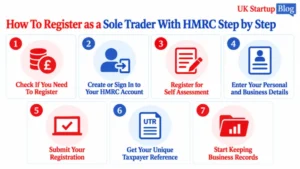
Step 1: Check If You Need To Register
First calculate your gross self-employed income for the tax year.
If it exceeds £1,000, you will usually need to register for Self Assessment as a sole trader.
Do not confuse turnover with profit. Turnover or gross income is generally the money the business receives before allowable costs are deducted.
Step 2: Create or Sign In to Your HMRC Account
You can access HMRC’s online services using the relevant Government Gateway or GOV.UK One Login process.
If you are registering for the first time, you may need to create login details before continuing.
Keep these details secure because your online account can later be used to manage your Self Assessment information and check important tax details.
Step 3: Register for Self Assessment
- Choose the registration route for someone who is self-employed as a sole trader.
- HMRC will ask questions about your circumstances to determine how you should register.
- This is different from incorporating a limited company. Sole traders generally do not receive a Companies House company number.
Step 4: Enter Your Personal and Business Details
Complete the requested information carefully.
Your business start date is particularly important because it helps establish the tax year in which your self-employment began.
You may also be asked to describe the nature of your business.
Use a straightforward description such as:
- Freelance Graphic Designer
- Plumber
- Business Consultant
- Online Retailer
- Photographer
- Marketing Consultant
The description should accurately reflect the work you actually carry out.
Step 5: Submit Your Registration
Check the information before submitting it.
Incorrect details can cause unnecessary delays or create problems when HMRC attempts to match your registration with existing tax records.
HMRC’s improved 2026 registration system includes features such as pre-populated information, save-and-return functionality and electronic confirmation when registration has been completed.
Step 6: Get Your Unique Taxpayer Reference
After registration, HMRC issues a 10-digit Unique Taxpayer Reference, commonly known as a UTR.
The UTR is linked to your Self Assessment record and may be required when dealing with HMRC, filing returns or working with an accountant.
HMRC’s improved registration service launched in September 2026 allows customers using the service to receive their UTR through their online account within 72 hours. Other circumstances may take longer.
Keep your UTR secure rather than sharing it unnecessarily.
Step 7: Start Keeping Business Records
Record keeping should begin when you start trading rather than when your first tax return becomes due.
Good records allow you to calculate:
- Total Business Income
- Allowable Expenses
- Taxable Profit
- VAT Turnover Where Relevant
- Amounts Reported To HMRC
Regular bookkeeping also makes it easier to understand whether the business is actually profitable.
HMRC Sole Trader Registration Changes in 2026
HMRC introduced an improved Self Assessment registration service on 9 September 2026.
The changes are particularly relevant to people becoming self-employed for the first time.
Features include:
- Pre-Populated Information: Existing customer information can be added automatically
- Save And Return: Applications can be paused without losing entered information
- Online Support: Guidance is available during registration
- Digital Confirmation: Registration confirmation can be sent by email or text
- Faster UTR Access: Customers using the new service can receive their UTR online within 72 hours
This can reduce the delay between registering and being able to access the information needed to manage Self Assessment.
Sole Trader Registration Deadlines for 2026
If you need to submit a tax return for the tax year running from 6 April 2025 to 5 April 2026, HMRC generally requires new self-assessment taxpayers to notify it by 5 October 2026.
Key dates include:
| Deadline | What It Means |
| 5 October 2026 | Tell HMRC if you need to register for Self Assessment for 2025/26 |
| 31 October 2026 | Deadline for a paper 2025/26 Self Assessment return |
| 31 January 2027 | Online 2025/26 Self Assessment filing deadline |
| 31 January 2027 | Deadline for tax due through Self Assessment |
| 31 July 2027 | Second Payment on Account where applicable |
Missing the 5 October registration deadline does not mean you should avoid registering. Register as soon as possible because penalties may apply in some circumstances.
Already Have a UTR? Do You Need To Register Again?
Having a UTR does not always mean HMRC already has you registered correctly for your new self-employed activity.
You may already have a UTR because you previously filed Self Assessment for another reason, such as rental income or investment income.
HMRC says people already registered for Self Assessment for another reason may still need to register as a sole trader.
If you previously used Self Assessment but were later told that you no longer needed to file a return, your account may need to be reactivated when you become liable again.
Do not apply repeatedly for new UTRs simply because you cannot remember your existing number. Check your HMRC account and previous tax documents first.
What Happens After You Register as a Sole Trader?
Registration is only the beginning of your ongoing tax responsibilities.
After registering, focus on establishing a simple system that keeps the business organised.
Useful actions include:
- Record Income From The Start
- Save Business Receipts And Invoices
- Track Allowable Expenses
- Monitor Your Taxable Profit
- Check Whether VAT Registration Applies
- Check Your Making Tax Digital Position
- Set Money Aside For Tax
- Note Self Assessment Deadlines
- Keep Your Contact Details With HMRC Updated
One of the biggest mistakes new sole traders make is treating every pound entering their account as spendable income. Some of that money may eventually be needed for Income Tax and National Insurance.
Sole Trader Tax and National Insurance in 2026
Sole traders generally pay tax on their profits, rather than their total turnover.
Profit is broadly calculated as business income minus allowable business expenses, subject to tax rules and any relevant elections or allowances.
For the 2026/27 tax year, the standard Personal Allowance is £12,570, although circumstances can affect the allowance and Scottish Income Tax rates differ from those applying elsewhere in the UK.
Self-employed National Insurance also depends on profit.
| 2026/27 Self-Employed NI Position | Amount |
| Small Profits Threshold | £7,105 |
| Class 4 Lower Profits Limit | £12,570 |
| Class 4 Upper Profits Limit | £50,270 |
| Class 4 Rate From £12,570 To £50,270 | 6% |
| Class 4 Rate Above £50,270 | 2% |
| Voluntary Class 2 Rate | £3.65 A Week |
If profits are at least £7,105, Class 2 contributions are generally treated as having been paid to protect the person’s National Insurance record, meaning there is no compulsory Class 2 charge.
People with profits below the threshold may be able to pay voluntary Class 2 contributions where appropriate.
Trading Allowance and Allowable Business Expenses
The £1,000 trading allowance can simplify tax calculations for people with relatively small levels of trading income.
If gross trading income is £1,000 or less, the trading allowance can mean there is no tax to pay on that income in straightforward cases.
Where income exceeds £1,000, a trader may be able to deduct the £1,000 allowance instead of claiming actual allowable expenses.
For example:
| Calculation | Trading Allowance | Actual Expenses |
| Business Income | £5,000 | £5,000 |
| Deduction | £1,000 | £400 |
| Result Before Other Adjustments | £4,000 | £4,600 |
In this simplified example, using the trading allowance produces the lower figure.
However, if actual allowable expenses were £2,000, claiming the genuine expenses could be more favourable.
You cannot normally use the £1,000 trading allowance and also deduct actual business expenses from the same trading income.
Potential allowable expenses can include qualifying:
- Office Costs
- Business Travel
- Advertising
- Insurance
- Bank Charges
- Stock And Raw Materials
- Business Premises Costs
- Staff Or Subcontractor Costs
- Relevant Training
- Business Telephone And Internet Costs
Only the business portion of a mixed personal and business expense is normally deductible.
Making Tax Digital for Sole Traders in 2026
Making Tax Digital for Income Tax represents a major change for some sole traders.
It is being introduced according to qualifying income, which broadly means gross income from self-employment and property before expenses.
| Qualifying Income | MTD Start Date |
| More Than £50,000 Based On 2024/25 | 6 April 2026 |
| More Than £30,000 Based On 2025/26 | 6 April 2027 |
| More Than £20,000 Based On 2026/27 | 6 April 2028 |
Sole traders within MTD generally need compatible software to:
- Create And Maintain Digital Records
- Record Business Income And Expenses
- Send Quarterly Updates To HMRC
- Complete Their End-Of-Year Tax Requirements
A new sole trader should therefore consider MTD when choosing bookkeeping software, especially if turnover is already high or the business is expected to grow quickly.
What Records Should a Sole Trader Keep?
You do not necessarily need complicated accounting systems when starting a small business, but your records must be sufficient to support the figures reported to HMRC.
Records may include:
- Sales And Other Business Income
- Purchase Receipts
- Supplier Invoices
- Customer Invoices
- Bank Statements
- Mileage And Travel Records
- Business Expense Evidence
- VAT Records Where Applicable
- PAYE Records If You Employ Staff
Cash basis accounting is now the standard accounting method for many sole traders. Under cash basis, income is generally recorded when money is received and expenses when they are paid.
Traditional accounting can still be chosen where appropriate.
Self-employed business records normally need to be kept for at least five years after the 31 January Self Assessment submission deadline for the relevant tax year.
Digital copies can make receipts and invoices easier to organise, particularly for businesses affected by Making Tax Digital.
Do Sole Traders Need To Register for VAT?
Being a sole trader does not automatically mean you need to register for VAT.
In 2026, compulsory VAT registration generally applies when:
- Your taxable turnover for the previous 12 months exceeds £90,000
- You expect taxable turnover to exceed £90,000 within the next 30 days
The 12-month test is a rolling period, not simply your financial year or the tax year.
For example, if your taxable turnover rises above £90,000 when looking back over any consecutive 12 months, you should check your VAT registration deadline rather than waiting until the end of the tax year.
Businesses below the threshold can also register voluntarily.
VAT registration is separate from registering as a sole trader with HMRC.
Can You Be Employed and a Sole Trader at the Same Time?
Yes. A person can work for an employer through PAYE while also operating a separate sole trader business.
For example, someone could work Monday to Friday as an employed software developer and run a photography business at weekends.
The employer continues deducting Income Tax and Class 1 National Insurance from employment pay in the usual way.
Separately, the individual may need to report the income and expenses from the photography business through Self Assessment. Class 4 National Insurance may also apply to self-employed profits.
This structure is common among freelancers and people testing a new business before leaving employment.
Conclusion
Registering as a sole trader with HMRC in 2026 remains relatively straightforward.
For most people, the key step is registering for Self Assessment once gross self-employed income goes above £1,000 or another registration condition applies.
The administrative responsibilities after registration are just as important.
Sole traders need to keep accurate records, understand their Income Tax and National Insurance position, monitor the £90,000 VAT threshold and check whether Making Tax Digital applies.
The September 2026 improvements to HMRC’s Self Assessment registration service have also made the initial process quicker for many new taxpayers, including faster online access to a UTR.
Starting with organised records and an understanding of the relevant deadlines can make the first Self Assessment considerably easier and reduce the risk of unexpected tax problems later.
Frequently Asked Questions
How Do I Register as a Sole Trader With HMRC?
You normally register as a sole trader by registering for Self Assessment with HMRC. You will provide personal and business information and receive or use a 10-digit UTR for your Self Assessment tax affairs.
How Long Does Sole Trader Registration Take?
HMRC’s improved Self Assessment registration service launched in September 2026 can provide customers using the new system with their UTR in their online account within 72 hours. Some registrations may take longer depending on the circumstances.
Do I Need To Register If I Earn Less Than £1,000?
If your gross trading income is £1,000 or less in a tax year, you normally do not need to register solely because of that income. However, registration can still be required or useful in certain situations, including voluntary National Insurance contributions or proving self-employment.
Can I Start Trading Before Registering With HMRC?
Yes. A sole trader can generally start trading before completing HMRC registration. However, once registration is required, HMRC must be notified within the applicable deadline.
Do Sole Traders Need To Register With Companies House?
No. Sole traders generally register their self-employment with HMRC rather than incorporating with Companies House. Companies House registration normally relates to structures such as limited companies and LLPs.
Can I Be Employed and Self-Employed at the Same Time?
Yes. You can have a PAYE job while earning separate income as a sole trader. Employment tax continues to be deducted through PAYE, while qualifying self-employed income is handled through Self Assessment.
Do I Need a Business Bank Account as a Sole Trader?
There is no general legal requirement for every sole trader to have a separate business bank account. However, using one can make it easier to separate personal spending from business income and expenses, subject to the account provider’s terms.

Expert Blogger | Strategic thinker anticipating future directions for UK business
Related Articles in Business
View All →
Shell Petrol Station Franchise Cost in the UK: Real Investment, Income and Process
If you are searching for the Shell petrol pump franchise cost in the UK, the first thing to understand is that Shell does not currently advertise its UK…

Is Raising Cane’s Opening in the UK? | London Locations Revealed
Yes, Raising Cane’s is officially coming to the UK. The American chicken restaurant brand plans to open its first UK restaurant at 22 Coventry Street in London’s West…
Best Parking App UK: 10 Startup-Led Parking Apps Compared for 2026
For most drivers, JustPark is the best parking app UK users can consider in 2026 because it combines parking search, advance booking and app-based payments in one platform.…