
How to Report a Neighbour Running a Business From Home in the UK (2027 Guide)?


UK Startup Blog Archive
Table of Contents
Can you report a neighbour running a business from home in the UK? Yes. If their activities cause persistent noise, excessive traffic, unpleasant smells, parking disruption or suspected planning breaches, you can complain to your local council.
However, running a business from a residential property is not automatically illegal. Many people operate online shops, consultancies and other home-based businesses without needing planning permission.
The key question is whether the property remains primarily a home or whether commercial activities have materially changed its use.
For 2027, our analysis of UK planning guidance and council procedures highlights three important considerations:
- A council can investigate an unauthorised change of use even when no obvious building work has occurred.
- Environmental health officers can investigate a qualifying nuisance even if the business has planning permission.
- The quality of your evidence often matters more than simply establishing that someone earns money from home.
Here is how to report the problem correctly, which department to contact and what happens afterwards.
Is It Legal for Your Neighbour to Run a Business From Home in the UK?
Yes. Home businesses are legal across the UK, provided operators comply with the applicable planning, environmental, licensing and property requirements.
For example, someone providing consulting services from a spare bedroom is unlikely to change the residential character of their home.
A neighbour using the same property for commercial vehicle repairs, however, may generate noise, customer visits, waste and traffic that justify council investigation.
We analysed the practical distinction between low-impact home working and potentially problematic commercial activities.
| Type of home business | Typical planning concern |
| Remote office or freelance work | Usually low |
| Small online business without customer visits | Usually low |
| Private tutoring with regular visitors | Depends on frequency and impact |
| Home-based hair or beauty salon | Customer traffic, noise and change of use |
| Catering or commercial baking | Smells, deliveries, hygiene and waste |
| Vehicle repair workshop | Noise, traffic, equipment and commercial use |
| Dog grooming or boarding | Noise, animal welfare and visitor numbers |
These are practical indicators, not automatic legal classifications.
Under the planning approach used in England, permission may be required where a home business causes a material change of use. Local authorities assess the individual circumstances, including frequency of deliveries, visitor numbers, disturbance and the property’s overall character.
For businesses, this is an important consideration when starting a company from a residential address.
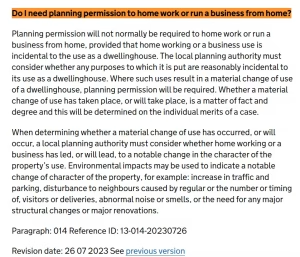
Official GOV.UK planning guidance explaining when running a business from home may require planning permission.
When Can You Report a Neighbour’s Home Business to the Council?
You can report a suspected planning breach or nuisance when commercial activities appear to be affecting the surrounding residential area.
Birmingham City Council’s guidance makes a useful distinction: low-key businesses operating from bedrooms or home offices are unlikely to trigger enforcement, while substantial changes in traffic, visitors or disturbance may warrant action.
The following circumstances deserve particular attention.
1. Frequent Commercial Deliveries and Customer Visits
Regular collections, vans arriving early in the morning and customers visiting throughout the day may indicate a change in how the property is used.
2. Excessive Noise or Machinery
Vehicle repairs, commercial woodworking, power tools and repeated loading operations may cause disturbance. Environmental health officers assess whether the noise meets the statutory nuisance test.
3. Smells, Smoke and Commercial Waste
A home catering operation may create cooking fumes, while a workshop could generate chemical smells or inappropriate waste storage.
4. Commercial Activities Outside the Property
Business signage, substantial outdoor stock storage or conversion of a garage into a customer-facing workspace may justify further planning enquiries.
5. Repeated Obstruction or Unsafe Parking
Extra business traffic can be relevant to a planning complaint. However, ordinary legal parking on a public road does not automatically constitute an offence, even when the vehicles belong to a business.
The distinction matters because councils assess the actual harm and applicable law, not simply whether neighbours dislike commercial activity.
How Do You Report a Neighbour Running a Business From Home?
Our recommended approach is to identify the problem, collect relevant evidence and report it to the department with authority to investigate.
Step 1: Check the Council’s Planning Records
Search your local council’s planning application database using the property’s address or postcode.
Look for planning permissions, change-of-use applications, relevant conditions and certificates of lawful use.
The absence of a planning application does not prove that a business is operating unlawfully. Certain activities can be carried out without a planning application.
Step 2: Record the Disturbance
Keep a factual diary containing:
- Dates and approximate times of repeated disturbances.
- The type and duration of noise or commercial activity.
- Frequency of deliveries and customer visits.
- Photographs of visible obstruction or waste.
- Details of how the activity affects your property.
Only collect information lawfully. Avoid entering private property, filming inside homes or confronting customers.
Step 3: Contact the Appropriate Council Department
| Problem | Authority to contact |
| Suspected unauthorised business use | Planning enforcement |
| Persistent noise, fumes or smells | Environmental health |
| Commercial rubbish or fly-tipping | Council waste enforcement |
| Suspected unsafe food preparation | Council food safety team |
| Council or housing association tenancy concerns | Housing officer or landlord |
| Threats, harassment or immediate danger | Police |
If the problem involves both a suspected change of use and noise, you can contact planning enforcement and environmental health separately.
Step 3: Contact the Appropriate Council Department
Use the relevant reporting form on your council’s website. Describe the activity, its frequency, the impact and any evidence available.
You do not need to establish that the neighbour has committed an offence. The council determines whether a breach or nuisance has occurred.
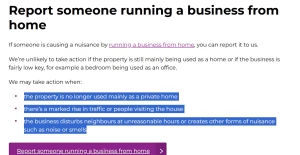
Birmingham City Council’s official page explaining when residents can report someone operating a business from home.
Which Home Businesses Are More Likely to Cause Legal Problems?
Different commercial activities create different regulatory risks.
Car Repairs From a Driveway
A neighbour regularly repairing customers’ vehicles may require planning assessment where the activity materially changes the property’s use. Noise, waste handling and public-highway obstruction may raise separate issues.
A Beauty Salon or Hairdressing Business
Occasional appointments do not automatically require permission. However, frequent customer visits, extended operating hours and significant commercial alterations may justify an investigation.
Home Catering or Food Delivery
Food businesses operating from home may have food-registration and hygiene obligations.
The Food Standards Agency’s guidance, updated during 2026, explains that relevant food businesses in England, Wales and Northern Ireland must normally register with their local authority at least 28 days before trading.
Registration is separate from planning permission and does not authorise a statutory nuisance.
A small food retailer’s responsibilities can differ substantially from those involved in starting a retail business without food handling.
Short-Term Holiday Accommodation
A property being used primarily for paying guests may involve planning, licensing or tenancy restrictions, depending on the UK nation and local rules.
Our coverage of Airbnb legal requirements explains the additional considerations affecting short-term accommodation businesses.
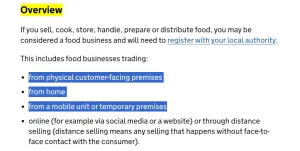
Food Standards Agency registration guidance confirming that food businesses can operate from domestic premises and explaining the registration requirements.
Can You Report a Neighbour Running a Business From Home Anonymously?
Sometimes, but it depends on the authority and complaint type.
Some councils accept anonymous information, while others require a complainant’s name and contact details before opening a planning enforcement investigation.
Leeds City Council, for example, says it does not accept anonymous planning complaints but keeps complainants’ personal details confidential.
There is also an important distinction between confidential reporting and anonymous reporting.
Confidential reporting means the council knows your identity but normally protects it during the investigation. Anonymous reporting means you do not provide identifying details.
Confidentiality cannot be absolutely guaranteed in every situation. If formal legal proceedings require witness evidence, disclosure may become necessary.
If you fear intimidation, explain this when contacting the council and request clarification about how your information will be handled.
What Happens After You Report a Neighbour’s Business?
A complaint does not automatically result in the business closing.
The council generally begins by assessing whether the alleged conduct falls within its responsibilities and whether sufficient evidence exists to investigate.
Depending on the circumstances, officers may inspect planning records, contact the occupier, request further information or carry out site visits.
Possible outcomes include:
| Council finding | Possible outcome |
| Ordinary home working | No enforcement action |
| Minor or limited impact | Advice or informal resolution |
| Potential planning breach | Further investigation or request for compliance |
| Breach causing planning harm | Formal enforcement action where justified |
| Statutory nuisance established | Abatement notice |
| Enforcement notice ignored | Potential prosecution or further legal action |
Planning enforcement is discretionary, and authorities consider whether formal action is proportionate.
Environmental health operates differently. In England, where a council establishes a statutory nuisance under the applicable legislation, it generally has a duty to serve an abatement notice requiring the problem to be stopped or restricted.
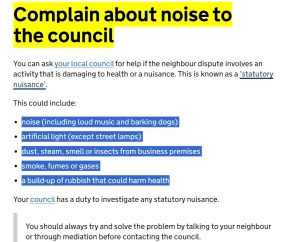
GOV.UK guidance showing the types of statutory nuisance councils can investigate and the use of abatement notices.
Can You Report a Home Business to HMRC Instead?
HMRC and local councils investigate different issues.
HMRC deals with tax compliance, while council planning departments investigate land-use matters.
Running a home business does not automatically mean someone is avoiding tax. A sole trader may legally operate without incorporating a limited company, and not every small business must register for VAT.
If you have a genuine concern about tax evasion, our article on reporting someone to HMRC explains the relevant process.
Business owners must also understand their self-employed taxes and, where appropriate, insurance obligations.
However, a lack of visible business insurance or an unfamiliar trading name is not proof of unlawful activity.
Our analysis suggests keeping these issues separate rather than submitting multiple speculative complaints about the same neighbour.
What Should You Do if the Council Takes No Action?
If the council decides the business is lawful or does not warrant enforcement, request an explanation of its decision.
You can also ask whether new evidence would justify reconsideration.
For continuing noise or other potential statutory nuisances, keep recording incidents and provide updated information to environmental health.
Where there are concerns about how your complaint was handled, use the council’s formal complaints procedure. If the matter remains unresolved, the relevant public services ombudsman may be able to consider administrative failures, subject to its jurisdiction and eligibility rules.
An ombudsman does not normally substitute its own planning judgement for a council’s properly reached decision.
Our recommendation is to focus on the measurable harm rather than trying to prevent every commercial activity in a residential street.
Final Thoughts
Reporting a neighbour running a business from home in the UK should focus on whether the activity breaches relevant rules or creates a demonstrable nuisance.
For 2027, the most effective approach remains straightforward: check local planning requirements, document recurring problems, contact the correct department and allow the authority to investigate.
A successful complaint is not necessarily one that shuts down a business. It may result in quieter operations, fewer disruptive deliveries or reasonable restrictions that allow residents and local entrepreneurs to coexist.
FAQs About Reporting a Neighbour’s Home Business
Can my neighbour run a business from a council house?
Potentially, yes, but council tenants may need their landlord’s written permission. Planning, licensing and nuisance requirements may also apply separately.
Can I complain about customers parking outside my house?
You can report genuine obstruction or unlawful parking through the appropriate authority. Legal parking on a public road does not automatically give a resident grounds to demand removal.
Does a neighbour need planning permission to run an online business?
Not usually where the property’s main residential use remains unchanged. Significant stock storage, commercial deliveries or customer visits could change that assessment.
How long does a council investigation take?
There is no universal timeframe. Councils prioritise complaints differently, and complex planning matters can take considerably longer than initial enquiries.
Can the council shut down a business operating from a house?
A council may be able to require unlawful business use or a nuisance to stop through the appropriate enforcement process. Closure is not automatic following a complaint.
Can I report my neighbour for running a business late at night?
Yes, if activities cause potentially actionable disturbance. There is no general rule that every business activity after a particular hour is unlawful; frequency, timing, intensity and impact are relevant.

Blogger | Business Writer | Sharing startup advice on UK business blogs
Related Articles in Startup
View All →
Newscivil Com: Can This Digital News Platform Help UK Startups Spot Emerging Trends?
For startup founders, staying informed is no longer simply about reading the business pages each morning. Artificial intelligence, changing consumer habits, technology developments, government decisions and wider social…

Meet the Startup Turning Screen Time Into a New Way to Make Money
Britain does not exactly have a shortage of side hustles. You can deliver takeaways, sell clothes online, start freelancing, walk dogs, tutor in the evenings or attempt to…

8 Best Coworking Spaces for Bootstrapped London Startups to Launch and Scale in 2026
Bootstrapped founders don’t have the luxury of a fitted-out HQ from day one. What you need is a London coworking space that flexes with you: a hot desk…