

Last Updated: 14-07-2026
In most cases, a general cleaning business in the UK does not need a specific cleaning licence.
Domestic cleaners, office cleaners and many commercial cleaning businesses can usually trade without a dedicated cleaning licence, provided they meet normal business, tax, insurance and safety obligations.
The main requirements are usually:
- Register as a sole trader with HMRC or form a limited company with Companies House.
- Keep proper tax and accounting records.
- Arrange public liability insurance.
- Get employers’ liability insurance if hiring staff.
- Follow COSHH rules when using cleaning chemicals.
- Register as a waste carrier if transporting controlled waste.
- Check ICO data protection fee requirements if storing customer or employee data.
- Complete DBS checks where clients or contracts require them.
- Follow additional rules for specialist cleaning, such as asbestos, hazardous waste or high-level window cleaning.
If the business will trade as a limited company, the owner can follow this article on how to register a new company with Companies House. Before choosing a name, it is also sensible to check company name availability at Companies House.
Key Facts About Cleaning Business Licences in the UK
| Area | What to Know |
| General domestic cleaning licence | Usually not required |
| General commercial cleaning licence | Usually not required |
| Business registration | Required through HMRC or Companies House depending on structure |
| Public liability insurance | Strongly recommended and often required by clients |
| Employers’ liability insurance | Legally required if the business employs staff, with limited exceptions |
| Waste carrier registration | Required if the business transports waste as part of its work |
| COSHH | Applies when hazardous cleaning substances are used |
| ICO registration | May apply if the business processes personal information |
| DBS check | Not always legally required, but often useful or requested |
| Specialist cleaning | May require extra permits, licences, training or risk controls |
Do You Need a Licence to Start a Cleaning Business in the UK?

In most cases, no specific licence is needed to start a general cleaning business in the UK. Routine domestic cleaning, office cleaning, end-of-tenancy cleaning and many commercial cleaning services do not require a dedicated government cleaning licence.
This makes cleaning one of the more accessible service businesses to start. However, the owner must still register the business correctly and follow relevant legal duties.
A new cleaning business should start by checking general startup requirements on GOV.UK’s start your business section. It should also decide whether to operate as a sole trader, partnership or limited company.
A cleaning business may need additional registration or permits if it:
- Carries waste away from client premises.
- Handles hazardous waste.
- Uses strong chemicals or hazardous substances.
- Employs staff.
- Works at height.
- Works in schools, care homes, healthcare sites or secure premises.
- Provides asbestos-related cleaning or removal.
- Offers specialist biohazard, trauma or industrial cleaning.
So, the better answer is: general cleaning does not usually need a cleaning licence, but some cleaning activities do trigger legal registrations, safety duties or specialist permissions.
Cleaning Licence vs Legal Business Requirements
Many new business owners confuse a licence with general business compliance.
A licence is formal permission to carry out a regulated activity. For example, alcohol sales, taxi operation, security work and some waste activities require official licensing.
A cleaning business is different. Most general cleaning work is not controlled by a single cleaning licence. Instead, the business must comply with several separate legal requirements.
These may include:
- HMRC tax registration
- Companies House registration if forming a limited company
- VAT registration if taxable turnover exceeds the VAT threshold
- Employers’ liability insurance if employing staff
- Health and safety duties
- COSHH chemical safety requirements
- Waste carrier registration where waste is transported
- ICO data protection fee requirements
- DBS checks where required by clients or contract settings
For example, a self-employed cleaner who only cleans private homes may not need a licence. But if that cleaner later starts removing rubbish from properties, employing staff and cleaning commercial premises, extra obligations may apply.
What Type of Cleaning Business Are You Starting?
The legal requirements depend partly on the type of cleaning service being offered.
Domestic Cleaning
Domestic cleaning usually covers private homes. It may include dusting, vacuuming, bathroom cleaning, kitchen cleaning, ironing, changing bedding and general household cleaning.
This is usually the simplest type of cleaning business to start. A domestic cleaner normally needs business registration, insurance, safe chemical use and proper tax records.
A DBS check is not usually mandatory, but many domestic clients value it because cleaners often work inside private homes.
Commercial Cleaning
Commercial cleaning includes offices, shops, restaurants, warehouses, schools, gyms and other workplaces. These clients often expect more formal documentation, including public liability insurance, risk assessments, method statements and COSHH information.
Commercial clients may ask for proof of insurance before allowing cleaners on site.
End-of-Tenancy Cleaning
End-of-tenancy cleaning is popular with landlords, tenants and letting agents. It may involve deep cleaning kitchens, bathrooms, carpets, ovens and appliances.
This business model can be profitable, but it can also involve disputes over standards, deposits and check-out reports. Clear service terms, before-and-after photos and written checklists are useful.
Carpet and Upholstery Cleaning
Carpet and upholstery cleaning may require specialist machines, detergents, stain treatments and training. No general licence is usually needed, but insurance should cover accidental damage to carpets, fabrics and furniture.
Window Cleaning
Window cleaning may involve working at height. In England and Wales, a general window cleaning licence is not usually required, but health and safety duties are important.
The HSE explains that window cleaning work at height must be properly planned, supervised and carried out by competent people, and work at height should be avoided where reasonably practicable, for example by using telescopic water-fed poles or cleaning from inside.
In Scotland, the rules can be different. GOV.UK states that most Scottish councils require window cleaners to have a window cleaner’s licence in Scotland. Anyone planning window cleaning work in Scotland should check the local council before trading.
Specialist Cleaning
Specialist cleaning may involve higher risks and extra rules.
This can include:
- Biohazard cleaning
- Trauma cleaning
- Industrial cleaning
- Hazardous waste cleaning
- Asbestos-related work
- High-level cleaning
- Confined space cleaning
- Healthcare cleaning
- Construction site cleaning
These services may need specialist training, environmental compliance, additional insurance, risk assessments and sometimes licences or permits.
Step 1: Choose a Business Structure

Before taking clients, decide how the cleaning business will trade.
Most cleaning businesses start as either sole traders or limited companies.
Sole Trader
A sole trader is the simplest structure. The owner trades as an individual and registers for Self Assessment with HMRC. This is common for solo domestic cleaners and small local cleaning businesses.
HMRC provides official information on how to register as a sole trader. If gross trading income is more than £1,000 in a tax year, the person usually needs to register for Self Assessment.
A sole trader structure is simple, but the owner is personally responsible for business debts and claims.
Limited Company
A limited company is a separate legal entity. Many cleaning businesses choose this structure when they want to look more established, employ staff, bid for commercial contracts or protect the business name.
Companies House confirms the current process to register a private limited company. From February 2026, online incorporation costs £100, so startup budgets should not use the older £12 or £50 figures.
If a limited company is the right option, follow how to register a new company with Companies House and make sure the company name, registered office and director details are correct.
Partnership
A partnership may suit two people starting a cleaning business together. A written agreement should explain how profits, responsibilities, expenses, decisions and exits will be handled.
Step 2: Check Your Cleaning Business Name
A cleaning business name should be clear, professional and easy to remember. Before using it publicly, check whether the name is already taken or too similar to another business.
Use this article on checking company name availability at Companies House before registering a limited company or building a brand.
It is also worth checking:
- Domain name availability
- Google search results
- Social media handles
- Local competitors
- UK trade mark records
- Whether the name suggests official status unfairly
Avoid names that imply the business is connected to a council, NHS, government body or national authority unless that is genuinely true.
Step 3: Register for Tax

A cleaning business must keep proper tax records from the start.
Sole traders usually register for Self Assessment with HMRC. Limited companies register with Companies House and then deal with Corporation Tax, accounts and confirmation statements.
A cleaning business should record:
- Client payments
- Cleaning supplies
- Equipment costs
- Mileage and travel
- Insurance
- Advertising
- Phone and software costs
- Staff wages
- Subcontractor payments
- Bank charges
- Training costs
Good records help the business calculate profit, complete tax returns and prove expenses if HMRC asks questions.
Step 4: Understand VAT Registration
A cleaning business does not need to register for VAT immediately unless it reaches the VAT threshold or chooses to register voluntarily.
GOV.UK states that businesses must register for VAT if taxable turnover is expected to go over £90,000 in the next 30 days or if taxable turnover over the previous 12 months exceeds the threshold.
The current VAT registration threshold is more than £90,000 of taxable turnover, as shown on GOV.UK’s VAT thresholds page.
For small domestic cleaning businesses, VAT may not apply at launch. For commercial cleaning companies, VAT can become relevant sooner if contracts grow quickly.
Step 5: Arrange Public Liability Insurance

Public liability insurance is not always legally required for a self-employed cleaner, but it is strongly recommended.
Cleaning work takes place in other people’s homes and workplaces. Accidents can happen. A cleaner may damage flooring, spill chemicals, break furniture, cause a slip hazard or accidentally damage client property.
Public liability insurance can help cover claims for injury or property damage caused by the business.
Many commercial clients, landlords and letting agents will not hire a cleaner without proof of public liability cover. Even domestic clients may feel more confident if the cleaner can show insurance documents.
A professional cleaning business should treat public liability insurance as essential, even where the law does not force it.
Step 6: Get Employers’ Liability Insurance If Hiring Staff
Employers’ liability insurance is different from public liability insurance.
GOV.UK states that a business must get employers’ liability insurance as soon as it becomes an employer, with cover of at least £5 million from an authorised insurer.
This insurance helps cover compensation if an employee becomes ill or injured because of their work.
A cleaning business that hires staff should also prepare:
- Employment contracts
- Payroll
- Holiday pay
- Pension duties
- Training records
- Health and safety procedures
- Accident reporting
- Staff supervision
- Right-to-work checks
If the business uses subcontractors, it should still get advice. Some arrangements may create employment-style obligations depending on how the work is controlled.
Step 7: Follow COSHH Rules for Cleaning Chemicals
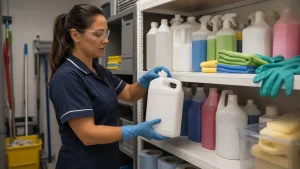
Cleaning businesses often use substances that can harm health if handled incorrectly. These may include bleach, disinfectants, degreasers, descalers, oven cleaners, solvents and strong acids or alkalis.
COSHH stands for Control of Substances Hazardous to Health. The HSE explains that COSHH applies to the way hazardous substances are used at work and helps businesses control exposure so substances do not cause ill health.
The HSE’s cleaning section explains how businesses should control hazardous substances through COSHH in cleaning work.
A cleaning business should:
- Identify hazardous products.
- Read labels and safety data sheets.
- Avoid mixing incompatible products.
- Store chemicals safely.
- Use gloves, goggles or masks where needed.
- Train workers on safe use.
- Keep chemicals away from children, pets and food.
- Ventilate rooms where strong products are used.
- Record significant COSHH findings where required.
- Replace hazardous products with safer alternatives where possible.
A common safety risk is mixing bleach with other products. Some combinations can produce harmful gases. Staff should be trained never to mix cleaning chemicals unless the product instructions specifically allow it.
Step 8: Complete Health and Safety Risk Assessments
Cleaning work can create hazards for cleaners, clients, staff and the public.
HSE identifies common cleaning risks including slips and trips, dermatitis, musculoskeletal disorders, work at height and COSHH. Cleaning businesses can review HSE’s common risks in cleaning when preparing safety procedures.
Risk assessments should cover:
- Wet floors
- Trailing cables
- Manual handling
- Lifting equipment
- Chemical exposure
- Skin irritation
- Electrical appliances
- Lone working
- Working at height
- Client premises hazards
- Sharp objects
- Waste handling
- Vehicle use
- Security and access
If the business employs five or more people, significant risk assessment findings should normally be recorded.
Even a solo cleaner should think through safety risks before each job. A simple checklist can prevent accidents and show professionalism.
Step 9: Check Whether You Need a Waste Carrier Registration
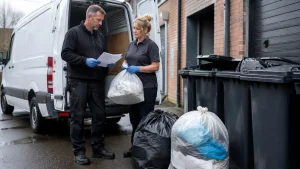
A cleaning business may need waste carrier registration if it transports waste as part of its work.
GOV.UK explains how to register or renew as a waste carrier, broker or dealer in England.
The Environment Agency has also explained that registration is free if a business only transports waste it produces itself, unless it is construction and demolition waste. Otherwise, upper tier registration currently costs £184 initially and £125 on renewal.
A cleaning business may need waste carrier registration if it:
- Removes rubbish from commercial premises.
- Takes waste away after deep cleaning.
- Removes waste from end-of-tenancy jobs.
- Transports office waste.
- Carries construction or renovation cleaning waste.
- Provides clearance-style cleaning services.
- Takes waste to a recycling centre or transfer station.
If the client keeps and disposes of normal household rubbish themselves, a waste carrier registration may not be needed. But if the cleaning business takes waste away in its own vehicle, the rules should be checked carefully.
Step 10: Understand Data Protection and ICO Registration
Cleaning businesses often store personal information. This may include client names, addresses, phone numbers, email addresses, key safe codes, alarm instructions, employee details and payment records.
The ICO states that organisations, including sole traders, that use personal information need to pay a data protection fee unless exempt.
For many small cleaning businesses, the fee may fall into the micro-organisation tier. The ICO’s data protection fee page shows tiered fee levels, including the current tier 1 fee of £52.
A cleaning business should also protect client data by:
- Keeping client addresses secure.
- Not sharing access codes casually.
- Using passwords on devices.
- Limiting staff access to client information.
- Deleting old client data when no longer needed.
- Using written privacy notices.
- Being careful with WhatsApp groups, spreadsheets and paper diaries.
- Keeping key and alarm information separate from identifiable client names where possible.
Good data protection is also a trust signal, especially where cleaners have access to homes, offices and sensitive spaces.
Step 11: Check Whether DBS Checks Are Needed

A DBS check is not usually mandatory for a general cleaning business. However, it can be useful, especially for domestic cleaners, school cleaning, care home cleaning, healthcare cleaning or work where cleaners have access to vulnerable people or private spaces.
GOV.UK explains that a basic DBS check costs £21.50 and shows unspent convictions and conditional cautions.
Clients may request DBS checks where cleaners work in:
- Schools
- Nurseries
- Care homes
- Healthcare premises
- Supported living settings
- Government buildings
- Private homes with vulnerable adults
- High-security commercial premises
A DBS certificate does not replace recruitment checks, references or supervision. It is one part of a wider trust and safeguarding approach.
Step 12: Know the Rules for Specialist Cleaning
Some cleaning work creates higher legal and safety risks. General cleaning rules may not be enough.
Asbestos Cleaning or Removal
A general cleaner should not take on asbestos removal unless properly qualified and authorised. HSE states that most higher-risk asbestos work must be done by a licensed contractor, and licensable asbestos work must be notified.
HSE provides official information on licensable work with asbestos. If asbestos is suspected, stop work and get specialist advice.
High-Level and Window Cleaning
Working at height is a major safety risk. HSE guidance on working at height while window cleaning says work must be planned, supervised and carried out by competent people with suitable equipment.
For window cleaning in Scotland, check whether a local council licence is needed.
Biohazard or Trauma Cleaning
Biohazard cleaning may involve blood, bodily fluids, needles, infection risks or contaminated materials. This requires specialist training, PPE, waste disposal procedures and insurance. It may also involve clinical or hazardous waste rules.
Industrial Cleaning
Industrial cleaning may involve machinery, confined spaces, chemicals, dust, oils, solvents or hazardous materials. Risk assessments, site inductions, permits to work and specialist insurance may be needed.
Construction and Builders Cleaning
Post-construction cleaning may involve dust, sharp objects, waste, working around contractors and construction materials. Waste carrier rules may apply if the cleaning business removes construction waste.
Step 13: Prepare Client Contracts and Terms

A cleaning business should use clear written terms before work starts. This protects both the business and the client.
The terms should explain:
- What cleaning tasks are included.
- What is not included.
- Price and payment terms.
- Cancellation policy.
- Key holding arrangements.
- Access instructions.
- Damage reporting.
- Insurance limits.
- Chemical restrictions.
- Client responsibilities.
- How complaints are handled.
- Minimum booking length.
- Whether parking or congestion charges are added.
- Whether waste removal is included.
- Whether photos may be taken for proof of work.
Clear terms help avoid disputes, especially in end-of-tenancy, commercial and deep cleaning jobs.
Step 14: Set Up Invoices, Records and Banking
A cleaning business should look professional from the first job. Proper records also make tax easier.
Before taking clients, set up:
- Business bank account
- Invoice template
- Quotation template
- Expense records
- Mileage records
- Client booking system
- Payment terms
- Receipts for supplies
- Payroll system if hiring staff
- Digital calendar or scheduling tool
Limited companies should usually use a separate business bank account. Sole traders should also strongly consider one to keep business and personal transactions separate.
Step 15: Register as an Employer If Hiring Staff

If the cleaning business hires employees, it will usually need to register as an employer with HMRC. GOV.UK explains how to register as an employer before the first payday.
A cleaning business with staff should also plan for:
- PAYE
- Pension auto-enrolment
- Holiday pay
- Sick pay
- National Minimum Wage compliance
- Training time
- Travel time
- Uniforms and PPE
- Staff rotas
- Disciplinary procedures
- Grievance procedures
- Accident reporting
The National Minimum Wage and National Living Wage change over time. Cleaning businesses should check current rates on the GOV.UK National Minimum Wage rates page and budget properly before hiring.
Step 16: Estimate Startup Costs
Starting a cleaning business is often cheaper than many other businesses, but it is not cost-free.
| Startup Requirement | Typical Cost Area |
| Sole trader registration | Usually free |
| Limited company incorporation | £100 online through Companies House from February 2026 |
| Public liability insurance | Often a modest annual policy, depending on cover and risk |
| Employers’ liability insurance | Required if employing staff, with limited exceptions |
| Waste carrier registration | Free in some lower-risk cases, but upper tier registration may apply |
| Basic DBS check | £21.50 through GOV.UK |
| ICO data protection fee | Tier 1 currently £52 unless exempt |
| Cleaning equipment | Depends on domestic, commercial or specialist work |
| COSHH training | Optional course cost varies, but chemical safety duties still apply |
| Marketing | Website, flyers, local SEO, Google Business Profile and business cards |
The older estimate of £3,000 to £15,000 may be high for a solo domestic cleaner but low for a commercial cleaning company with staff, vans, equipment and contracts. A realistic budget depends on the niche.
Step 17: Market the Cleaning Business Professionally

Once the legal basics are in place, the business needs clients.
Marketing methods may include:
- Local SEO
- Google Business Profile
- Flyers
- Social media pages
- Referral offers
- Partnerships with estate agents
- Landlord and letting agent outreach
- Office manager outreach
- Local directory listings
- Reviews and testimonials
- Before-and-after photos where appropriate
The business can also be listed on the UK Startup Blog Business Directory to support local visibility.
A cleaning business website should show:
- Service areas
- Services offered
- Insurance details
- Contact information
- Booking process
- Prices or quotation process
- Opening hours
- Reviews
- FAQs
- Health and safety approach
- Privacy information
Avoid making unsupported claims such as “fully licensed” unless the business actually holds a specific licence. A better phrase may be “registered, insured and compliant with relevant UK business and safety requirements”.
Step 18: Complete the Legal Checklist Before the First Client
Before taking the first cleaning job, complete these steps:
- Choose domestic, commercial or specialist cleaning.
- Decide whether to trade as a sole trader or limited company.
- Register with HMRC or Companies House.
- Check business name availability.
- Open a business bank account.
- Arrange public liability insurance.
- Get employers’ liability insurance if hiring staff.
- Understand COSHH duties.
- Prepare risk assessments.
- Check waste carrier registration requirements.
- Check ICO data protection fee requirements.
- Consider a DBS check where useful.
- Prepare client terms and invoices.
- Buy suitable equipment and PPE.
- Set prices that cover time, travel, supplies and tax.
- Create a simple booking and record system.
- Start marketing only after the legal basics are ready.
Common Mistakes to Avoid
Many cleaning startups make avoidable mistakes.
The most common include:
- Assuming no cleaning licence means no legal duties.
- Starting without public liability insurance.
- Using strong chemicals without COSHH awareness.
- Mixing cleaning products unsafely.
- Transporting waste without checking waste carrier rules.
- Hiring staff without employers’ liability insurance.
- Not checking the VAT threshold as the business grows.
- Failing to keep receipts and tax records.
- Working at height without proper planning.
- Taking specialist cleaning jobs without training or insurance.
- Storing client keys and access codes insecurely.
- Not using written service terms.
- Underpricing jobs and losing money on travel time.
- Claiming to be “licensed” without a real licence.
- Ignoring data protection duties.
What Licence Might Be Needed for Different Cleaning Services?
| Cleaning Service | Specific Licence Usually Needed? | Other Requirements to Check |
| Domestic cleaning | No | HMRC registration, insurance, COSHH, DBS if useful |
| Office cleaning | No | Insurance, risk assessments, COSHH, client site rules |
| End-of-tenancy cleaning | No | Insurance, service terms, photo evidence, waste rules |
| Carpet cleaning | No | Insurance for accidental damage, chemical safety |
| Window cleaning in England or Wales | Usually no specific licence | Work at height rules, insurance, risk assessments |
| Window cleaning in Scotland | Often yes, depending on council | Local council window cleaner licence |
| Commercial waste removal with cleaning | Yes, waste registration may apply | Waste carrier registration and waste records |
| Asbestos-related work | Sometimes, high-risk work needs HSE licence | HSE asbestos rules and specialist contractor requirements |
| Biohazard cleaning | May require specialist compliance | Waste, PPE, training, insurance and risk controls |
| Industrial cleaning | Sometimes | Site permits, risk assessments, training and insurance |
Final Thoughts
Most people starting a general cleaning business in the UK do not need a specific cleaning licence. The real legal work is business registration, tax compliance, insurance, health and safety, COSHH, waste rules and data protection.
A domestic cleaner may be able to start with a simple setup, while a commercial or specialist cleaning business needs stronger documentation, insurance and risk controls. The safest approach is to define the exact cleaning services first, then check which registrations and safety duties apply.
A cleaning business that is registered, insured, clear with clients and careful with chemicals, waste and data will look more professional and be better prepared to grow.
FAQs About Cleaning Business Licences in the UK
What license do I need to start a cleaning business in the UK?
Most general cleaning businesses do not need a specific cleaning licence. However, the business must still register correctly for tax, follow health and safety rules, arrange insurance where needed, and check whether waste carrier registration, ICO registration or specialist permits apply.
Do I need a licence for domestic cleaning?
Usually no. Domestic cleaning does not normally require a specific licence. A cleaner should still register with HMRC or Companies House, keep proper records, follow COSHH rules and consider public liability insurance.
Do I need a licence for commercial cleaning?
Usually no general cleaning licence is required for commercial cleaning. However, commercial clients often require proof of insurance, risk assessments, method statements, COSHH information and sometimes DBS checks depending on the site.
Do I need public liability insurance to start a cleaning business?
Public liability insurance is not always legally required, but it is strongly recommended. Many clients will not hire a cleaning business without it because cleaners work in homes and workplaces where damage or injury claims can happen.
Do I need employers’ liability insurance?
Yes, if the business employs staff, employers’ liability insurance is usually legally required. GOV.UK states that employers must have at least £5 million of cover from an authorised insurer, with limited exceptions.
Do I need a waste carrier licence for a cleaning business?
You may need waste carrier registration if the business transports waste as part of its work. This is especially relevant for commercial cleaning, end-of-tenancy cleaning, property clearance, construction cleaning and rubbish removal.
Do I need COSHH training to start a cleaning business?
The law requires businesses to control risks from hazardous substances. A specific COSHH training certificate is not always mandatory for a sole trader, but the business must understand chemical risks, follow safe storage and handling practices, and provide information and training to staff where applicable.
Do cleaners need DBS checks?
DBS checks are not usually mandatory for general cleaning. However, they may be requested by clients, schools, care homes, healthcare sites or households where cleaners work around vulnerable people or access private spaces.
Do I need to register with the ICO?
A cleaning business may need to pay the ICO data protection fee if it processes personal information, unless exempt. Many cleaning businesses store client names, addresses, phone numbers and access instructions, so this should be checked.
Do I need to register for VAT?
A cleaning business must register for VAT if taxable turnover exceeds the VAT threshold. The current VAT registration threshold is more than £90,000 of taxable turnover. Voluntary VAT registration is also possible.
Do I need a licence for window cleaning?
In England and Wales, general window cleaning usually does not require a specific licence, but work at height rules apply. In Scotland, most councils require window cleaners to have a local authority licence, so local council rules should be checked.
Do I need a licence for carpet cleaning?
Usually no specific licence is needed for carpet cleaning. However, the business should have suitable insurance, use chemicals safely and make sure the policy covers accidental damage to carpets, rugs and upholstery.
Can I start a cleaning business as a sole trader?
Yes. Many cleaners start as sole traders because it is simple and low-cost. Sole traders should register with HMRC when required, keep records and consider insurance.
Is a limited company better for a cleaning business?
A limited company can be useful if the business wants to employ staff, bid for commercial contracts, protect its name or look more established. However, it comes with extra filing and accounting responsibilities.
What is the first legal step to start a cleaning business?
The first legal step is to choose the business structure and register correctly with HMRC or Companies House. After that, arrange insurance, prepare safety procedures and check whether waste, ICO or specialist rules apply.

Blogger | Business Writer | Sharing startup advice on UK business blogs